When a writer wants to describe a person, story, creature, or atmosphere as unusually evil, the word “demonic” can feel too strong or specific. For example, you might describe a frightening character, a cruel action, or an unsettling mood without suggesting a connection to demons.
Choosing another word depends on what you mean: extreme evil, cruelty, frightening behavior, supernatural imagery, or a dark and disturbing quality. English offers several alternatives, but they are not interchangeable in every sentence. Words such as “evil,” “fiendish,” “satanic,” “malevolent,” and “sinister” carry different levels of intensity and associations.
Understanding these differences helps you sound more precise and natural. This guide explains useful synonyms and related expressions for “demonic,” shows which choices fit contexts, and gives examples you can adapt in conversation, creative writing, academic discussion, or descriptive prose. The goal is to help you choose the right word rather than simply replace one word.
Featured Snippet
Synonyms for “demonic” include evil, malevolent, fiendish, sinister, diabolical, and devilish. The best choice depends on context: evil is broad, malevolent emphasizes harmful intent, sinister suggests danger, and fiendish or diabolical emphasizes extreme wickedness.
What Does Demonic Mean?

Demonic is an adjective used to describe something associated with a demon or demons, or something that seems extremely evil, cruel, frightening, or destructive.
The word can have a literal or figurative use.
- Literal or supernatural: “The story describes a demonic creature that haunts the village.”
- Figurative: “The villain gave a demonic laugh before attacking.”
In the figurative example, the person is not necessarily a literal demon. The word creates an image of frightening, unnatural, or intensely evil behavior.
“Demonic” is usually stronger and more dramatic than simply saying evil. It often appears in horror, fantasy, religious discussion, literature, and dramatic descriptions. In ordinary conversation, using it about a person can sound highly judgmental or theatrical.
It can also describe an expression, appearance, laugh, voice, energy, or behavior when the writer wants to emphasize something frightening or disturbingly evil.
Another Word for Demonic
There is no single replacement that works in every context. The best alternative depends on if you want to emphasize evil, cruelty, harmful intent, supernatural imagery, or a threatening atmosphere.
Common Synonyms for Demonic
| Number | Synonym/Alternative | Type | Simple Meaning | Example Sentence |
|---|---|---|---|---|
| 1 | Evil | Synonym | Morally very wrong or wicked | The story centers on an evil ruler. |
| 2 | Malevolent | Near-synonym | Intending to cause harm | The character has a malevolent purpose. |
| 3 | Fiendish | Near-synonym | Extremely cruel or wicked | His fiendish plan frightened everyone. |
| 4 | Satanic | Context-specific alternative | Connected with Satan or Satanism | The novel uses satanic imagery. |
| 5 | Sinister | Near-synonym | Suggesting danger or evil | She noticed a sinister figure nearby. |
| 6 | Diabolical | Near-synonym | Extremely wicked or cruel | The villain created a diabolical scheme. |
| 7 | Devilish | Near-synonym | Wicked, mischievous, or devil-like | He gave a devilish grin. |
| 8 | Wicked | Near-synonym | Morally bad or evil | The witch was portrayed as wicked. |
Words Emphasizing Cruelty and Wickedness
| Number | Synonym/Alternative | Type | Simple Meaning | Example Sentence |
|---|---|---|---|---|
| 9 | Vile | Near-synonym | Extremely unpleasant or morally bad | The story describes a vile act. |
| 10 | Heinous | Formal | Shockingly evil or cruel | The crime was described as heinous. |
| 11 | Monstrous | Near-synonym | Shockingly cruel or inhuman | His monstrous actions horrified the town. |
| 12 | Cruel | Near-synonym | Causing pain deliberately or without concern | The cruel character enjoyed causing fear. |
| 13 | Brutal | Near-synonym | Extremely violent or harsh | The novel contains a brutal confrontation. |
| 14 | Wicked-hearted | Phrase | Having a deeply bad character | The tale portrays him as wicked-hearted. |
| 15 | Malicious | Near-synonym | Intending to hurt or upset someone | Her malicious behavior caused problems. |
| 16 | Nefarious | Formal | Wicked or criminal | The detective uncovered a nefarious scheme. |
Supernatural and Dark Alternatives
| Number | Synonym/Alternative | Type | Simple Meaning | Example Sentence |
|---|---|---|---|---|
| 17 | Hellish | Context-specific | Like or associated with hell | They described the battlefield as hellish. |
| 18 | Infernal | Formal/context-specific | Related to hell or extremely unpleasant | The infernal noise continued all night. |
| 19 | Unholy | Context-specific | Spiritually wrong or lacking holiness | The story depicts an unholy ritual. |
| 20 | Dark | Near-synonym | Morally troubling, gloomy, or disturbing | The film has a dark atmosphere. |
| 21 | Malevolent-minded | Descriptive phrase | Having harmful intentions | The tale features a malevolent-minded villain. |
| 22 | Foul | Near-synonym | Wicked, offensive, or morally bad | The character’s foul behavior shocked the audience. |
Descriptive Phrases for Demonic
| Number | Synonym/Alternative | Type | Simple Meaning | Example Sentence |
|---|---|---|---|---|
| 23 | Corrupt | Context-specific | Morally damaged or dishonest | The corrupt leader abused his power. |
| 24 | Devil-like | Phrase | Resembling a devil in appearance or behavior | The creature had a devil-like appearance. |
| 25 | Wickedly cruel | Phrase | Extremely cruel in a deliberately wicked way | The antagonist was wickedly cruel. |
Important Distinction
Some choices above are near-synonyms rather than exact synonyms. For example, sinister focuses more on an appearance or feeling of danger, while malevolent focuses on harmful intention. Satanic, hellish, and infernal have more specific supernatural or religious associations.
Best Synonym by Context
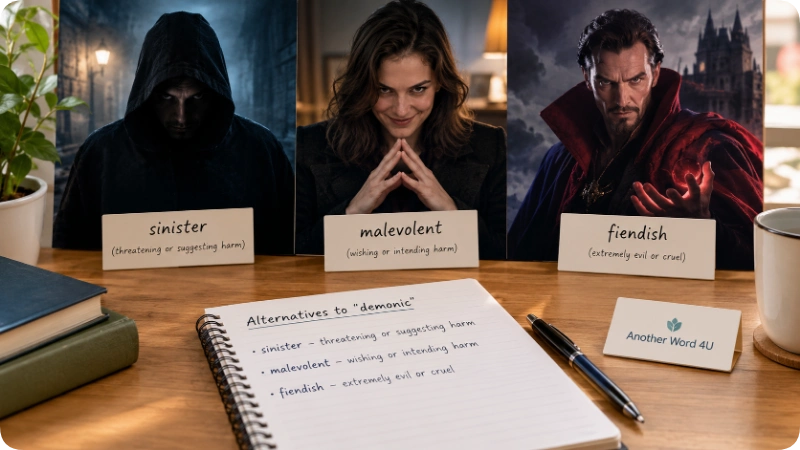
| If you mean… | Use… | Why |
|---|---|---|
| Generally very bad or morally wrong | Evil | It is broad, familiar, and easy to understand. |
| Someone intends to cause harm | Malevolent | It emphasizes harmful intention. |
| Extremely cruel behavior | Fiendish | It strongly suggests wicked or cruel conduct. |
| A threatening feeling or appearance | Sinister | It emphasizes danger or an unsettling quality. |
| A connection with Satan | Satanic | It has a specific religious or supernatural association. |
| An extremely wicked plan | Diabolical | It often describes a cruel or cleverly wicked scheme. |
| A cruel or shocking crime | Heinous | It is formal and strongly condemning. |
| A setting that resembles hell | Hellish | It emphasizes an intensely unpleasant or hell-like environment. |
| A morally corrupt person or system | Corrupt | It focuses on moral or ethical deterioration. |
| A frightening supernatural creature | Demonic | It directly communicates a demon-like or supernatural quality. |
How to Choose the Right Synonym for Demonic
Start by identifying what part of “demonic” you want to preserve.
If you simply mean “very evil,” evil is usually the clearest choice. If the important point is that someone wants to hurt others, malevolent or malicious may be more precise.
If you are describing something that looks or feels threatening rather than proving that it is actually evil, sinister can work better. For extreme cruelty, fiendish, diabolical, or heinous may fit depending on if you are describing behavior, a plan, or an act.
Also consider your audience. Evil and sinister are common and accessible. Malevolent, diabolical, and nefarious sound more formal or literary. Satanic should be reserved for contexts where the connection to Satan or Satanism is actually intended.
Finally, consider if you mean the word literally or figuratively. A fictional demon may genuinely be described as demonic, while a cruel person might only be described that way figuratively.
Real-Life Examples
1. Describing a villain
“The villain’s demonic laugh echoed through the empty building.”
Here, demonic creates a strong horror-like image.
A less supernatural version would be:
“The villain’s sinister laugh echoed through the empty building.”
Sinister makes the laugh sound threatening without directly suggesting a demon.
2. Describing harmful intentions
“The character’s malevolent intentions became clear.”
This is more precise than demonic when the important idea is a deliberate desire to cause harm.
3. Describing a cruel plan
“The antagonist devised a diabolical plan.”
Diabolical works particularly well for an extremely wicked or cruel scheme.
4. Describing a disturbing atmosphere
“The abandoned house had a sinister atmosphere.”
Here, sinister is more natural than demonic because the focus is on an unsettling feeling rather than an actual supernatural being.
5. Describing extreme cruelty
“The novel portrays the ruler as fiendish and ruthless.”
Fiendish emphasizes extreme wickedness or cruelty and works especially well in dramatic or literary writing.
6. Describing a religious connection
“The painting contains satanic imagery.”
Satanic is appropriate because the sentence specifically refers to imagery associated with Satan or Satanism.
Antonyms for Demonic
Because demonic can describe either literal supernatural associations or figurative evil, its opposites depend somewhat on context.
| Antonym | Meaning | Example |
|---|---|---|
| Benevolent | Kind and well-intentioned. | The benevolent character helped the villagers. |
| Kind | Caring and considerate. | She was kind to everyone around her. |
| Good | Morally right or positive. | The story presents him as a good person. |
| Angelic | Extremely innocent, beautiful, or virtuous. | The child had an angelic expression. |
| Innocent | Not guilty or morally corrupt. | The character appears innocent at first. |
| Compassionate | Showing concern for others. | The compassionate doctor comforted the patient. |
These are not all direct opposites in every sentence. For example, angelic is often used figuratively to describe appearance or behavior, while benevolent focuses specifically on good intentions toward others.
Words That Are Easy to Confuse With Demonic
Demonic vs. Satanic
Demonic can describe something demon-like, extremely evil, or frightening. Satanic specifically relates to Satan or Satanism.
The horror film featured a demonic creature.
The story included satanic symbols.
Do not automatically replace demonic with satanic because they have different associations.
Demonic vs. Sinister
Sinister usually describes something that seems threatening, suspicious, or evil. It does not necessarily imply a supernatural being.
The stranger gave him a sinister look.
A demonic look would create a much stronger supernatural or extremely evil image.
Demonic vs. Diabolical
Both can suggest extreme wickedness, but diabolical often describes a cruel, clever, or shocking plan or action.
The villain created a diabolical scheme.
Demonic is more strongly connected with demon-like imagery or behavior.
When Demonic Is Not the Precise Choice
“Demonic” is powerful, but that strength can make it inaccurate or unnecessarily dramatic.
If you only mean that someone behaved badly, evil, cruel, or vile may be clearer. Calling an ordinary unpleasant person “demonic” can make the description sound exaggerated.
If you mean that someone deliberately wants to harm another person, malevolent or malicious can provide greater precision.
If you mean that something feels threatening without actually being evil, sinister is often better.
If you mean a specific connection with Satan, use satanic rather than the broader demonic. If you are describing a hell-like environment, hellish may communicate the idea more accurately.
The key question is simple: Are you describing evil itself, harmful intent, frightening appearance, supernatural imagery, or a specific religious association? The answer should guide your word choice.
Phrases, Idioms, and Expressions Related to Demonic
There are several established expressions that can convey related ideas, although they are not direct synonyms for demonic.
1. Like a demon
Meaning: Behaving with extreme energy, force, or intensity; sometimes used negatively.
She worked like a demon to finish the project before midnight.
This expression does not necessarily mean that the person is evil.
2. Raise hell
Meaning: Cause serious trouble, make a lot of noise, or behave disruptively.
The angry customers threatened to raise hell about the poor service.
This is an idiomatic expression, not a synonym for demonic.
3. A devil of a time
Meaning: A very difficult or troublesome experience.
We had a devil of a time finding the missing documents.
This expression is often informal and can be used without any literal religious meaning.
4. Speak of the devil
Meaning: Said when the person being discussed suddenly appears or is mentioned.
“Speak of the devil—there’s Maya now.”
This is a common idiom and is not normally intended as an accusation that someone is evil.
5. Play devil’s advocate
Meaning: Argue an opposing position to test an idea or discussion.
I’ll play devil’s advocate and point out one possible weakness in the plan.
Again, the expression is figurative and does not mean that the speaker supports evil.
Common Mistakes When Using Demonic
1. Treating every related word as an exact synonym
Sinister, malevolent, satanic, and diabolical overlap with demonic, but they emphasize different ideas. Choose based on the specific meaning you need.
2. Using “satanic” when you only mean “evil”
Satanic has a specific connection with Satan or Satanism. If you simply mean extremely bad or wicked, evil is usually safer and more accurate.
3. Using “demonic” for ordinary unpleasant behavior
Calling a rude or annoying person “demonic” can sound exaggerated. If the behavior is simply unkind, words such as cruel, mean, or malicious may be more precise.
4. Assuming “demonic” always refers to a literal demon
The word is often figurative. A writer may describe a laugh, expression, person, or atmosphere as demonic to create a frightening or intensely evil impression.
Comparison of Demonic and Its Alternatives
| Word | Main Focus | Tone | Typical Context |
|---|---|---|---|
| Demonic | Demon-like or intensely evil. | Dramatic | Horror, fiction, description. |
| Evil | Moral wrongness. | Strong but general | Everyday and formal writing. |
| Malevolent | Desire to cause harm. | Formal | Character analysis, literature. |
| Sinister | Threatening or unsettling quality. | Dramatic | Descriptions, fiction. |
| Fiendish | Extreme cruelty or wickedness. | Literary | Stories and dramatic writing. |
| Satanic | Connection with Satan or Satanism. | Specific | Religious or cultural contexts. |
| Diabolical | Extreme wickedness, often in a plan. | Strong/formal | Fiction, commentary. |
| Heinous | Shockingly evil act. | Very strong/formal | Crime or serious wrongdoing. |
| Hellish | Like hell or extremely unpleasant. | Dramatic | Settings and experiences. |
| Corrupt | Moral or ethical decay. | Formal | People, institutions, systems. |
The most important distinction is that demonic often creates a supernatural or horror-like image, while evil is broader and more neutral in structure. Malevolent focuses on harmful intention, sinister on an ominous impression, and satanic on a specific religious association.
Frequently Asked Questions About Demonic
1. What is the closest synonym for demonic?
There is no perfect replacement in every context. Evil is the broadest alternative, while fiendish, diabolical, and malevolent can work when the intended meaning involves extreme wickedness or harmful intent.
2. Is “sinister” the same as “demonic”?
No. Sinister usually means threatening, suspicious, or suggestive of evil. Demonic is stronger and can imply something demon-like, supernatural, or intensely evil.
3. Is “satanic” a synonym for “demonic”?
Not exactly. The words overlap in supernatural or religious contexts, but satanic specifically relates to Satan or Satanism. Demonic has a broader meaning and can be used figuratively.
4. What is a formal synonym for demonic?
Depending on the context, malevolent, diabolical, nefarious, or heinous may provide a more formal alternative. They are not identical, so choose according to the intended meaning.
5. Can demonic be used to describe a person?
Yes. It can be used figuratively to describe a person’s appearance, behavior, expression, voice, or actions as extremely frightening or evil. However, it is a strong and dramatic description.
Final Thoughts
The best synonym for demonic depends on the exact idea you want to express.
Use evil for broad moral wrongness, malevolent for harmful intent, sinister for an ominous quality, fiendish for extreme cruelty, and satanic only when a specific connection with Satan or Satanism is intended.
Choosing by meaning, tone, context, and audience will make your writing more precise.

I am Olivia Carter, a passionate Language Researcher and Content Writer at AnotherWord4UU.com. I specialize in creating well-researched content on synonyms, alternative words, phrases, vocabulary, and English language usage. My goal is to help students, writers, professionals, and language enthusiasts find the perfect words to communicate more clearly and confidently. Through practical language guides and easy-to-understand resources, I make expanding your vocabulary simple and enjoyable.










