Featured Snippet
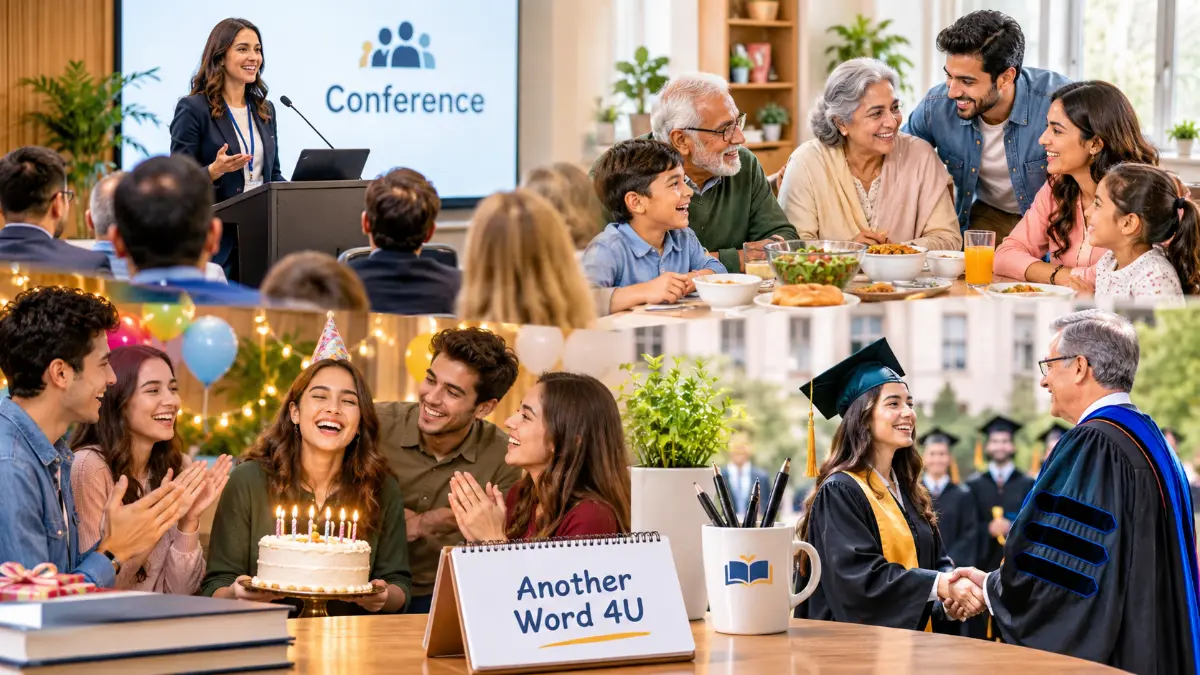
A synonym for event is occasion, gathering, function, ceremony, celebration, occurrence, or happening. The best choice depends on context: occasion suits a special moment, gathering focuses on people meeting, ceremony describes a formal occasion, and occurrence refers to something that happens.
“Are you going to the event this weekend?” is easy to say, but sometimes event feels too general for what you really mean. You might be talking about a wedding, a school gathering, a business meeting, a public celebration, or an unexpected occurrence.
Choosing a more precise word can make your writing clearer and help your listener understand the situation immediately. For example, occasion can sound more personal or ceremonial, while gathering emphasizes people coming together. Ceremony fits a formal ritual, whereas conference describes an organized meeting focused on a subject. In everyday English, event is a flexible word, but its alternatives are not always interchangeable.
Learning the differences between these words helps you sound more natural in conversations, emails, essays, invitations, and professional writing. This guide explains useful synonyms, near-synonyms, phrases, and related expressions so you can choose the right word based on meaning, tone, formality, and context.
What Does Event Mean?
Event is a noun with two closely related uses.
The most common meaning is something planned that happens at a particular time and place, especially when people gather for a purpose.
- The school is hosting a sports event.
- We attended a charity event last Saturday.
- The company organized an employee event.
In this meaning, event can describe anything from a small social gathering to a large public occasion.
A second common meaning is something that happens, especially something important or noticeable.
- The storm was a major event for the local community.
- Winning the final was an unforgettable event in her life.
The word is neutral and highly flexible. It works in everyday conversation, academic writing, news reporting, business communication, and formal descriptions. Because it is so broad, however, a more specific alternative can sometimes communicate the situation more clearly.Another Word for Event
The best alternative depends on what kind of event you mean.
Another Word for Event
The best alternative depends on what kind of event you mean.
Common Alternatives for Event
| Number | Synonym/Alternative | Type | Simple Meaning | Example Sentence |
|---|---|---|---|---|
| 1 | Occasion | Near-synonym | A particular time or special situation | It was a memorable occasion for everyone. |
| 2 | Gathering | Near-synonym | A group of people meeting | We attended a family gathering. |
| 3 | Function | Formal | An organized social occasion | The hotel hosted a formal function. |
| 4 | Ceremony | Context-specific | A formal event with a ritual or procedure | The graduation ceremony begins at noon. |
| 5 | Celebration | Context-specific | An event held to mark something happy | The team held a celebration after the victory. |
| 6 | Activity | Context-specific | Something people do, often as part of a program | The children joined a weekend activity. |
| 7 | Conference | Context-specific | A formal meeting about a subject | She spoke at a technology conference. |
| 8 | Meeting | Context-specific | People coming together to discuss something | We have a staff meeting tomorrow. |
| 9 | Festival | Context-specific | A public celebration with activities | The city holds a music festival every summer. |
Social and Public Events
| Number | Synonym/Alternative | Type | Simple Meaning | Example Sentence |
|---|---|---|---|---|
| 10 | Party | Informal | A social gathering for enjoyment | They are having a birthday party. |
| 11 | Reception | Context-specific | A formal social gathering | Guests attended the wedding reception. |
| 12 | Affair | Formal | A particular social or organized occasion | The annual affair attracted many guests. |
| 13 | Occasion | Formal/neutral | A particular time or circumstance | On this special occasion, everyone gathered together. |
| 14 | Happening | Informal | Something taking place | Several interesting happenings occurred downtown. |
| 15 | Occurrence | Formal | Something that happens | The unusual occurrence attracted attention. |
| 16 | Incident | Context-specific | An event, often unusual or problematic | The incident was reported to the manager. |
Specific Types of Events
| Number | Synonym/Alternative | Type | Simple Meaning | Example Sentence |
|---|---|---|---|---|
| 17 | Episode | Context-specific | A particular occurrence or period | The episode became an important part of the story. |
| 18 | Development | Formal | A new event or change | The latest development changed the situation. |
| 19 | Milestone | Context-specific | An important point of progress | Graduation was a major milestone in her life. |
| 20 | Engagement | Context-specific | A scheduled appointment or commitment | The speaker has several public engagements this month. |
| 21 | Proceeding | Formal | An organized action or formal activity | The court proceeding continued for several hours. |
| 22 | Spectacle | Context-specific | A striking public display or event | The parade was a spectacular sight. |
| 23 | Tournament | Context-specific | An organized competition | The school hosted a football tournament. |
| 24 | Meetup | Informal | An informal meeting or gathering | We joined a local photography meetup. |
| 25 | Do | Informal | A social event or gathering | They organized a small family do. |
Choosing the Right Alternative
Not every word in this table is a direct synonym of event. Several are context-specific alternatives. This distinction matters because replacing event with any related word can change the meaning.
For example, a ceremony usually involves a formal ritual or procedure, while a tournament refers to an organized competition. A milestone marks an important point of progress, whereas a meeting involves people coming together to discuss something. Choosing the right alternative depends on the specific type of event you are describing.
Best Synonym by Context
| If you mean… | Use… | Why |
|---|---|---|
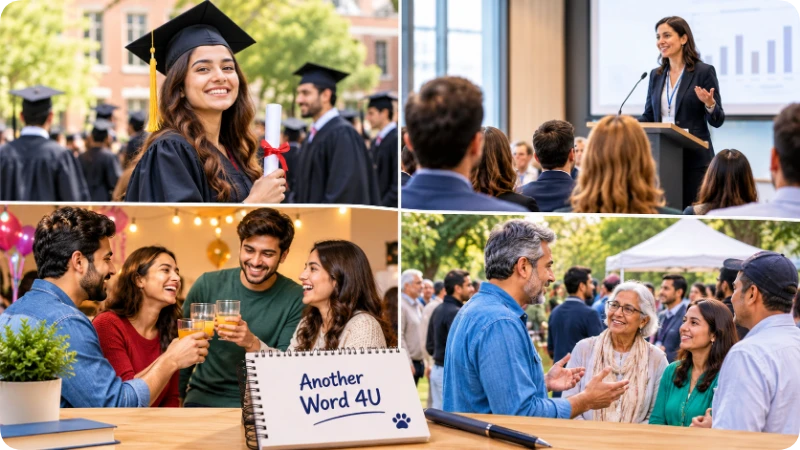
| A general planned occasion | Occasion | Broad, often suggests something noteworthy or special |
| People meeting socially | Gathering | Emphasizes people coming together |
| A formal social occasion | Function | Sounds formal and organized |
| A religious or formal ritual | Ceremony | Focuses on formal proceedings |
| A happy occasion | Celebration | Emphasizes enjoyment or something positive |
| A large public cultural event | Festival | Suggests recurring public celebration and activities |
| A professional meeting | Conference | Gives a professional or academic context |
| A small informal social event | Party | Natural for casual social occasions |
| Something unusual that happened | Occurrence | Focuses on the fact that something happened |
| A problematic or unexpected event | Incident | Often suggests an unusual or troublesome occurrence |
| An important stage of progress | Milestone | Highlights significance and progress |
| A scheduled professional commitment | Engagement | Fits appointments, appearances, or commitments |
How to Choose the Right Synonym for Event
Start by asking what event actually describes.
If people are gathering, gathering may be clearer. If the occasion is formal, function may work better. If there is a ritual or official procedure, choose a ceremony. For professional knowledge-sharing, conferences are more precise.
Also consider the emotional tone. Celebration suggests happiness, while incident may suggest something unusual or problematic. Milestone emphasizes importance and progress rather than simply describing something that happened.
Think about your audience, too. Meetup and party are natural in casual conversation, but they may sound inappropriate in a formal report. In professional or academic writing, conference, occurrence, development, or function may be more suitable when their meanings fit.
Finally, check if you mean a planned gathering or simply something that happened. That distinction eliminates many incorrect substitutions.
Real-Life Examples
Everyday conversation
- “Are you going to the party tonight?”
- “Are you attending the gathering tonight?”
Party suggests a social occasion for enjoyment, while gathering is broader and more neutral.
School
- “The school is holding a science event.”
- “The school is hosting a science fair.”
The second version is more specific when students display projects or experiments.
Business
- “She is attending a business event.”
- “She is attending a business conference.”
Conference tells the reader that the event involves organized professional discussion.
Wedding
- “Everyone attended the wedding event.”
- “Everyone attended the wedding ceremony.”
Ceremony identifies the formal part of the wedding rather than the entire occasion.
Unexpected situation
- “The strange event surprised everyone.”
- “The strange occurrence surprised everyone.”
Occurrence emphasizes something that happened rather than a planned gathering.
Important life change
- “Graduation was an important event.”
- “Graduation was an important milestone.”
Milestone emphasizes achievement and progress.
Antonyms for Event
There is no single perfect opposite of event because the word has several meanings. Depending on context, these can function as contextual opposites:
| Antonym | Meaning | Example |
|---|---|---|
| Inactivity | Lack of activity or events | The office was quiet during a period of inactivity. |
| Stillness | A state without movement or activity | The stillness of the room was noticeable. |
| Routine | Regular, repeated activity rather than a special event | Her day followed the same routine. |
| Normality | The usual state of affairs | The town gradually returned to normality. |
| Continuity | An ongoing state without a distinct interruption | The project continued with little disruption. |
| Nonoccurrence | The fact that something did not happen | The nonoccurrence of the predicted problem was reassuring. |
These are contextual opposites, not universal dictionary antonyms. For example, routine is not the direct opposite of every meaning of event, but it contrasts with a special or notable occurrence.
Words That Are Easy to Confuse With Event
Incident
An incident is a particular occurrence, especially one that is unusual, unexpected, or potentially problematic. It is not a general replacement for every planned event.
- The event attracted hundreds of visitors.
- The incident was reported to the police.
Occasion
An occasion often refers to a particular time or special circumstance. It can describe a social event, but it has a stronger sense of a meaningful or special moment.
- The wedding was a beautiful occasion.
- The conference was a large event.
Activity
An activity is something people do. An event may contain several activities, so the two words are not always interchangeable.
- The festival included several children’s activities.
- The festival was a major community event.
When Event Is Not the Precise Choice
Event is useful when you want a broad, neutral term, but it can sometimes be too vague.
If you know people are meeting socially, gathering gives more information. If the event is a formal ritual, ceremony is more precise. If it is a professional knowledge-sharing meeting, conference is clearer.
Event can also be too weak when you want to emphasize importance. In that case, milestone may be better for a significant stage of progress.
It may also be too broad for an unexpected problem. Incident identifies an unusual occurrence more clearly.
The goal is not to avoid event. The word is perfectly natural in many situations. The goal is to replace it only when another word communicates your intended meaning more precisely.
Phrases, Idioms, and Expressions Related to Event
Special occasion
A particular time that is important or memorable.
- We dressed formally for the special occasion.
Major event
An important or significant occurrence or organized occasion.
- The championship was a major event for the city.
One-off event
An event that happens only once rather than regularly.
- The museum organized a one-off event for local artists.
Event of the year
An informal expression for an event considered especially important or exciting within a particular setting.
- The annual festival is considered the event of the year by many local residents.
Current events
Recent happenings, especially important news and developments.
- We discussed current events in class.
In the event of
A formal expression meaning “if something happens.”
- In the event of bad weather, the outdoor activity will be canceled.
Common Mistakes When Using Event
1. Treating every related word as an exact synonym
Ceremony, conference, and party describe specific types of events. They cannot replace event in every sentence.
2. Using occurrence for a planned gathering
Occurrence normally focuses on something happening. It does not naturally describe a birthday party or conference.
3. Confusing activity with event
An activity is something people do. An event may contain several activities.
4. Choosing a formal word in casual conversation
Words such as function, proceeding, or occurrence can sound unnecessarily formal in everyday situations. Match the word to your audience and setting.
Comparison of Event and Its Alternatives
| Word | Meaning Focus | Tone | Best Context |
|---|---|---|---|
| Event | General happening or organized occasion | Neutral | Almost any context |
| Occasion | Particular or special time | Neutral to formal | Special moments and social situations |
| Gathering | People meeting together | Neutral | Family, friends, communities |
| Function | Organized social occasion | Formal | Business and formal settings |
| Ceremony | Formal ritual or procedure | Formal | Weddings, graduations, official occasions |
| Celebration | Marking something positively | Positive | Birthdays, achievements, victories |
| Conference | Organized professional meeting | Formal | Business, education, professional fields |
| Incident | Specific unusual occurrence | Neutral to serious | Unexpected or problematic situations |
| Milestone | Significant point of progress | Positive | Personal, academic, or professional progress |
| Party | Social occasion for enjoyment | Informal | Casual social settings |
Frequently Asked Questions About Event
1. What is the best synonym for event?
There is no single best synonym. Occasion works for a special situation, gathering for people meeting, ceremony for a formal ritual, and conference for a professional meeting.
2. Is occasion the same as event?
Not exactly. Occasion often emphasizes a particular or special time, while event is broader and can describe almost any organized occasion or notable occurrence.
3. What is a formal word for event?
Depending on the meaning, function, occasion, proceeding, occurrence, or ceremony can sound more formal. The right choice depends on what kind of event you are describing.
4. Is incident a synonym for event?
Incident is a context-specific alternative, not a universal synonym. It usually refers to a particular occurrence, especially one that is unusual, unexpected, or problematic.
5. What is the difference between an event and a gathering?
An event can be any organized occasion or notable happening. A gathering specifically emphasizes people coming together, usually for a social, community, or informal purpose.
Final Thoughts
Event is a broad and useful word, but more precise alternatives can make your meaning clearer.
Use occasion for a special time, gathering for people meeting, ceremony for formal proceedings, conference for professional meetings, celebration for happy occasions, and incident for unusual occurrences.
Always choose according to meaning, tone, context, and audience.

Sophia Bennett is a dedicated Language Researcher and Content Writer at AnotherWord4UU.com. She specializes in creating well-researched content on synonyms, alternative words, vocabulary, expressions, and English language usage. Her goal is to help students, writers, professionals, and language learners communicate more effectively by finding the most accurate and impactful words. Through clear, practical, and engaging language guides, Sophia makes expanding vocabulary simple, accessible, and enjoyable.










