
Choosing the right synonym for death depends on the situation, audience, and tone. You may need a gentle expression for a sympathy message, a formal term for professional writing, or a descriptive phrase for a story. Although several English words are associated with death, they do not all carry the same meaning.
For example, demise is a formal alternative to death, while passing and passing away are gentler expressions often used when discussing someone’s loss. Other terms, such as fatality and mortality, describe related concepts rather than serving as direct replacements.
Understanding these differences helps you choose words that communicate your meaning clearly and respectfully. This guide explores useful synonyms, alternative expressions, contextual meanings, antonyms, and practical examples to help you use the right word in everyday English and formal writing.
Quick Answer
A synonym for death is demise, which means the end of someone’s life. Other alternatives include passing, decease, and passing away. For a gentler expression, use passing away; for formal writing, demise may be appropriate. Words such as fatality and mortality have related but different meanings.
What Does Death Mean?

Death is the permanent ending of the biological functions that sustain a living organism. When a person dies, their body can no longer perform the functions necessary to maintain life.
The word is a noun and is commonly used in medical, everyday, historical, legal, and literary contexts.
Examples:
- The family was deeply affected by his death.
- The doctor explained the medical circumstances surrounding the patient’s death.
- The novel explores themes of love, loss, and death.
Death is a direct and generally neutral word. However, its emotional effect depends on the context. It can sound serious or upsetting when discussing someone’s loss, so people sometimes choose gentler expressions when speaking with grieving family members.
A secondary meaning:
Death can also describe the destruction or complete ending of something that is not alive.
Example: The invention of new technology contributed to the death of several traditional industries.
Here, death is used figuratively rather than literally.
Another Word for Death
The best alternative to death depends on whether you want a direct synonym, a gentle expression, or a term suited to a specific situation. Some words describe death itself, while others refer to the process of dying or the circumstances surrounding it.
Common Synonyms and Gentle Alternatives for Death
| Word or Expression | Type | Meaning | Example Sentence |
|---|---|---|---|
| Demise | Formal synonym | The end of someone’s life | The family announced his demise. |
| Passing | Gentle expression | Someone’s death | We were saddened by her passing. |
| Passing away | Euphemism | A gentle way to say someone died | His passing away deeply affected his friends. |
| Decease | Formal term | The death of a person | The document recorded the date of her decease. |
| Expiry | Formal/context-specific term | The ending of a period or, in some contexts, life | The historical account referred to the expiry of the ruler. |
| Departure | Literary euphemism | A symbolic way of referring to someone’s death | Her departure left a lasting sadness. |
| End of life | Contextual expression | The final stage of a person’s life | The family discussed end-of-life care. |
| Loss of life | Formal phrase | The death of one or more people | The incident resulted in a tragic loss of life. |
| Fatality | Related term | A death resulting from an accident or incident | The accident resulted in one fatality. |
| Final breath | Figurative phrase | The last breath before death | He took his final breath surrounded by family. |
Literary, Religious, and Descriptive Expressions
| Word or Expression | Type | Meaning | Example Sentence |
|---|---|---|---|
| Last breath | Figurative phrase | The final moment of breathing | She stayed beside him until his last breath. |
| Final journey | Literary euphemism | A symbolic expression for the end of life | The poem describes his final journey. |
| Depart this life | Formal/literary expression | To die | He departed this life many years ago. |
| Breathe one’s last | Idiom | To take the final breath before dying | The old man breathed his last at home. |
| Meet one’s end | Expression | To die or reach the end of life | The character eventually met his end. |
| Perishing | Related term | Dying, often because of danger or hardship | Several animals faced the risk of perishing. |
| Fatal end | Descriptive phrase | An ending that results in death | The dangerous expedition had a fatal end. |
| Rest in peace | Religious/spiritual expression | A wish for peace after someone’s death | May she rest in peace. |
| Eternal rest | Religious expression | Spiritual peace after death | The family prayed that he would find eternal rest. |
| Departure from this world | Literary euphemism | A gentle, indirect reference to death | His departure from this world saddened everyone. |
Important distinction: These expressions are not all interchangeable. Demise and passing are alternatives for death, while fatality refers to a death caused by an incident. Mortality describes the condition of being subject to death, and end of life can refer to the final stage before death. Expressions such as rest in peace communicate a wish rather than name the event itself. Choose each expression according to its actual meaning.
Best Synonym by Context
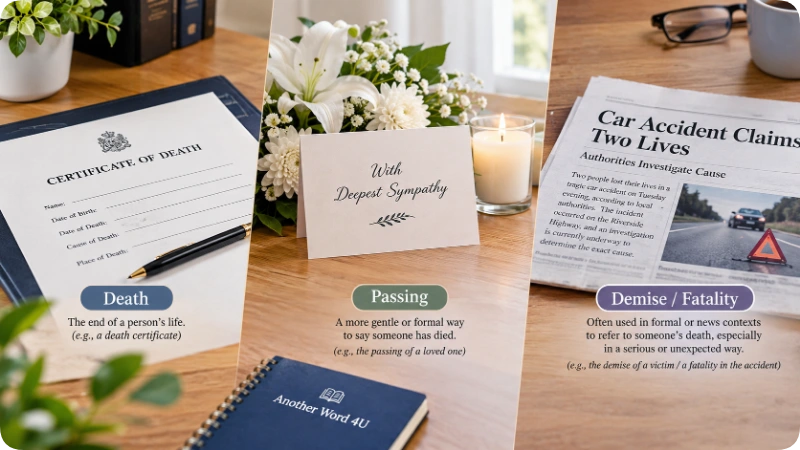
The right alternative depends on what you want to communicate. Some expressions are suitable for personal conversations, while others work better in formal, medical, or literary writing.
| If You Mean… | Use… | Why |
|---|---|---|
| A gentle way to discuss someone’s death | Passing | Respectful and commonly understood |
| A formal description of someone’s death | Demise | More formal than everyday language |
| A direct medical or biological description | Death | Clear and precise |
| A death caused by an accident | Fatality | Identifies a death resulting from an incident |
| The condition of being subject to death | Mortality | Describes a broader human condition |
| A gentle expression for grieving families | Passing away | Softer than the direct word death |
| The final moment of life | Last breath | Creates an emotional or descriptive effect |
| The final stage of a person’s life | End of life | Appropriate in healthcare discussions |
| A spiritual wish after someone’s death | Eternal rest | Expresses a religious or spiritual sentiment |
| The ending of an organization or institution | Demise | Can describe a figurative ending |
Always consider your audience and the situation before choosing an alternative. A word that works in a novel may sound inappropriate in a medical report or condolence message.
How to Choose the Right Synonym for Death
Selecting the right alternative requires more than finding a word with a similar meaning. Consider these practical factors.
1. Understand the meaning
First, decide if you are discussing a person’s death, a fatal accident, the condition of mortality, or the ending of something figuratively.
For example, fatality is appropriate when discussing an accident-related death, but it cannot replace death in every sentence.
2. Consider the tone
Your language should suit the emotional situation.
- Gentle: Passing away
- Neutral: Death
- Formal: Demise
- Literary: Final journey
3. Think about your audience
When speaking with someone who has experienced a loss, gentle and respectful expressions may be more appropriate than blunt language.
In medical or official communication, direct and accurate terminology is usually preferable.
4. Check the level of formality
Words such as demise and decease are more formal than everyday expressions. Choose language that sounds natural in your conversation or writing.
5. Avoid unnecessary emotional language
A literary expression may work beautifully in poetry but sound unnatural in a medical report. Always match the expression to the purpose of your message.
Real-Life Examples
These examples demonstrate how different alternatives work in practical situations.
1. Everyday conversation
Direct: We were sorry to hear about his death.
Gentler: We were sorry to hear about his passing.
The second sentence sounds softer and is often preferred when discussing someone’s loss.
2. Formal writing
Direct: The death of the former president was announced yesterday.
Formal alternative: The demise of the former president was announced yesterday.
Demise creates a more formal tone, although death is still perfectly appropriate.
3. News reporting
Direct: Three people died in the accident.
Alternative: The accident resulted in three fatalities.
Fatalities is particularly useful when reporting deaths caused by accidents or disasters.
4. Medical discussion
Direct: The patient died after a prolonged illness.
Related expression: The family discussed end-of-life care with the medical team.
The second expression concerns care near the end of life, not the death itself.
5. Religious or spiritual writing
Direct: The family mourned her death.
Alternative: The family prayed that she would find eternal rest.
The alternative expresses a spiritual sentiment rather than simply describing the event.
6. Literary Writing
Direct: His death changed the family’s future.
Descriptive: His final journey marked the end of an extraordinary life.
The descriptive version uses figurative language to create a more emotional and literary tone.
Antonyms for Death
The most direct opposite of death is life. Other words can express related contrasts, depending on the sentence.
| Antonym | Meaning | Example |
|---|---|---|
| Life | The condition of being alive. | The treatment helped save her life. |
| Birth | The beginning of an individual’s life. | The family celebrated the birth of their child. |
| Living | Being alive. | The patient is still living. |
| Survival | Continuing to live despite danger. | His survival surprised everyone. |
| Existence | The state of being present or alive. | The discovery changed our understanding of life and existence. |
| Revival | The return of activity or consciousness. | The medical team attempted revival. |
Note: These are contextual opposites rather than interchangeable antonyms. For example, birth is the beginning of life, while revival means a return to activity or consciousness. Neither is a direct opposite in every context.
Words That Are Easy to Confuse With Death
Some English words are closely associated with death but have different meanings.
1. Dying
Dying describes the process of approaching death, whereas death refers to the completed ending of life.
Example: The patient was dying after a serious illness.
2. Fatality
A fatality is a death resulting from an accident, disaster, or other harmful event. It is not a general replacement for death.
Example: Officials confirmed one fatality after the collision.
3. Mortality
Mortality refers to the condition of being mortal or the occurrence and frequency of deaths within a population.
Example: The study examined mortality rates among different age groups.
Understanding these differences helps prevent inaccurate word choices.
When Death Is Not the Precise Choice
Although death is a clear and widely understood word, some situations require more specific language.
When discussing an ongoing process: Use dying rather than death when someone is approaching the end of life but has not died.
When discussing an accident: Use fatality when referring specifically to a death resulting from an incident.
When discussing medical care: Use end-of-life care when describing support provided to people approaching the end of life. It does not mean the same thing as death.
When expressing sympathy: Use passing or passing away if a gentler expression suits the conversation.
When discussing a population: Use mortality when referring to patterns or rates of death rather than an individual event.
When discussing the end of an organization: Use closure, collapse, or demise according to the situation. These words describe different kinds of endings and are not always interchangeable.
The goal is to communicate accurately while respecting the emotional and practical context.
Phrases, Idioms, and Expressions Related to Death
English contains several established expressions associated with death. Some are gentle, while others are religious, literary, or informal.
| Phrase/Expression | Simple Meaning | Example |
|---|---|---|
| Pass away | To die, expressed gently. | Her grandfather passed away peacefully. |
| Rest in peace | A wish for someone who has died to be at peace. | May she rest in peace. |
| Breathe one’s last | To take the final breath before dying. | The old man breathed his last at home. |
| Depart this life | A formal or literary way to say someone died. | He departed this life many years ago. |
| Meet one’s end | To reach the point of death. | The character eventually met his end. |
| At death’s door | Extremely ill or close to dying. | After the serious illness, he was at death’s door. |
Usage tip: Expressions such as pass away and depart this life are euphemisms. They soften the direct meaning of death. However, at death’s door describes a person who is extremely close to death, not someone who has already died.
Common Mistakes When Using Death
English learners sometimes use related words incorrectly. Avoid these common mistakes.
1. Treating every alternative as an exact synonym
Incorrect: The accident caused three mortalities.
Better: The accident caused three fatalities.
Mortality generally describes the condition or frequency of death, while fatality can refer to an individual death.
2. Using passing without considering context
Incorrect: The passing of the company happened after financial problems.
Better: The closure of the company followed financial problems.
Passing is commonly used as a gentle reference to a person’s death. Closure is more precise for a business ending its operations.
3. Confusing dying with death
Incorrect: His death for several weeks was painful to witness.
Better: His final weeks were difficult to witness.
Dying describes a process, whereas death refers to the ending of life.
4. Using religious expressions for every audience
Expressions such as eternal rest may not suit every person’s beliefs. When writing a general condolence message, a neutral expression such as passing may be more appropriate.Comparison of Death and Its Alternatives
Comparison of Death and Its Alternatives
Although several words are associated with death, their meanings and appropriate uses differ.
| Word | Meaning | Tone | Best Context |
|---|---|---|---|
| Death | End of biological life | Neutral/direct | General and medical writing |
| Demise | End of someone’s life | Formal | Official and literary writing |
| Passing | Someone’s death | Gentle | Sympathy and personal conversations |
| Passing away | A gentle way to say someone died | Gentle | Everyday conversation |
| Decease | The death of a person | Very formal | Legal and official contexts |
| Fatality | Death resulting from an incident | Neutral/formal | Accident and disaster reports |
| Mortality | The condition or frequency of death | Academic/formal | Population and health discussions |
| Dying | The process of approaching death | Direct | Medical and everyday discussions |
| Perishing | Dying, often through hardship | Literary | Descriptive writing |
| End of life | The final stage of life | Neutral/formal | Healthcare discussions |
The main distinction is simple: death is the broad term, demise adds formality, passing offers a gentler expression, and fatality identifies a particular kind of death. Mortality and dying describe related but different concepts.Frequently Asked Questions About Death
Frequently Asked Questions About Death
1. What is the most common synonym for death?
Demise is a commonly recognized formal synonym for death. Passing and passing away are also widely used when people want to refer to someone’s death more gently.
2. What is a polite way to say death?
Passing and passing away are polite alternatives often used in sympathy messages and personal conversations. They communicate the loss without sounding as direct as the word death.
3. Is demise a formal word for death?
Yes. Demise is a formal noun that means the end of someone’s life. It is commonly used in formal writing, historical accounts, and literary contexts. It can also describe the figurative ending of an organization or institution.
4. What is the difference between death and mortality?
Death refers to the ending of life, while mortality describes the condition of being subject to death or the frequency of deaths within a population. For example, human mortality refers to a general condition rather than one individual death.
5. What is the opposite of death?
The most direct opposite of death is life. Other related words include living and survival, depending on the context. Birth represents the beginning of life rather than simply being an interchangeable opposite of death.
Final Thoughts
Choosing the right synonym for death depends on your intended meaning, audience, and tone.
Demise is suitable for formal writing, while passing and passing away offer gentler ways to discuss someone’s loss.
Other terms, including fatality, mortality, and dying, describe different aspects of death and should not be used interchangeably.
Understanding these distinctions helps you communicate clearly, naturally, and respectfully in everyday conversations and written English.

I am Olivia Carter, a passionate Language Researcher and Content Writer at AnotherWord4UU.com. I specialize in creating well-researched content on synonyms, alternative words, phrases, vocabulary, and English language usage. My goal is to help students, writers, professionals, and language enthusiasts find the perfect words to communicate more clearly and confidently. Through practical language guides and easy-to-understand resources, I make expanding your vocabulary simple and enjoyable.










