Featured Snippet
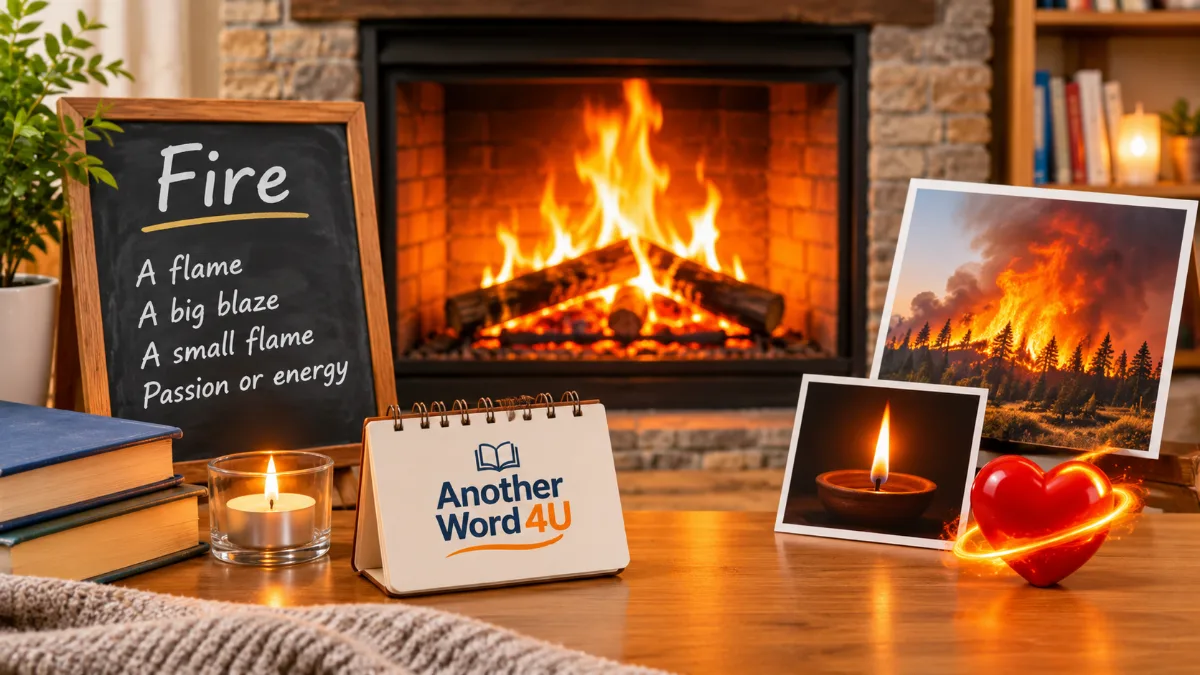
Synonyms for fire include blaze, flame, inferno, bonfire, wildfire, and conflagration. For figurative meanings, useful alternatives include passion, enthusiasm, energy, and drive. The best choice depends on whether you mean a literal fire, its intensity, a specific type of fire, or strong emotion and motivation.
“The fire spread quickly,” you write, but suddenly the word fire appears several times on the page. You may want a different word that sounds more precise, vivid, or appropriate for your audience. The best alternative depends on what you mean.
A physical fire might be described as a blaze, flame, or inferno, while figurative fire can mean passion, enthusiasm, energy, or determination. In some situations, a more formal expression is useful; in others, an everyday word sounds more natural. Understanding these differences helps you avoid replacing a word with a synonym that changes the original meaning.
This guide explains useful alternatives to fire, shows how their meanings and intensity differ, and gives practical examples for conversation, school, creative writing, and professional communication. You will also learn which related expressions are idiomatic rather than true synonyms, so you can choose the right word confidently without sounding forced or unnatural.
What Does Fire Mean?
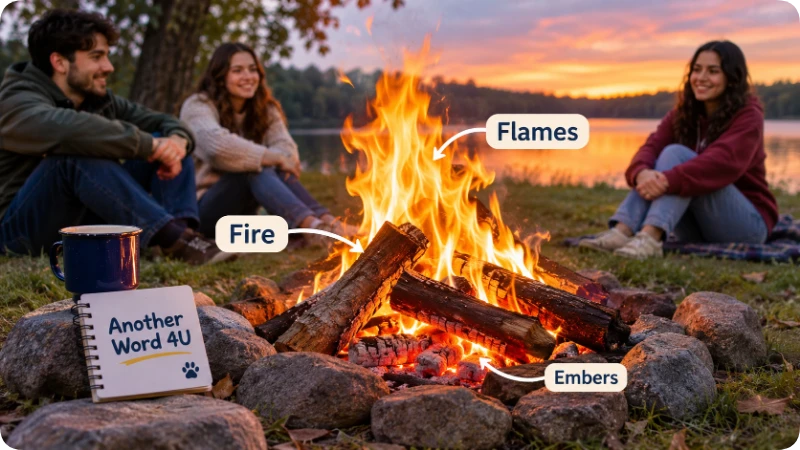
Fire most commonly means the visible heat, light, and flames produced when something burns. It can describe a small controlled flame, such as a fire in a fireplace, or a large destructive event involving burning buildings, forests, or other materials.
Examples:
- We gathered around the fire on a cold evening.
- The firefighters worked quickly to control the fire.
- Smoke filled the room after the fire started.
The word can also have several figurative meanings. Someone may have fire in their personality, meaning strong energy, determination, or enthusiasm. A person can also fire someone, meaning to dismiss them from a job. This is a different verb meaning, so it should not automatically be replaced with words such as blaze or flame.
The tone of fire is usually neutral and flexible. More specific alternatives can make writing clearer by showing if you mean a controlled flame, a destructive burning event, intense emotion, or strong motivation.
Another Word for Fire
Not every alternative below is a direct synonym in every situation. Some are near-synonyms or context-specific choices.
Fire-Related Synonyms and Alternatives
| Number | Synonym/Alternative | Type | Simple Meaning | Example Sentence |
|---|---|---|---|---|
| 1 | Blaze | Synonym / near-synonym | A large, strong fire | A bright blaze could be seen from the road. |
| 2 | Flame | Near-synonym | The visible burning part of a fire | A small flame flickered in the fireplace. |
| 3 | Inferno | Context-specific | A very large, intense, destructive fire | The building was engulfed in an inferno. |
| 4 | Conflagration | Formal | A large, destructive fire | The conflagration destroyed several structures. |
| 5 | Bonfire | Context-specific | A large outdoor fire | They gathered around the bonfire at night. |
| 6 | Campfire | Context-specific | A fire made outdoors for warmth or cooking | We cooked dinner over the campfire. |
| 7 | Fireplace fire | Phrase | A fire burning in a fireplace | A fireplace fire warmed the room. |
| 8 | Brushfire | Context-specific | A fire burning through dry vegetation | A brushfire spread across the hillside. |
| 9 | Wildfire | Context-specific | An uncontrolled fire in natural vegetation | The wildfire moved quickly through the forest. |
| 10 | Ember | Related term | A glowing piece left from a fire | A few embers remained after the flames died down. |
| 11 | Spark | Related term | A small glowing particle from fire | A spark jumped from the burning wood. |
| 12 | Blaze up | Phrase | To begin burning more strongly | The dry leaves blazed up suddenly. |
| 13 | Burn | Verb / related term | To consume something through fire | The flames began to burn the wooden fence. |
| 14 | Combustion | Formal / technical | The process of burning | Combustion produces heat and light. |
Figurative Alternatives for Fire
Some choices above describe fire itself, while others describe something fire-like in a figurative sense. For example, flame can directly describe burning, whereas passion is appropriate when fire represents strong emotion.
| Number | Synonym/Alternative | Type | Simple Meaning | Example Sentence |
|---|---|---|---|---|
| 15 | Passion | Figurative alternative | Strong emotional interest or feeling | She has a passion for teaching. |
| 16 | Enthusiasm | Figurative alternative | Strong excitement or interest | His enthusiasm for the project was obvious. |
| 17 | Energy | Figurative alternative | Vitality or active force | Her energy inspired the whole team. |
| 18 | Intensity | Figurative alternative | Extreme strength or force | The intensity of his determination impressed everyone. |
| 19 | Fervor | Formal / figurative | Very strong enthusiasm or feeling | The supporters spoke with great fervor. |
| 20 | Zeal | Formal / figurative | Strong enthusiasm for a cause or activity | She approached the work with zeal. |
| 21 | Drive | Figurative alternative | Strong motivation to achieve something | His drive helped him finish the project. |
| 22 | Ardor | Formal / literary | Strong passion or enthusiasm | The speech expressed her ardor for the cause. |
| 23 | Excitement | Figurative alternative | A strong feeling of enthusiasm or anticipation | The announcement created excitement among the students. |
| 24 | Fury | Context-specific / figurative | Extreme anger or force | The storm arrived with the fury of a fire. |
| 25 | Passionate spirit | Figurative phrase | Strong enthusiasm or commitment | Her passionate spirit made the presentation memorable. |
Best Synonym by Context
The most useful alternative depends on the exact meaning you want.
| If You Mean… | Use… | Why |
|---|---|---|
| A normal burning fire | Fire | It is the broadest and most natural choice. |
| A large, powerful fire | Blaze | It emphasizes visible strength and size. |
| The visible part of burning | Flame | It focuses on the flames themselves. |
| A huge destructive fire | Inferno | It strongly emphasizes extreme heat and destruction. |
| A large outdoor fire | Bonfire | It identifies the setting and purpose. |
| A fire in the countryside | Wildfire | It identifies an uncontrolled natural-area fire. |
| A very formal description | Conflagration | It is formal and usually describes a major destructive fire. |
| Strong personal interest | Passion | It works for hobbies, causes, careers, and relationships. |
| Strong excitement or interest | Enthusiasm | It sounds natural in everyday and professional contexts. |
| Strong motivation | Drive | It emphasizes determination to achieve something. |
| Very strong feeling | Fervor | It conveys intense emotional commitment. |
| Strong romantic feeling | Ardor | It has a more literary or formal tone. |
How to Choose the Right Synonym for Fire
First, decide if fire is literal or figurative. If something is actually burning, words such as blaze, flame, inferno, or bonfire may work. If fire is being used as a metaphor, consider words such as passion, enthusiasm, or drive.
Next, consider intensity. A flame can be small, while a blaze suggests stronger burning. An inferno normally suggests an extremely large and destructive fire.
Think about formality as well. Fire and blaze are ordinary words, while conflagration is much more formal. Similarly, enthusiasm is common in professional writing, whereas ardor has a more literary feel.
Finally, check the audience and situation. In a school essay, conflagration may be appropriate if the subject is a major destructive event, but using it instead of fire in every sentence can sound unnatural. Choose the word that adds useful precision rather than simply replacing the original word.
Real-Life Examples
1. Everyday conversation
“We sat beside the campfire until it became too cold.”
Campfire is more precise than fire because it tells the reader that the fire was outdoors and used in a camping setting.
2. News-style writing
“Firefighters contained the blaze before it reached nearby homes.”
Blaze makes the fire sound substantial without necessarily suggesting the extreme destruction associated with inferno.
3. Descriptive writing
“Orange flames danced above the logs.”
Flames focuses on the visible part of the burning fire, making it suitable for visual description.
4. Strong destruction
“The warehouse was consumed by an inferno.”
Inferno communicates an extremely intense and destructive fire.
5. Professional writing
“She approached her research with great enthusiasm.”
Here, fire would be figurative, but enthusiasm makes the intended meaning clear and professional.
6. Personal motivation
“His drive pushed him to keep practicing after every mistake.”
Drive is more precise than fire when the intended meaning is determination or motivation.
7. Passion for an activity
“She has a real passion for photography.”
Passion describes strong personal interest rather than literal burning.
Antonyms for Fire
There is no single opposite of fire that works in every meaning. The appropriate opposite depends on if you mean literal burning or figurative intensity.
| Antonym | Meaning | Example |
|---|---|---|
| Extinguish | To put out a fire. | The firefighters managed to extinguish the flames. |
| Put out | To stop a fire from burning. | Please put out the fire before leaving. |
| Quench | To satisfy or extinguish, especially a fire or thirst. | Water was used to quench the flames. |
| Douse | To cover something with liquid to extinguish it. | They doused the burning wood with water. |
| Cold | Lacking heat; opposite in temperature. | The metal became cold after the fire died. |
| Calm | Lack of emotional intensity. | Her calm attitude contrasted with his fiery anger. |
Extinguish, put out, quench, and douse are actions used to stop a fire rather than direct noun opposites.
Words That Are Easy to Confuse With Fire
Flame
A flame is part of a fire or the visible burning gas produced during combustion. It is not always interchangeable with fire.
Example: “The candle flame was very small.”
Ember
An ember is a glowing piece of material remaining after a fire has burned. It does not mean the entire fire.
Example: “A single ember was still glowing in the fireplace.”
Spark
A spark is a small glowing particle produced by burning or friction. It can start a fire, but it is much smaller than a fire itself.
Example: “A spark landed on the dry grass.”
When Fire Is Not the Precise Choice
Fire can be too broad when you need to describe a specific kind of burning. If you mean only the visible burning part, flame is more precise. If the fire is large and destructive, blaze or inferno may communicate its intensity more clearly.
It can also be too vague when the setting matters. A campfire, bonfire, or wildfire immediately gives the reader information about where or how the fire exists.
In figurative writing, fire can also be less precise than the emotion or quality you actually mean. If someone has “fire” because they are highly motivated, drive may be clearer. If they have strong interest in something, passion or enthusiasm may be better.
The goal is not to avoid the word fire. It is to replace it only when another word communicates the intended meaning more accurately.
Phrases, Idioms, and Expressions Related to Fire
Set fire to
Meaning: To cause something to start burning.
Example: “The investigators determined that someone had deliberately set fire to the building.”
Catch fire
Meaning: To begin burning.
Example: “The dry leaves caught fire almost immediately.”
Put out a fire
Meaning: To extinguish a fire; it can also mean solving an urgent problem.
Example: “The crew quickly put out the fire.”
Fight fire with fire
Meaning: To respond to a difficult situation using a similar method.
Example: “He decided to fight fire with fire during the competitive negotiation.”
Add fuel to the fire
Meaning: To make an already difficult or emotional situation worse.
Example: “His angry response only added fuel to the fire.”
Where there’s smoke, there’s fire
Meaning: A suspicious sign may indicate that something is actually wrong, although the expression does not prove that something is true.
Example: “People started asking questions after several unusual reportswhere there’s smoke, there’s fire.”
These expressions are related to fire, but they are not interchangeable single-word synonyms.
Common Mistakes When Using Fire
1. Treating flame and fire as exact equivalents
A flame is generally the visible burning part, while a fire can refer to the whole burning event.
Better: “The candle’s flame flickered,” rather than “The candle’s fire flickered,” when focusing on the visible flame.
2. Using inferno for every large fire
Inferno strongly suggests an extremely intense and destructive fire. It can sound exaggerated when the fire is relatively small.
3. Using formal words unnecessarily
Conflagration is much more formal than fire. In everyday conversation, fire or blaze will usually sound more natural.
4. Confusing literal and figurative meanings
If you mean strong motivation, passion, drive, or enthusiasm may be clearer than fire.
Comparison of Fire and Its Alternatives
| Word | Meaning | Intensity | Tone | Best Context |
|---|---|---|---|---|
| Fire | General burning event | Varies | Neutral | Everyday and general use |
| Blaze | Large or strong fire | High | Neutral / vivid | Descriptive writing and reports |
| Flame | Visible burning part | Varies | Neutral | Visual descriptions |
| Inferno | Extremely large destructive fire | Very high | Dramatic | Descriptive or news-style writing |
| Conflagration | Major destructive fire | High | Formal | Formal writing |
| Bonfire | Large outdoor fire | Moderate to high | Neutral | Outdoor gatherings |
| Wildfire | Uncontrolled natural-area fire | High | Neutral | Forest, grassland, or rural fires |
| Passion | Strong emotional interest | High | Neutral / positive | Interests, causes, careers |
| Enthusiasm | Strong excitement or interest | Moderate to high | Neutral / positive | Everyday and professional use |
| Drive | Strong motivation | Moderate to high | Neutral | Goals and achievement |
| Fervor | Intense enthusiasm | High | Formal | Causes, movements, strong beliefs |
| Ardor | Strong passion | High | Literary / formal | Romantic or expressive writing |
The key difference is that the first group primarily describes literal fire, while the later group describes figurative qualities associated with fire.
Frequently Asked Questions About Fire
1. What is the best synonym for fire?
There is no single best synonym. Blaze is useful for a large or strong fire, flame for the visible burning part, and inferno for an extremely destructive fire. The best choice depends on the exact meaning and intensity.
2. Is blaze another word for fire?
Yes, blaze can be a synonym or near-synonym for fire, especially when describing a large or strong fire. However, it is more specific and vivid than the general word fire.
3. What is a formal word for fire?
Conflagration is a formal word for a large, destructive fire. It is appropriate in formal or technical-style writing but can sound unnecessarily formal in everyday conversation.
4. What is a synonym for fire in a figurative sense?
For figurative meanings, possible alternatives include passion, enthusiasm, drive, fervor, and ardor. The correct choice depends on if you mean interest, motivation, emotional intensity, or strong commitment.
5. What is the difference between fire and flame?
A fire can refer to the entire burning event, while a flame usually refers to the visible burning part. For example, a fireplace can contain a fire with several visible flames.
Final Thoughts
Fire is a flexible word, so the best alternative depends on what you want to communicate.
Use blaze for a strong fire, flame for its visible burning part, and inferno for extreme destruction.
For figurative meanings, choose words such as passion, enthusiasm, or drive according to the intended emotion or quality.
Always consider meaning, intensity, tone, context, and audience before replacing the original word.











