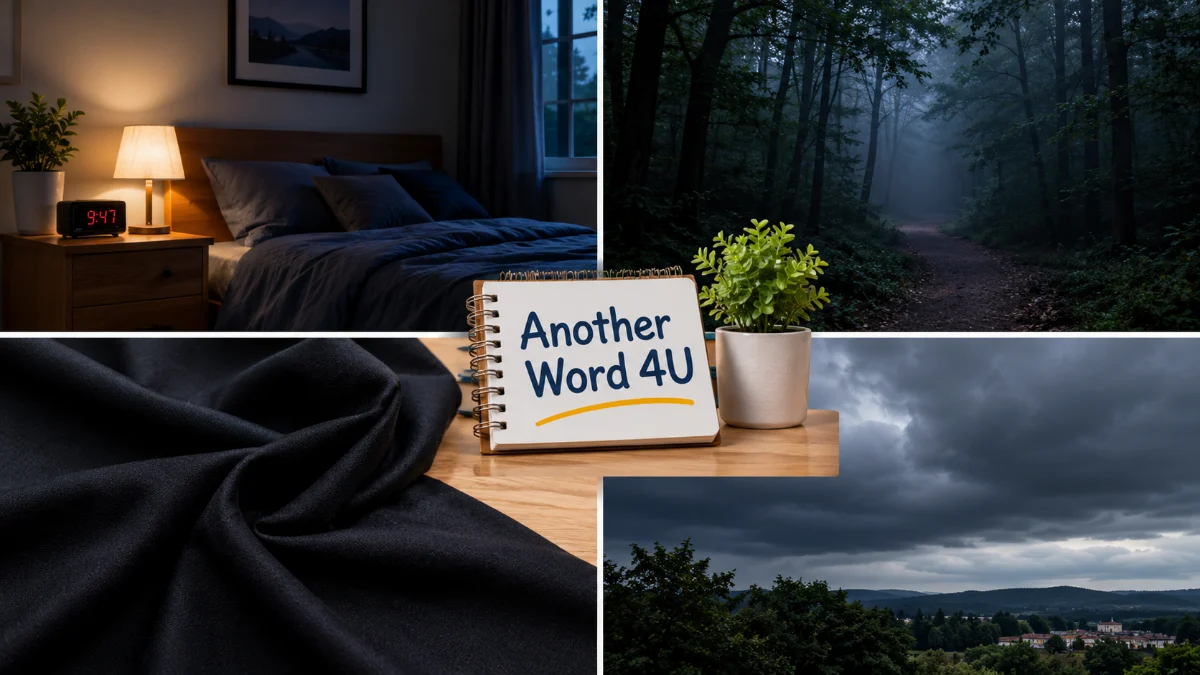
When describing a room with little light, a deep color, or a frightening atmosphere, the word dark is often the first choice. However, other words can communicate these meanings more precisely. For example, dim describes weak lighting, gloomy suggests a depressing mood, and pitch-black emphasizes a complete lack of visible light.
Learning synonyms for dark can help you improve your vocabulary, avoid repetition, and express ideas more clearly. Some alternatives describe physical darkness, while others refer to colors, emotions, mystery, or threatening situations.
This guide explains useful alternatives to dark, their meanings, example sentences, and differences. You will also learn how to choose the right word for everyday conversations, school assignments, and creative writing.
Featured Snippet
Common synonyms and alternatives for dark include dim, shadowy, dusky, gloomy, murky, somber, bleak, and pitch-black. Dim describes weak lighting, gloomy suggests a depressing atmosphere, and pitch-black means almost completely without light. The best alternative depends on whether you are describing brightness, color, mood, or appearance.
What Does Dark Mean?
The word dark generally describes something that has little or no light. It can refer to a physical environment, a color, or an atmosphere.
For example:
- The room was too dark to read comfortably.
- She wore a dark blue jacket.
- We walked along a dark street after sunset.
Dark is a common adjective used in everyday conversations, descriptions, stories, and formal writing.
Different Meanings of Dark
1. Lack of light
This is the most common meaning. A dark place has little natural or artificial light.
Example: The basement was dark because there were no windows.
2. Deep or low-light colors
Dark can describe colors that have a low level of brightness, such as dark green, dark brown, or navy blue.
Example: He painted the bedroom walls a dark shade of gray.
3. Sad, frightening, or unpleasant atmosphere
Dark can describe an emotional mood, disturbing subject, or frightening situation.
Example: The novel explores some dark themes.
4. Mystery or lack of knowledge
Dark can also suggest something hidden, unclear, or unknown.
Example: The truth about the incident remained unknown for many years
The intended meaning matters because an appropriate synonym for a dark room may not work for a dark story or a dark blue dress.
Another Word for Dark
The best alternative depends on what you want to describe. Some words refer specifically to poor lighting, while others communicate color, atmosphere, mystery, or emotional intensity.
Synonyms for Darkness and Low Lighting
| Word | Meaning | Example |
|---|---|---|
| Dim | Having weak light | The hallway was dim. |
| Shadowy | Filled with shadows | We entered a shadowy passage. |
| Dusky | Slightly dark, especially at twilight | The garden looked beautiful in the dusky light. |
| Unlit | Without artificial lighting | They walked down an unlit street. |
| Lightless | Completely without light | The explorers entered a lightless cave. |
| Pitch-black | Extremely or completely dark | The room became pitch-black. |
| Pitch-dark | Having almost no visible light | We drove along a pitch-dark road. |
| Shadowed | Covered or affected by shadows | A shadowed corner stood behind the door. |
Alternatives for Dark Colors
| Word | Meaning | Example |
|---|---|---|
| Deep | Having a rich, dark shade | She chose a deep blue dress. |
| Jet-black | Extremely dark black | The cat had jet-black fur. |
| Inky | Very dark, like black ink | The sky looked inky before sunrise. |
| Black | A specific dark color | He wore a black jacket. |
Words for Gloomy or Threatening Atmospheres
| Word | Meaning | Example |
|---|---|---|
| Gloomy | Dark or depressing | The gloomy weather affected our plans. |
| Somber | Serious or sad | The ceremony had a somber atmosphere. |
| Bleak | Cold, unpleasant, or without hope | The abandoned building looked bleak. |
| Dreary | Dull and depressing | It was a dreary afternoon. |
| Ominous | Suggesting something bad may happen | An ominous silence filled the room. |
| Sinister | Suggesting evil or danger | The character had a sinister expression. |
| Foreboding | Creating a feeling that something bad may happen | The dark clouds created a foreboding atmosphere. |
| Murky | Dark, cloudy, or difficult to see through | The river water looked murky. |
Figurative Alternatives for Unclear Situations
| Word | Meaning | Example |
|---|---|---|
| Obscure | Difficult to understand or see | The meaning of the message was obscure. |
| Indistinct | Not clear or easy to recognize | A figure appeared indistinct in the distance. |
| Vague | Not expressed clearly | The explanation was vague. |
| Mysterious | Difficult to explain or understand | They discovered a mysterious object. |
Important distinction: These words are not interchangeable in every sentence. Some are direct alternatives in particular contexts, while others describe related ideas. For example, jet-black describes color, ominous describes a threatening feeling, and vague describes unclear information.
Best Synonym by Context
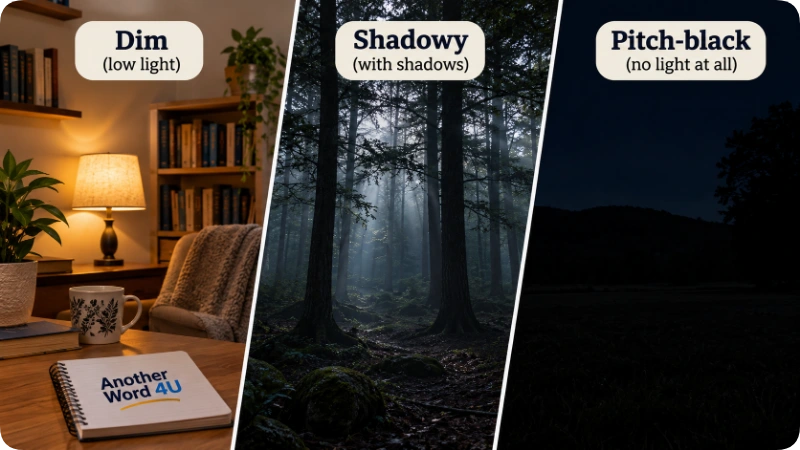
There is no single best synonym for dark in every situation. The following table shows which alternatives work naturally in different contexts.
How to Choose the Right Synonym for Dark
| If you mean… | Use… | Example |
|---|---|---|
| A room with weak lighting | Dim | The bedroom was dim. |
| A place with no visible light | Pitch-black | The tunnel was pitch-black. |
| A place filled with shadows | Shadowy | We entered a shadowy forest. |
| A twilight scene | Dusky | The hills looked beautiful at dusk. |
| A depressing atmosphere | Gloomy | The room felt gloomy. |
| A serious or sad mood | Somber | The gathering had a somber mood. |
| A deep black color | Jet-black | She wore a jet-black coat. |
| A rich color shade | Deep | He selected a deep green sofa. |
| Cloudy or unclear water | Murky | The pond water looked murky. |
| A threatening situation | Ominous | An ominous silence followed. |
| An evil appearance | Sinister | The villain had a sinister smile. |
| Something difficult to understand | Obscure | The instructions were obscure. |
| A dull, unpleasant day | Dreary | It was a dreary morning. |
Choosing an appropriate alternative becomes easier when you consider the meaning and situation.
1. Identify what you are describing
First, decide if dark refers to lighting, color, atmosphere, or something figurative.
For example:
- Dark room → Dim room
- Dark blue → Deep blue
- Dark atmosphere → Gloomy atmosphere
- Dark intentions → Sinister intentions
2. Consider the intensity
Some alternatives describe a slight lack of light, while others suggest complete darkness.
- Dim: Weak lighting.
- Shadowy: Partly covered by shadows.
- Pitch-black: Almost or completely without visible light.
Choose a word that matches the actual situation.
3. Think about emotional meaning
If you describe a sad situation, gloomy or somber may be more appropriate than dim. If something suggests danger, ominous or sinister may communicate the intended feeling more accurately.
4. Match the formality
Dark, dim, and gloomy are common in everyday English. Obscure and somber can sound more formal depending on the sentence.
5. Check the audience and context
A beginner-friendly description should use familiar vocabulary. Creative writing may benefit from more expressive words such as inky, shadowy, or pitch-black.
6. Read the complete sentence
A synonym should fit grammatically and naturally. Replacing dark with black in every sentence will not preserve the original meaning.
Real-Life Examples
| Situation | Original Sentence | Better Alternative |
|---|---|---|
| Bedroom lighting | The bedroom was dark. | The bedroom was dim. |
| Nighttime road | The road was dark. | The road was pitch-black. |
| Weather | The afternoon was dark. | The afternoon was gloomy. |
| Clothing | She wore a dark dress. | She wore a deep blue dress. |
| Forest | We entered a dark forest. | We entered a shadowy forest. |
| Water | The lake looked dark. | The lake looked murky. |
| Fiction writing | The story had dark themes. | The story explored sinister themes. |
| Mystery | The figure looked dark. | The figure looked shadowy. |
| Ceremony | The event had a dark mood. | The event had a somber atmosphere. |
| Painting | The artist used dark shades. | The artist used deep shades. |
Here are practical examples showing how different alternatives work in everyday English.
These examples demonstrate why choosing an alternative according to context is more effective than simply replacing one word with another.
Antonyms for Dark
Antonyms are words with opposite or contrasting meanings. The appropriate opposite of dark depends on if you are describing light, color, or mood.
| Antonym | Meaning | Example |
|---|---|---|
| Bright | Giving plenty of light. | The kitchen looks bright in the morning. |
| Light | Having or reflecting considerable light. | She painted the room a light color. |
| Luminous | Producing or reflecting light. | The luminous moon illuminated the garden. |
| Radiant | Shining brightly. | The radiant sunlight filled the room. |
| Sunny | Receiving plenty of sunlight. | We enjoyed a sunny afternoon. |
| Cheerful | Happy and positive in mood. | Her cheerful personality lifted everyone’s spirits. |
| Hopeful | Showing optimism. | The story ended on a hopeful note. |
| Clear | Easy to see through or understand. | The water looked clear and clean. |
Note: These are context-dependent opposites. Bright and light contrast with darkness in lighting or color, while cheerful and hopeful contrast with dark when it describes an emotional mood.
Words That Are Easy to Confuse With Dark
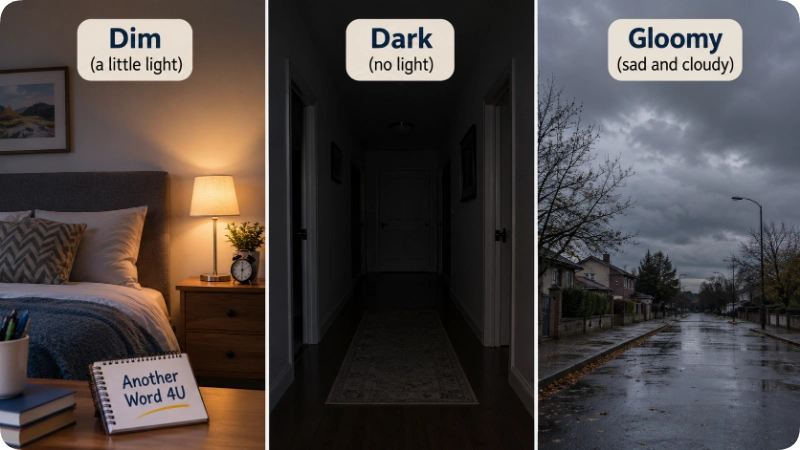
Some English words have related meanings but describe different things.
1. Dim vs. Dark
Dim means that there is some light, but it is weak. Dark generally suggests little or no light.
Example:
- Dim: The lamp produced a dim glow.
- Dark: The room became dark after the electricity went out.
2. Gloomy vs. Dreary
Both words can describe unpleasant surroundings or weather. However, gloomy emphasizes darkness or sadness, while dreary emphasizes dullness and a lack of interest.
Example:
- Gloomy: The gloomy sky made everyone feel sad.
- Dreary: It was another dreary day of endless rain.
3. Murky vs. Muddy
Murky describes something dark, cloudy, or difficult to see through. Muddy specifically suggests the presence of mud or dirt.
Example:
- Murky: The river water was murky.
- Muddy: His shoes were covered in muddy water.
When Dark Is Not the Precise Choice
Although dark is a useful everyday adjective, it sometimes fails to communicate the exact meaning.
When describing weak lighting: Dark may sound too general if a place still has some light. Use dim or dimly lit instead.
Example: The restaurant was dimly lit rather than completely dark.
When describing deep colors: Dark does not identify the exact color or shade. Use deep, jet-black, or navy when appropriate.
Example: She selected a deep green sofa.
When describing sadness: Dark may sound too broad when you mean an emotionally unpleasant atmosphere. Gloomy, somber, or bleak may communicate the feeling more clearly.
When describing danger: If a situation feels threatening, ominous or sinister can express that meaning more precisely.
When describing unclear information: Dark is not always suitable for explaining something confusing. Use obscure, unclear, or ambiguous depending on the intended meaning.
The goal is not to avoid the word dark. Instead, choose a more specific alternative when it improves clarity.
Phrases, Idioms, and Expressions Related to Dark
English includes several established expressions involving darkness. These expressions have meanings that go beyond simple descriptions of lighting.
| Phrase or Expression | Meaning | Example |
|---|---|---|
| In the dark | Without information or knowledge | We were kept in the dark about the changes. |
| A dark horse | An unexpected competitor or candidate | She became the dark horse of the competition. |
| A shot in the dark | A guess made without enough information | My answer was just a shot in the dark. |
| Dark clouds on the horizon | Signs of possible future trouble | Dark clouds are gathering on the horizon for the company. |
| The dark side | An unpleasant or negative aspect | The documentary explored the dark side of fame. |
| A dark secret | A hidden and unpleasant secret | The family kept a dark secret for years. |
These expressions are not direct single-word synonyms. They are phrases with specific meanings and should be used according to their established contexts.
Common Mistakes When Using Dark
English learners sometimes use dark and its alternatives incorrectly. Avoid these common mistakes.
1. Using dark and dim interchangeably
Dark suggests little or no light, whereas dim describes weak lighting.
Incorrect: The lamp was dark.
Better: The lamp was dim.
2. Using murky for every dark object
Murky usually describes something cloudy or difficult to see through. It is particularly useful for water, liquids, and figurative situations.
Better: The pond water looked murky.
3. Confusing black with dark
Black is a specific color, while dark describes a broader quality of low brightness.
For example, dark green and dark blue are not black.
4. Using sinister when you only mean mysterious
Sinister suggests something threatening or evil. Shadowy or mysterious is often more appropriate when something is simply unknown.
Comparison of Dark and Its Alternatives
| Word | Main Meaning | Tone | Best Context |
|---|---|---|---|
| Dark | Having little or no light | Neutral | General descriptions |
| Dim | Having weak light | Neutral | Rooms and lamps |
| Shadowy | Filled with shadows | Mysterious | Places and figures |
| Dusky | Slightly dark or twilight-like | Descriptive | Evening scenery |
| Gloomy | Dark or depressing | Negative | Weather and atmosphere |
| Murky | Cloudy or difficult to see through | Negative | Water and unclear situations |
| Jet-black | Extremely dark black | Neutral | Hair, clothing, and objects |
| Inky | Deep black like ink | Descriptive | Sky and dark surfaces |
| Somber | Serious or sad | Serious | Events and emotions |
| Bleak | Without warmth, hope, or comfort | Negative | Situations and surroundings |
| Ominous | Suggesting danger | Threatening | Warnings and situations |
| Sinister | Suggesting evil or harm | Negative | People and expressions |
| Pitch-black | Almost completely without light | Strong | Dark places |
| Obscure | Difficult to understand or see | Neutral/formal | Information and ideas |
| Dreary | Dull and depressing | Negative | Weather and surroundings |
The following comparison highlights the most useful differences between dark and commonly used alternatives.
The main difference is specificity. Dark is a broad adjective, while its alternatives communicate particular qualities such as weak light, deep color, sadness, mystery, or danger.
Frequently Asked Questions About Dark
1. What is the best synonym for dark?
The best synonym depends on the context. Dim describes weak lighting, gloomy suggests a depressing atmosphere, shadowy refers to areas covered in shadows, and pitch-black describes a place with almost no visible light.
2. What is another word for dark but not completely black?
Dim, dusky, shadowy, and deep can work depending on what you describe. Use dim for weak lighting, dusky for twilight-like appearances, and deep for rich, dark colors.
3. What is a stronger word for dark?
Pitch-black and pitch-dark are strong alternatives when describing a place with almost no visible light. Lightless can also describe a place completely without light.
4. What is a positive word for dark?
Dusky can create a soft and attractive impression when describing evening scenery. Inky can also be an appealing descriptive word for deep, rich darkness in creative writing.
5. What is the opposite of dark?
Bright and light are common opposites when describing lighting or colors. When dark refers to a sad mood, cheerful, hopeful, or positive may express the opposite meaning.
Final Thoughts
Dark is a useful everyday adjective, but choosing a more specific alternative can make your writing clearer and more expressive.
Dim works for weak lighting, shadowy describes places filled with shadows, gloomy communicates a depressing atmosphere, and pitch-black emphasizes an extreme lack of light.
Remember that not every related word is a direct synonym. Jet-black describes a color, ominous suggests danger, and obscure refers to something difficult to understand.
Consider the meaning, tone, and context before choosing an alternative.
By understanding these differences, you can improve your vocabulary and use more accurate words in everyday conversations, academic writing, and creative descriptions.

Ethan Brooks is a passionate Language Researcher and Content Writer at AnotherWord4UU.com. He specializes in creating well-researched content on synonyms, alternative words, vocabulary, idioms, and English language usage. His goal is to help students, writers, professionals, and language enthusiasts find the right words to communicate with clarity and confidence. Through practical language guides and easy-to-understand resources, Ethan makes expanding vocabulary simple, engaging, and effective.










