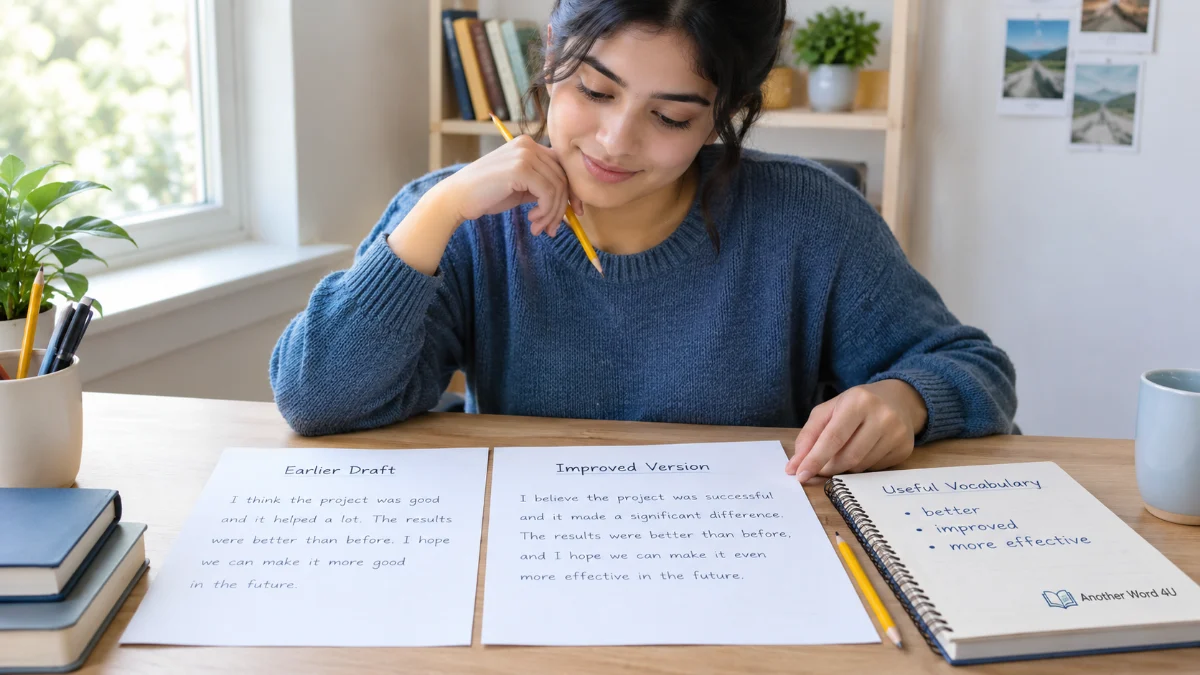
Imagine writing an email that says, “I want to make my work better.” The sentence is clear, but a more precise word could communicate your goal more effectively. You might want to improve the quality, strengthen the results, refine the details, or make the work more effective. Each meaning calls for a slightly different alternative.
Learning synonyms for better helps you express ideas clearly in everyday conversations, school assignments, professional emails, creative writing, and formal reports. Words such as improved, superior, stronger, healthier, and more effective can replace better in certain situations, but they do not all mean exactly the same thing. Some describe higher quality, while others emphasize progress, performance, or well-being.
The best choice depends on what you want to communicate and who will read or hear your words. In this guide, you will discover useful alternatives, understand their differences, explore natural examples, and learn which words fit particular contexts. You will also find antonyms, common expressions, and practical tips to help you choose accurate vocabulary without making your writing sound unnatural.
Quick Answer
A synonym for better is improved, superior, higher-quality, stronger, or more effective, depending on the context. Use improved to describe progress, superior to compare quality, stronger to emphasize power or performance, and more effective to describe something that achieves its purpose successfully. The right alternative depends on your intended meaning.
What Does Better Mean?
Better is the comparative form of good and generally means more desirable, more useful, higher in quality, or more satisfactory than something else.
For example:
- “This version is better than the original.” It has greater overall quality.
- “I feel better today.” My condition has improved.
- “We need a better solution.” We need a more suitable or effective answer.
- “She is better at mathematics now.” Her ability has improved.
Better can describe quality, health, performance, behavior, skills, decisions, or general improvement. Its precise meaning depends on the noun, verb, or situation it describes.
It can also function as a verb, meaning to improve or surpass something. For example, “The athlete hopes to better her previous record.” In this sentence, better means to achieve a higher result.
Because better is broad and common, replacing it with a more specific word can make a sentence clearer. However, a substitute should preserve the original meaning rather than simply sound more sophisticated.
Another Word for Better
The following table presents useful alternatives, including close synonyms and context-specific expressions. Some are interchangeable with better in certain sentences, while others express a narrower meaning.
Common Synonyms for Better
| No. | Synonym/Alternative | Type | Simple Meaning | Example Sentence |
|---|---|---|---|---|
| 1 | Improved | Near-synonym | Made or become better | The improved design is easier to use. |
| 2 | Superior | Synonym in comparisons | Higher in quality or ability | This material is superior in durability. |
| 3 | Higher-quality | Context-specific alternative | Made to a higher standard | We chose higher-quality ingredients. |
| 4 | Excellent | Quality alternative | Extremely good | Her presentation was excellent. |
| 5 | Outstanding | Quality alternative | Exceptionally good | He delivered an outstanding performance. |
| 6 | Greater | Context-specific alternative | Larger in amount, degree, or importance | The new system offers greater flexibility. |
| 7 | Stronger | Near-synonym | More powerful, convincing, or effective | We need a stronger argument. |
| 8 | Finer | Context-specific alternative | More delicate or of better quality | The artist used a finer brush. |
| 9 | Superior-quality | Context-specific alternative | Of a higher standard | The shop sells superior-quality fabrics. |
Alternatives for Performance, Suitability, and Accuracy
| No. | Synonym/Alternative | Type | Simple Meaning | Example Sentence |
|---|---|---|---|---|
| 10 | More effective | Context-specific alternative | More successful at achieving a goal | This method is more effective for beginners. |
| 11 | More efficient | Context-specific alternative | Producing results with less wasted time or effort | The updated process is more efficient. |
| 12 | More suitable | Near-synonym | A closer match for a purpose | This option is more suitable for children. |
| 13 | Preferable | Near-synonym | More desirable than another option | A written agreement is preferable here. |
| 14 | More capable | Context-specific alternative | Better able to do something | The team is more capable than before. |
| 15 | More skilled | Context-specific alternative | Having greater ability or expertise | He has become more skilled at editing. |
| 16 | More advanced | Context-specific alternative | At a more developed stage | The laboratory uses more advanced equipment. |
| 17 | More reliable | Context-specific alternative | More dependable | This model is more reliable in cold weather. |
| 18 | More accurate | Context-specific alternative | Closer to the truth or correct result | The revised figures are more accurate. |
| 19 | More convincing | Context-specific alternative | More likely to persuade | Her explanation was more convincing. |
Alternatives for Well-Being, Appeal, and Progress
| No. | Synonym/Alternative | Type | Simple Meaning | Example Sentence |
|---|---|---|---|---|
| 20 | Healthier | Context-specific alternative | Better for health or well-being | A healthier breakfast kept me satisfied. |
| 21 | Happier | Context-specific alternative | More pleased or content | She feels happier in her new role. |
| 22 | More appealing | Context-specific alternative | More attractive or interesting | The new layout is more appealing. |
| 23 | More profitable | Context-specific alternative | Producing greater financial gain | The revised strategy proved more profitable. |
| 24 | An improvement | Phrase | A positive change | The latest draft is an improvement. |
| 25 | A step forward | Expression | Progress toward a goal | Completing the course was a step forward. |
Important distinction: Words such as excellent and outstanding describe high quality, while improved emphasizes change from an earlier state. Superior usually compares one thing with another. Choose the alternative that expresses the intended relationship.
Best Synonym by Context
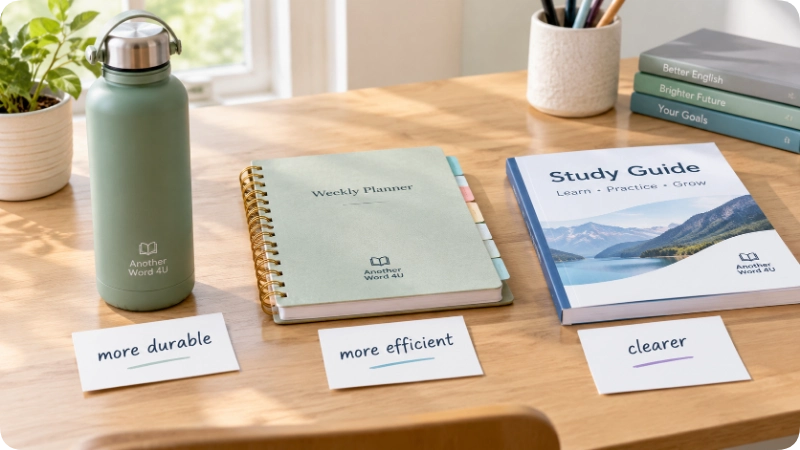
There is no single best replacement for better. The most accurate choice depends on what has changed or what you want to compare.
| If you mean… | Use… | Why |
|---|---|---|
| Something has improved over time | Improved | Highlights progress from an earlier state. |
| One product has higher quality | Superior | Emphasizes a comparison. |
| Something works more successfully | More effective | Focuses on results. |
| A process saves time or resources | More efficient | Emphasizes reduced waste. |
| A choice fits a particular need | More suitable | Highlights appropriateness. |
| Someone has developed a skill | More skilled | Describes increased ability. |
| An explanation is easier to believe | More convincing | Focuses on persuasive strength. |
| Someone’s health has improved | Healthier or feeling better | Describes well-being, depending on the sentence. |
| A design looks more attractive | More appealing | Emphasizes visual or general attraction. |
| A result contains fewer errors | More accurate | Focuses on correctness. |
| An option is more desirable | Preferable | Expresses a preference between choices. |
| A result is exceptionally good | Excellent or outstanding | Communicates a high standard. |
For example, a better plan might be more practical, a better machine might be more efficient, and a better explanation might be clearer. The specific alternative tells readers exactly what makes the option better.
How to Choose the Right Synonym for Better
Use these practical checks before replacing better in a sentence.
1. Identify the improvement
Ask what has changed. Is the result more accurate, the design more attractive, or the person more skilled? Name the specific quality instead of relying on the broad word better.
2. Consider the comparison
Superior and preferable usually make a comparison explicit. Improved describes progress, often relative to an earlier version. If no comparison is intended, a word such as excellent may fit more naturally.
3. Match the tone and formality
In everyday conversation, better is natural and perfectly acceptable. In professional writing, more effective, more suitable, or improved may communicate the point more precisely. Superior can sound formal or overly forceful if used unnecessarily.
4. Check the intensity
Better does not automatically mean excellent. If something has improved slightly, improvement may be accurate. If it is exceptionally good, outstanding may fit. Avoid exaggerating the result.
5. Keep the audience in mind
Choose words your readers understand easily. For beginner-friendly instructions, easier to use may be clearer than superior in usability. In technical writing, a precise term is more useful than an impressive-sounding one.
6. Read the complete sentence
Not every alternative fits every grammatical structure. For example, “This is preferable” works naturally, while “This is more efficient” describes how something performs. Check the sentence rather than replacing words mechanically.
Real-Life Examples

These examples show how different alternatives can improve precision in everyday situations.
| Situation | General Sentence | More Precise Sentence |
|---|---|---|
| Schoolwork | My essay is better now. | My revised essay is clearer and more organized. |
| Workplace | We need a better process. | We need a more efficient process. |
| Shopping | This phone is better. | This phone is more reliable for everyday use. |
| Health | I feel better. | I feel healthier and more energetic. |
| Communication | That explanation is better. | That explanation is easier to understand. |
| Design | This layout is better. | This layout is more appealing and practical. |
| Learning | My English is better. | My English skills have improved. |
| Persuasion | He gave a better argument. | He gave a more convincing argument. |
| Cooking | This recipe is better. | This recipe is more flavorful. |
| Decision-making | This is a better option. | This option is more suitable for our needs. |
Notice that several revised sentences use more than one word to express the intended meaning. A precise phrase is often more natural than a single-word synonym.
Antonyms for Better
The opposite of better depends on the meaning being expressed. Since better can describe quality, progress, health, or suitability, different antonyms apply in different contexts.
| Antonym | Meaning | Example |
|---|---|---|
| Worse | Of lower quality or in a less desirable condition. | The second version is worse than the first. |
| Inferior | Lower in quality or standard. | This material is inferior in durability. |
| Poorer | Of lower quality or in a less favorable condition. | The poorer result needs further investigation. |
| Less effective | Achieving a goal less successfully. | This approach is less effective for large groups. |
| Less suitable | A weaker match for a particular purpose. | That option is less suitable for beginners. |
| Weaker | Less powerful, persuasive, or effective. | The revised argument is weaker. |
| Less efficient | Using more time or resources for a result. | The old process is less efficient. |
| Deteriorated | Become worse in condition or quality. | The building’s condition has deteriorated. |
Usage note: Worse is the most general opposite of better. Inferior emphasizes comparison, while deteriorated describes a decline over time. The correct antonym depends on the sentence.
Words That Are Easy to Confuse With Better
Some words are closely related to better but express different ideas.
1. Best
Difference: Best is the superlative form of good. It identifies the highest-ranking option among a group, while better generally compares two things or describes improvement.
Example: “This is the better of the two options, but that one is the best of all five.”
2. Good
Difference: Good describes a positive quality without necessarily making a comparison. Better indicates a higher degree of quality or a more favorable state.
Example: “The first draft is good, but the revised draft is better.”
3. Improve
Difference: Improve is a verb meaning to make or become better. Better is commonly an adjective or adverb and can also function as a verb.
Example: “I want to improve my writing” describes the action; “I want to write better” describes the desired result.
When Better Is Not the Precise Choice
Better is useful in everyday English, but it can be too broad when readers need to understand the exact nature of an improvement.
- When describing quality: Replace “a better product” with a more durable product if durability is the relevant advantage.
- When describing results: Use more effectively when the key point is if a method achieves its purpose.
- When describing speed or resource use: Choose faster if speed matters, or more efficient if the process uses time or resources more effectively.
- When describing suitability: Use more appropriate or more suitable if an option matches the circumstances more closely.
- When describing a high standard: Choose excellent or outstanding only when the intended praise is strong enough to justify it.
- When describing personal progress: Use more confidence, more experienced, or more skilled when you know which quality has developed.
Do not replace better simply to make a sentence sound formal. If the comparison is obvious and the meaning is clear, better may be the most natural choice.
Phrases, Idioms, and Expressions Related to Better
These common expressions communicate improvement, progress, or a preference. They are related expressions, not exact single-word synonyms.
| Phrase or Expression | Meaning | Example |
|---|---|---|
| For the better | In a way that produces a positive change. | The new schedule changed our routine for the better. |
| Better off | In a more favorable situation. | We would be better off leaving earlier. |
| A step in the right direction | Progress toward a desired goal. | The revised policy is a step in the right direction. |
| Turn over a new leaf | Make a fresh start, especially by changing behavior. | He turned over a new leaf and began studying regularly. |
| Get better | Improve in condition, ability, or quality. | Her pronunciation continues to get better. |
| The best of both worlds | The advantages of two different situations. | Working remotely part-time gives her the best of both worlds. |
These expressions are not interchangeable. For example, better off often concerns someone’s circumstances, whereas turn over a new leaf specifically suggests a change in behavior.
Common Mistakes When Using Better
1. Assuming every synonym has the same meaning
Superior, healthier, and more efficient describe different qualities. Choose the word that matches the intended improvement.
Correction: Instead of “This is a superior way to save time,” consider “This is a more efficient way to save time.”
2. Using better when the comparison is unclear
A sentence such as “This option is better” may leave readers wondering why.
Correction: Explain the advantage: “This option is cheaper and easier to maintain.”
3. Confusing comparative and superlative forms
Better usually compares two things or describes improvement; best identifies the highest-ranking choice in a group.
Correction: “This is the better of the two designs” and “This is the best design in the collection.”
4. Choosing unnecessarily complicated vocabulary
A sophisticated alternative does not automatically make writing stronger. Words that sound unnatural can make simple ideas harder to understand.
Correction: Use better when it communicates your meaning clearly. Choose a more specific alternative only when it adds useful information.
Comparison of Better and Its Alternatives
The following comparison highlights the most useful distinctions without treating the alternatives as exact substitutes in every sentence.
| Word | Main Emphasis | Tone | Best Used When |
|---|---|---|---|
| Better | General improvement or comparison. | Neutral, everyday. | The context makes the intended improvement clear. |
| Improved | Progress from an earlier state. | Neutral, factual. | Describing a revised version or developed ability. |
| Superior | Higher quality or rank. | Formal or evaluative. | Comparing products, performance, or standards. |
| Excellent | Very high quality. | Positive, enthusiastic. | Expressing strong approval. |
| More effective | Successful results. | Practical, professional. | Evaluating methods, plans, or strategies. |
| More efficient | Reduced waste of time or resources. | Practical, professional. | Comparing processes or systems. |
| Preferable | Greater desirability. | Neutral to formal. | Explaining which option is more desirable. |
| More suitable | Better fit for a purpose. | Neutral, practical. | Matching a choice to specific needs. |
| Healthier | Better for health or well-being. | Neutral, descriptive. | Comparing habits, food, or health-related choices. |
| Best | Highest rank in a group. | Neutral or emphatic. | Identifying the top choice among several options. |
The main difference is specificity. Better covers many kinds of improvement, while its alternatives explain the particular advantage, degree, or quality being discussed.
Frequently Asked Questions About Better
1. What is the closest synonym for better?
Improved is a close alternative when describing progress from an earlier state. However, superior, more effective, or more suitable may be more accurate when comparing quality, results, or appropriateness.
2. What is a more formal word for better?
Superior is a formal alternative when comparing quality or performance. Preferable works when expressing a preference, and improved is useful in reports describing progress. The appropriate choice depends on the sentence.
3. What is a stronger word than better?
Excellent and outstanding express strong praise, while superior emphasizes comparison. These words are not suitable for every context because they may communicate a higher degree of quality than better alone.
4. Is improved the same as better?
Not exactly. Improved usually highlights positive change from an earlier condition or version. Better can describe that change, but it can also compare two different things without suggesting that either one has changed over time.
5. What is the opposite of better?
Worse is the most common general antonym. Depending on the context, inferior, less effective, less suitable, or weaker may be more precise. For a condition that has declined over time, deterioration may be appropriate.
Final Thoughts
Better is a versatile everyday word, but a more specific alternative can make your meaning clearer.
Use improved for progress, superior for comparisons, more effective for successful results, and more suitable for a good match with a particular need..
Choose according to meaning, tone, context, and audience rather than selecting a synonym simply because it sounds more advanced.

Sophia Bennett is a dedicated Language Researcher and Content Writer at AnotherWord4UU.com. She specializes in creating well-researched content on synonyms, alternative words, vocabulary, expressions, and English language usage. Her goal is to help students, writers, professionals, and language learners communicate more effectively by finding the most accurate and impactful words. Through clear, practical, and engaging language guides, Sophia makes expanding vocabulary simple, accessible, and enjoyable.