Imagine writing, “Please bring your documents to the meeting.” The sentence is clear, but depending on the situation, you might choose “carry,” “deliver,” “take,” or “provide” instead. Each word expresses a slightly different action, so choosing the right alternative can make your English more precise and natural.
Learning synonyms for bring helps you avoid repetition in conversations, school assignments, emails, stories, and professional writing. However, not every alternative works in every sentence. You carry something when you move it, deliver something when you take it to a destination, and provide something when you make it available. The best choice depends on what is being moved, where it is going, and what you want to communicate.
This guide explains useful alternatives to bring, their meanings, and their differences through simple definitions, practical examples, and comparison tables. if you are learning English or improving your writing, you will discover how to select words that fit your intended meaning and audience.
Featured Snippet
A synonym for bring is carry, deliver, fetch, transport, or provide, depending on the context. Use carry for moving something, deliver for taking it to a destination, fetch for going to get it, and provide for making something available. No single alternative fits every sentence.
What Does Bring Mean?
The verb bring generally means to carry, move, or accompany someone or something toward a person, place, or situation being discussed.
For example:
- Please bring your notebook to class.
- Could you bring your friend to the party?
- The new policy may bring positive changes.
- Her explanation brought clarity to the discussion.
The first two examples involve physically moving an object or person. The last two use bring figuratively to describe causing a result.
Common uses of bring
1. Moving something to a place
“Bring your lunch to work” means to take your lunch with you to work.
2. Going to get something
“Bring me the keys” asks someone to get the keys and carry them to the speaker.
3. Causing a result
“The decision brought relief” means the decision caused people to feel relieved.
4. Introducing or contributing something
“Her experience brings valuable knowledge to the team” means her experience contributes something useful.
5. Accompanying someone
“Bring your children along” means to come with your children.
The intended meaning matters because alternatives such as deliver, fetch, cause, and contribute apply to different uses of bring.
Another Word for Bring
The best alternative depends on whether you mean physically moving something, collecting an item, supplying something, or causing a result.
Synonyms for Physically Moving or Delivering Something
| No. | Synonym/Alternative | Type | Simple Meaning | Example Sentence |
|---|---|---|---|---|
| 1 | Carry | Near-synonym | Move something while holding or supporting it | Please carry these books upstairs. |
| 2 | Deliver | Context-specific synonym | Take something to its intended recipient or destination | The courier will deliver the package tomorrow. |
| 3 | Fetch | Context-specific synonym | Go and get something, then return with it | Please fetch my glasses from the bedroom. |
| 4 | Transport | Near-synonym | Move people or goods between places | Trucks transport supplies to the warehouse. |
| 5 | Take | Context-specific alternative | Move something or someone to another place | Take these papers to the office. |
| 6 | Convey | Formal near-synonym | Carry or communicate something from one place or person to another | The vehicle conveys passengers to the airport. |
| 7 | Move | Broad synonym | Change the position of something or someone | Move the chairs into the conference room. |
| 8 | Ship | Context-specific alternative | Send goods using a delivery or transport service | The store will ship your order next week. |
| 9 | Forward | Context-specific alternative | Send something onward to another person or destination | Please forward the email to your manager. |
Alternatives for Giving, Supplying, and Introducing Something
| No. | Synonym/Alternative | Type | Simple Meaning | Example Sentence |
|---|---|---|---|---|
| 10 | Provide | Context-specific alternative | Make something available to someone | The school provides students with textbooks. |
| 11 | Supply | Context-specific alternative | Give something needed or requested | The company supplies equipment to hospitals. |
| 12 | Present | Context-specific alternative | Formally give something to someone | She will present the award tonight. |
| 13 | Hand | Context-specific alternative | Give something directly to another person | Please hand me the envelope. |
| 14 | Pass | Context-specific alternative | Give or move something to another person | Could you pass me the salt? |
| 15 | Transfer | Near-synonym | Move something from one person, place, or system to another | They transferred the files to a new computer. |
| 16 | Contribute | Figurative alternative | Add something useful to a group or situation | Her ideas contribute fresh perspectives to the project. |
| 17 | Introduce | Context-specific alternative | Bring something new into a situation | The company introduced a new payment system. |
Alternatives for Causing Results or Creating Effects
| No. | Synonym/Alternative | Type | Simple Meaning | Example Sentence |
|---|---|---|---|---|
| 18 | Cause | Figurative synonym | Make something happen | The announcement caused considerable excitement. |
| 19 | Create | Figurative alternative | Make something happen or produce something new | The changes created new opportunities. |
| 20 | Generate | Formal alternative | Produce a result, response, or effect | The campaign generated considerable interest. |
| 21 | Produce | Context-specific alternative | Create or yield a result | The discussion produced several useful ideas. |
| 22 | Induce | Formal alternative | Cause a particular condition or response | The medication may induce drowsiness. |
| 23 | Elicit | Context-specific alternative | Draw out a response or reaction | The question elicited an honest answer. |
| 24 | Lead to | Phrase | Result in something | Poor planning can lead to delays. |
| 25 | Give rise to | Formal phrase | Cause something to develop or happen | The dispute gave rise to further questions. |
Important distinction: These alternatives are not interchangeable in every sentence. Fetch emphasizes going to get something, deliver emphasizes reaching a recipient or destination, and cause applies to results rather than physically moving objects. Choose the alternative that best matches your intended meaning.
Best Synonym by Context
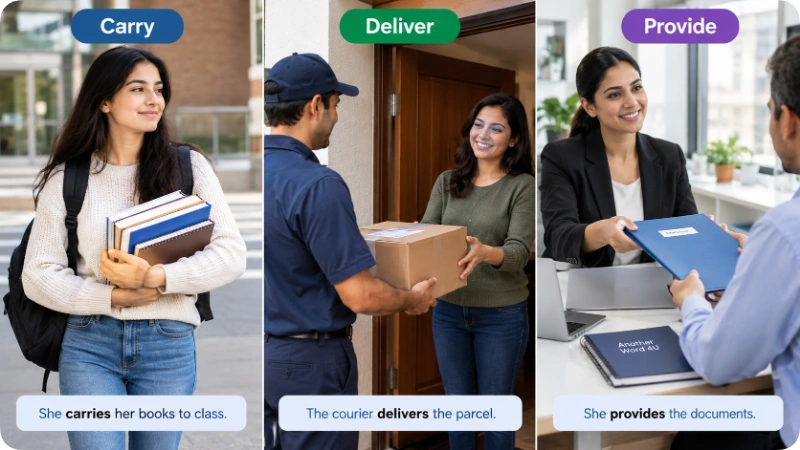
Use this table to identify an alternative that matches your intended meaning.
| If you mean… | Use… | Why |
|---|---|---|
| Moving an object by hand | Carry | Emphasizes physically holding or supporting something. |
| Taking a package to a customer | Deliver | Focuses on reaching the intended recipient. |
| Going to get something | Fetch | Includes the action of retrieving an item. |
| Moving goods over a distance | Transport | Emphasizes movement between locations. |
| Taking an object somewhere else | Take | Fits a change of destination or direction. |
| Making a resource available | Provide | Focuses on availability rather than movement. |
| Giving something formally | Present | Suitable for awards, gifts, and official occasions. |
| Passing an object directly | Hand or pass | Describes a direct exchange. |
| Causing a feeling or result | Cause or create | Expresses a figurative effect. |
| Producing interest or demand | Generate | Often suitable for business and analytical writing. |
| Adding value to a team | Contribute | Emphasizes participation or a useful addition. |
| Causing a later consequence | Lead to | Connects an action with its outcome. |
How to Choose the Right Synonym for Bring
Choosing the right word becomes easier when you consider five practical factors.
1. Identify the action
Ask what is actually happening.
- Carry: Someone physically moves an item.
- Fetch: Someone goes to get an item.
- Deliver: Someone takes an item to its destination.
- Provide: Someone makes something available.
For example, “Please fetch the folder” suggests retrieving it, while “Please deliver the folder” emphasizes taking it to the recipient.
2. Consider the direction
Bring often describes movement toward the speaker, listener, or relevant destination. Take commonly describes movement away from the current reference point or toward another place.
Compare:
- Bring your coat here.
- Take your coat upstairs.
The correct verb depends on the perspective and destination.
3. Match the level of formality
Use familiar words in everyday conversation and more specific alternatives when the context calls for them.
- Everyday: “Can you bring me a glass of water?”
- More specific: “Could you deliver the documents to reception?”
- Formal: “The report conveys the main findings.”
Formal vocabulary should improve precision rather than make a sentence unnecessarily complicated.
4. Check if the meaning is literal or figurative
For physical movement, consider carry, move, or transport. For results, consider cause, create, generate, or lead to.
For example, “The announcement brought excitement” can become “The announcement generated excitement.”
5. Think about your audience
A simple word such as give may work best for beginner-friendly instructions, while provide may be more appropriate in a professional report.
Choose the word that helps your reader understand the action immediately.
Real-Life Examples

The following examples show how different alternatives work in everyday situations.
| Situation | Sentence Using Bring | Alternative Sentence |
|---|---|---|
| At school | Bring your textbook tomorrow. | Carry your textbook to class tomorrow. |
| At home | Bring me my glasses. | Fetch my glasses from the bedroom. |
| At work | Bring the signed form to reception. | Deliver the signed form to reception. |
| Shopping | The store will bring your order. | The store will deliver your order. |
| In a meeting | Bring your ideas to the discussion. | Contribute your ideas to the discussion. |
| In business | The campaign brought more interest. | The campaign generated more interest. |
| In a report | The changes brought delays. | The changes caused delays. |
| In a presentation | The speaker brought the main point across. | The speaker conveyed the main point clearly. |
| At a gathering | Bring some snacks to the party. | Take some snacks to the party. |
| At a formal event | They brought her an award. | They presented her with an award. |
Notice that some alternatives change the emphasis. Contribute focuses on participation, while delivery focuses on the destination. A good replacement preserves the original meaning rather than merely changing the vocabulary.
Antonyms for Bring
There is no single antonym for every meaning of bring. The opposite depends on if you mean physical movement, giving something, or causing a result.
| Antonym | Meaning | Example |
|---|---|---|
| Remove | Take something away from a place. | Remove the boxes from the hallway. |
| Take away | Carry something away from a person or place. | Please take away the empty plates. |
| Withdraw | Take back or remove something previously offered or made available. | The company withdrew its offer. |
| Retrieve | Get something back or recover it; an opposite only in certain movement contexts. | She retrieved the file from storage. |
| Prevent | Stop something from happening; the opposite of bringing about a result. | Careful planning can prevent delays. |
| Avoid | Stay away from or prevent an unwanted outcome. | We changed the schedule to avoid confusion. |
Note: Retrieve is not a general antonym of bring. It can describe a contrasting movement when something is collected from a location, but it is often a near-synonym of fetch. The most appropriate opposite depends on the original sentence.
Words That Are Easy to Confuse With Bring
1. Take
Bring commonly describes movement toward a relevant person or destination, whereas take often emphasizes moving something away from the current location or toward another destination.
Example:
- Bring your laptop here.
- Take your laptop to the office.
2. Fetch
Fetch means to go somewhere, get something, and return with it or carry it to the person who requested it. Bring emphasizes the act of carrying or accompanying something to a destination.
Example:
- Please fetch the keys from the kitchen.
- Please bring the keys to me.
3. Deliver
Deliver emphasizes transporting something to its intended recipient or destination. Bring is broader and can describe carrying something without a formal delivery arrangement.
Example:
- Bring the invitation to the meeting.
- Deliver the invitation to the client’s office.
The second sentence emphasizes getting the invitation to a particular destination.
When Bring Is Not the Precise Choice
Although bring is versatile, a more specific verb can make your meaning clearer.
When you mean retrieval: Use fetch or retrieve if the action involves going to get something.
- Broad: Bring my jacket.
- More precise: Fetch my jacket from the bedroom.
When you mean professional delivery: Use deliver when an item must reach a recipient.
- Broad: Bring the order to the customer.
- More precise: Deliver the order to the customer.
When you mean supplying resources: Use provide or supply when the emphasis is on making something available.
- Broad: The organization brings equipment to schools.
- More precise: The organization supplies equipment to schools.
When you mean causing a result: Use cause, generate, or lead to to clarify the relationship between an action and its outcome.
- Broad: The decision brought problems.
- More precise: The decision caused problems.
When you mean communicating an idea: Use convey or express when describing the communication of meaning, information, or emotion.
- Broad: Her words brought her feelings to the audience.
- More precise: Her words conveyed her feelings to the audience.
The goal is not to replace bring every time. It is to choose a more precise verb when doing so genuinely improves the sentence.
Phrases, Idioms, and Expressions Related to Bring
These established expressions are used in literal or figurative ways. They are not all single-word synonyms.
| Phrase or Expression | Simple Meaning | Example |
|---|---|---|
| Bring about | Cause something to happen. | The reforms brought about significant changes. |
| Bring up | Mention a topic or raise a child, depending on the context. | She brought up an important question during the meeting. |
| Bring along | Take someone or something with you. | You can bring along a friend to the event. |
| Bring back | Return something or cause a memory to return. | That song brings back childhood memories. |
| Bring to light | Reveal information that was previously unknown. | The investigation brought new evidence to light. |
| Bring home the point | Make a point especially clear or memorable. | The final example brought home the point about safety. |
These expressions can be useful in conversation and writing, but their meanings depend on the complete phrase. For example, bring up does not simply mean carry when it means mentioning a topic.
Common Mistakes When Using Bring
1. Treating bring and take as identical
These verbs can overlap, but direction and perspective often distinguish them.
Incorrect for the intended direction: “Take the documents here to me.”
More natural: “Bring the documents here to me.”
Use bring when movement is toward the relevant destination or person.
2. Using deliver for every kind of movement
Deliver often implies that something is being taken to a recipient or designated destination. It may sound unnecessarily formal when someone is simply moving an object around the house.
Instead of “Deliver the cup to the table,” say “Take the cup to the table.”
3. Using cause for physical movement
Cause describes making something happen, not ordinarily carrying an object to a place.
Unnatural: “Please cause the bag to the office.”
Natural: “Please take the bag to the office.”
4. Choosing a formal alternative without checking its meaning
Words such as convey, provide, and generate are useful in specific contexts, but they cannot replace bring everywhere.
For example, “Please generate my coat” does not mean “Please bring my coat.” Choose alternatives for their meaning, not simply because they sound sophisticated.
Comparison of Bring and Its Alternatives
| Word | Main Emphasis | Typical Context | Example |
|---|---|---|---|
| Bring | Movement toward a relevant destination. | Everyday conversation and general writing. | Bring your notes to class. |
| Take | Movement to another place. | Instructions and directions. | Take these files upstairs. |
| Carry | Physically holding or supporting something while moving. | Everyday activities. | Carry the box carefully. |
| Fetch | Going to get something. | Requests and errands. | Fetch the newspaper, please. |
| Deliver | Reaching a recipient or destination. | Packages, documents, and services. | Deliver the parcel by Friday. |
| Provide | Making something available. | Education, work, and services. | Provide the requested information. |
| Transport | Moving people or goods between locations. | Logistics and formal descriptions. | Transport the equipment safely. |
| Cause | Making an event or result happen. | Explanations and analysis. | The delay caused confusion. |
| Contribute | Adding something to a shared effort or result. | Teamwork and professional writing. | Contribute useful ideas. |
| Convey | Communicating information, meaning, or emotion. | Communication and formal writing. | Convey your message clearly. |
The central difference is that bring is broad, while many alternatives identify a more specific action. Carry describes physical handling, fetch emphasizes retrieval, deliver focuses on a destination, and cause describes an outcome.
Frequently Asked Questions About Bring
1. What is the closest synonym for bring?
There is no single closest synonym for every use. Carry often works for physical movement, delivery for taking something to a recipient, and cause for producing a result. Choose the alternative that preserves the original sentence’s meaning.
2. What is a formal word for bring?
Depending on context, convey, transport, provide, and deliver can sound more formal or specific than bring. For example, “The vehicle transports passengers” suits a formal description better than “The vehicle brings passengers.”
3. What is the difference between bring and take?
Bring generally describes movement toward a relevant person or destination, while take often describes movement toward another place or away from the current reference point. The intended direction determines which word sounds natural.
4. Can cause be a synonym for bring?
Yes, when bring means making something happen. For example, “The change brought confusion” can become “The change caused confusion.” However, cause cannot ordinarily replace bring when the sentence describes physically carrying an object.
5. What is the opposite of bring?
The opposite depends on the meaning. Remove or take away may contrast with physically bringing something into a place, while preventing can contrast with bringing about an event. There is no single antonym that fits every use.
Final Thoughts
The best synonym for bring depends on the action and the intended meaning.
Choose carry for physical movement, fetch for retrieval, deliver for reaching a recipient, provide for making something available, and cause for producing a result.
Consider tone, context, direction, and audience before replacing the original word.
Precise vocabulary makes everyday English, professional communication, and creative writing clearer and more natural.

Ethan Brooks is a passionate Language Researcher and Content Writer at AnotherWord4UU.com. He specializes in creating well-researched content on synonyms, alternative words, vocabulary, idioms, and English language usage. His goal is to help students, writers, professionals, and language enthusiasts find the right words to communicate with clarity and confidence. Through practical language guides and easy-to-understand resources, Ethan makes expanding vocabulary simple, engaging, and effective.