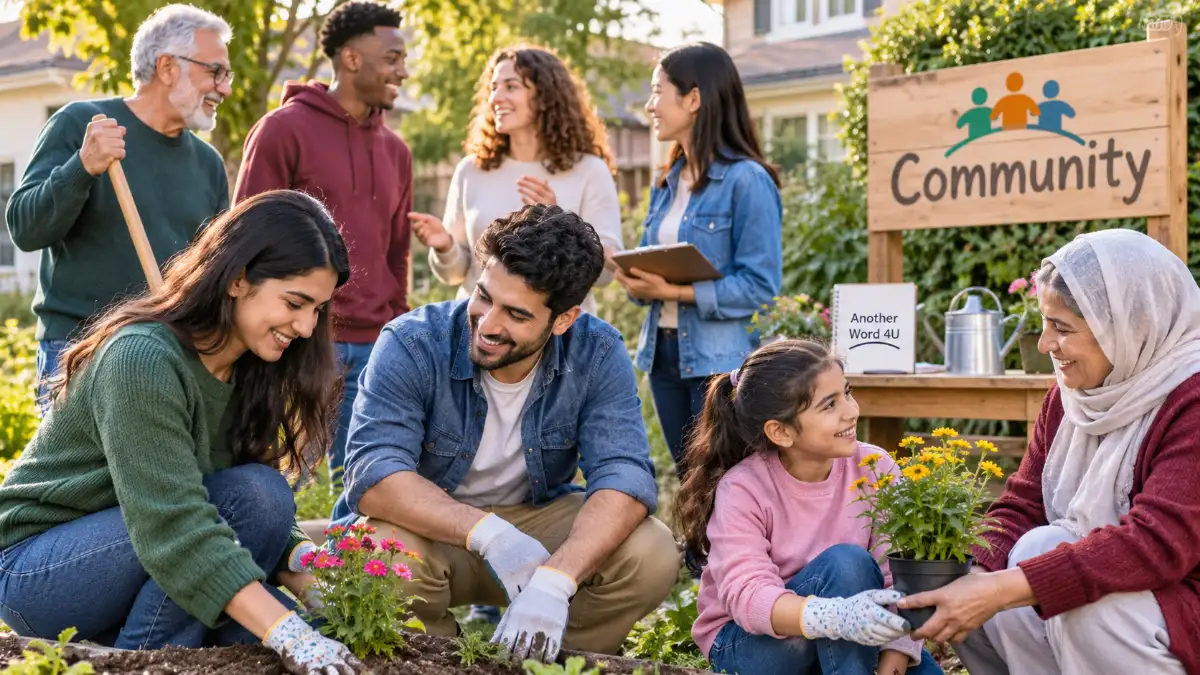
Imagine writing about a neighborhood project, a group of people with shared interests, or a place where everyone feels connected. Using the word “community” repeatedly can make your writing sound less natural.
Choosing another word can help you communicate the exact meaning, if you are describing a local population, a social group, a professional network, or people with a common purpose. However, not every alternative has the same meaning. A neighborhood is connected to a geographical area, while a network emphasizes relationships and communication.
A society usually describes a larger organized group, and an association often refers to people who come together for a particular purpose. Understanding these differences makes it easier to select the right expression. In this guide, you will discover useful synonyms for the community, learn how they differ in meaning and tone, explore everyday examples, and understand which alternatives work best in academic, professional, social, and casual writing.
Featured Snippet
Another word for community is group, society, neighborhood, or network. Use neighborhood for people living in the same area, society for a broader social population, network for connected individuals, and association for people united by a common interest or goal.
What Does Community Mean?

The word community describes a group of people who share something that connects them. This connection may come from living in the same geographical area, having similar interests, sharing cultural traditions, or working toward a common goal.
For example:
- The local community organized a neighborhood cleanup.
- An online community shares advice about photography.
- The school community welcomed new students.
- The farming community discussed changes in local agriculture.
Community is a flexible noun that appears in everyday conversation, education, business, social discussions, and formal writing.
Common Contexts of Community
1. Geographical community
People who live in the same town, neighborhood, village, or region.
Example: The community supported the new public library.
2. Interest-based community
People connected through a shared hobby, activity, or interest.
Example: She joined an online community of language learners.
3. Professional community
People working in the same profession or industry.
Example: The teaching community discussed new classroom strategies.
4. Cultural or social community
People connected through shared traditions, experiences, identity, or social relationships.
Example: The festival brought members of the cultural community together.
The word generally has a positive or neutral tone because it often suggests belonging, cooperation, and connection. However, its exact meaning depends on the situation.
Another Word for Community
The best alternative depends on what connects the people being described. Some words emphasize location, while others highlight relationships, shared interests, or organization.
Common Synonyms and General Alternatives for Community
| Number | Synonym/Alternative | Type | Simple Meaning | Example Sentence |
|---|---|---|---|---|
| 1 | Society | Near-synonym | People living together in an organized social system | Society benefits from responsible citizens. |
| 2 | Group | General synonym | People gathered or connected together | A group of volunteers cleaned the park. |
| 3 | Collective | Near-synonym | People acting together as one unit | The collective worked toward a common goal. |
| 4 | Network | Near-synonym | Connected people who communicate or support one another | She built a professional network online. |
| 5 | Fellowship | Near-synonym | A feeling or group based on friendship and shared interests | The club encouraged fellowship among members. |
| 6 | Organization | Context-specific | An organized group working toward a purpose | The organization supports local families. |
| 7 | Society | Formal alternative | An organized group with shared interests or activities | She joined a historical society. |
| 8 | Circle | Informal alternative | A small group of connected people | He belongs to a close circle of writers. |
| 9 | Crowd | Context-specific | A large gathering of people | A crowd gathered outside the town hall. |
| 10 | Public | Context-specific | People considered collectively | The project received support from the public. |
Alternatives for Local Communities and Populations
| Number | Synonym/Alternative | Type | Simple Meaning | Example Sentence |
|---|---|---|---|---|
| 11 | Neighborhood | Context-specific | People or homes in a particular local area | Our neighborhood organized a food drive. |
| 12 | Population | Context-specific | People living in a particular place | The town has a growing population. |
| 13 | Residents | Context-specific | People living in a particular area | Residents requested better street lighting. |
| 14 | Citizens | Context-specific | Members of a particular state or country | Citizens participated in the public discussion. |
| 15 | Local population | Descriptive phrase | People living in a particular locality | The local population supported the development. |
Alternatives for Shared Interests, Relationships, and Support
| Number | Synonym/Alternative | Type | Simple Meaning | Example Sentence |
|---|---|---|---|---|
| 16 | Association | Context-specific | People organized around a shared interest or purpose | The teachers’ association held a meeting. |
| 17 | Membership | Context-specific | People belonging to an organization or group | The membership approved the proposal. |
| 18 | Network of people | Descriptive phrase | Connected individuals with shared relationships | A network of people supported the initiative. |
| 19 | Social group | Descriptive phrase | People connected through social relationships | The social group meets every weekend. |
| 20 | Peer group | Context-specific | People of similar age, status, or experience | Her peer group encouraged her studies. |
| 21 | Collective body | Formal phrase | People considered as one organized unit | The collective body reviewed the recommendations. |
| 22 | Fellowship group | Descriptive phrase | People connected through companionship or shared beliefs | The fellowship group welcomed new members. |
| 23 | Cultural group | Context-specific | People sharing cultural traditions or backgrounds | The cultural group celebrated its heritage. |
| 24 | Support network | Context-specific | People providing practical or emotional assistance | New parents often benefit from a support network. |
| 25 | Interest group | Context-specific | People sharing a particular interest or concern | The interest group discussed environmental protection. |
Important distinction: These alternatives are not interchangeable in every sentence. Neighborhood and local population emphasize location, while network and support network highlight connections between people. Association and organization suggest a structured group, whereas crowd usually describes people gathered in one place.
Best Synonym by Context

Choosing the right synonym becomes easier when you identify the type of community you are describing.
| If you mean… | Use… | Why |
|---|---|---|
| People living in the same area | Neighborhood | Emphasizes geographical location. |
| People living in a city or country | Population | Focuses on the people who inhabit a place. |
| People connected by shared interests | Group | A simple, flexible alternative. |
| People connected professionally | Network | Highlights professional relationships. |
| People organized around a common purpose | Association | Suggests an organized membership. |
| People sharing cultural traditions | Cultural group | Identifies a shared cultural connection. |
| People working together | Collective | Emphasizes joint action. |
| People providing mutual assistance | Support network | Highlights practical or emotional support. |
| A large organized social system | Society | Suitable for broader social discussions. |
| People sharing friendship and companionship | Fellowship | Emphasizes connection and belonging. |
| People attending a public event | Crowd | Describes a gathering rather than an ongoing community. |
| People living in a particular region | Local population | Provides a more specific geographical meaning. |
How to Choose the Right Synonym for Community
Before replacing the community, consider these practical points.
1. Identify the connection
Ask what brings the people together. Do they live in the same place, share an interest, work in the same profession, or support one another?
For example, the neighborhood works for local residents, while the network is better for professional relationships.
2. Consider formality
Some alternatives sound more appropriate in formal writing.
- Formal: society, association, population.
- Neutral: group, neighborhood, organization.
- Informal: circle, crowd.
3. Think about the size
Population can describe all the people living in a particular area. Circle usually suggests a smaller group of people who know or interact with one another.
4. Check the emotional meaning
Fellowship emphasizes friendship and belonging. Support network highlights assistance and encouragement. Neither has exactly the same emphasis as the general word community.
5. Match the audience
For beginner-friendly writing, groups and neighbourhoods are easy to understand. In academic or professional writing, society, population, association, and network may communicate more precise ideas.
Real-Life Examples
Here are practical examples showing how different alternatives work naturally.
| Situation | Example Sentence | Why This Word Works |
|---|---|---|
| Local activities | The neighborhood collected donations for families. | Identifies people living nearby. |
| Education | The school community welcomed new teachers. | Includes people connected to the school. |
| Business | She developed a professional network through conferences. | Emphasizes professional connections. |
| Volunteering | A group of volunteers repaired the playground. | Describes people working together. |
| Culture | The cultural group organized a traditional celebration. | Highlights shared traditions. |
| Academic writing | Society plays an important role in shaping individual behavior. | Refers to a broader social structure. |
| Online activities | The photography group shares editing tips. | Describes people with a common interest. |
| Emotional support | Her support network helped her through a difficult period. | Emphasizes assistance and encouragement. |
Antonyms for Community
Community does not have one perfect opposite in every context. Its antonyms depend on if you mean social connection, shared belonging, or collective organization.
| Antonym | Meaning | Example |
|---|---|---|
| Isolation | Separation from other people. | Social isolation can make daily life difficult. |
| Solitude | The state of being alone. | He enjoyed solitude after a busy week. |
| Loneliness | Feeling unhappy because of a lack of connection. | Loneliness affected his social life. |
| Separation | A state of being apart. | The separation of the groups reduced cooperation. |
| Division | A condition of disagreement or separation. | Division weakened the organization. |
| Disconnection | Lack of contact or connection. | Disconnection made communication difficult. |
These are contextual opposites rather than direct antonyms. For example, solitude can be a positive personal choice, whereas isolation may suggest unwanted separation.
Words That Are Easy to Confuse With Community
Some related words sound similar in meaning but describe different things.
1. Society
Society refers to a larger organized system of people, relationships, customs, and institutions. Community usually describes a more specific group connected through location, interests, or belonging.
Example: Society influences how communities develop.
2. Population
Population refers to the people living in a particular geographical area. Community often emphasizes connections among those people.
Example: The population of the town increased, but the local community remained closely connected.
3. Organization
An organization is an arranged group with defined responsibilities or objectives. A community does not necessarily have formal leadership or membership.
Example: The organization provides services to the surrounding community.
When Community Is Not the Precise Choice
Although community is useful, it can sometimes be too general.
When describing local residents: Use residents or neighborhood when the geographical connection matters.
Less precise: The community requested road repairs.
More precise: Local residents requested road repairs.
When describing professional connections: Use network when relationships between professionals are the main focus.
Less precise: She built a community of business contacts.
More precise: She built a professional network.
When discussing population size: Use population when referring to the number or demographic composition of people.
Less precise: The community of the city is growing.
More precise: The city’s population is growing.
When describing organized membership: Use association or organization when people belong to a formal body.
Less precise: The community introduced new membership rules.
More precise: The association introduced new membership rules.
The goal is not to replace community every time. Use it when it expresses the intended meaning clearly.
Phrases, Idioms, and Expressions Related to Community
These expressions describe belonging, cooperation, social connections, and shared responsibility.
1. Sense of belonging
Meaning: Feeling accepted and connected to a group.
Example: The school created a sense of belonging among new students.
2. Close-knit community
Meaning: A group of people with strong relationships and connections.
Example: They grew up in a close-knit community where neighbors helped one another.
3. Common ground
Meaning: Shared interests, beliefs, or experiences that help people connect.
Example: The two groups found common ground during the discussion.
4. Strong social ties
Meaning: Close relationships between individuals.
Example: Strong social ties can encourage people to support one another.
5. Work together
Meaning: Cooperate to achieve a shared goal.
Example: Residents worked together to improve the local park.
6. It takes a village
Meaning: Raising a child or completing an important responsibility often requires help from many people.
Example: The new parents received support from relatives and neighbors because it takes a village.
These are expressions and phrases, not direct single-word synonyms for community.
Common Mistakes When Using Community
English learners sometimes use community and its alternatives incorrectly. Here are four mistakes to avoid.
1. Using population when you mean relationships
Incorrect: Our population is very supportive of one another.
Better: Our community is very supportive of one another.
Population identifies inhabitants, not necessarily their relationships.
2. Treating a crowd and a community as identical
A crowd usually describes people gathered in one place, often temporarily. A community suggests a more lasting connection.
3. Using association for every informal group
An association often suggests an organized body with members and a shared purpose. A casual group of friends is not necessarily an association.
4. Assuming society and community always mean the same thing
Society generally has a broader meaning. A neighborhood community may be part of a much larger society.
Comparison of Community and Its Alternatives
The following comparison highlights the most useful differences.
| Word | Main Meaning | Tone/Formality | Best Context |
|---|---|---|---|
| Community | Connected people | Neutral, welcoming | General social connections |
| Society | Organized social population | Formal | Social structures and institutions |
| Neighborhood | People in a local area | Neutral | Local residents |
| Group | People gathered or connected | Simple, neutral | General situations |
| Population | Inhabitants of an area | Formal, factual | Demographics and statistics |
| Network | Connected individuals | Professional, neutral | Business and relationships |
| Association | Organized membership | Formal | Clubs and professional bodies |
| Collective | People acting together | Formal | Shared action and responsibility |
| Fellowship | Friendship and shared belonging | Warm, sometimes formal | Social and supportive relationships |
Frequently Asked Questions About Community
1. What is the closest synonym for community?
Group is a useful general alternative, but neighborhood, society, and network may be more accurate depending on the context. The closest choice depends on what connects the people.
2. What is another word for a local community?
Neighborhood, local population, and residents are useful alternatives. Neighborhood emphasizes the area, residents identify the people living there, and local population describes the inhabitants collectively.
3. What is a formal word for community?
Society, association, collective, and population can work in formal writing. However, each has a different meaning, so choose according to the subject.
4. What is the difference between community and society?
Community usually describes a specific group connected through location, interests, or shared experiences. Society refers to a broader organized system of people, institutions, customs, and relationships.
5. What is the opposite of community?
There is no single perfect opposite. Isolation, disconnection, separation, and division can express contrasting ideas depending on if you mean a lack of social connection or a breakdown in group relationships.
Final Thoughts
The best synonym for community depends on the connection you want to describe.
Use neighborhood for local residents, network for professional relationships, society for broader social structures, and association for organized groups.
Words such as group and collective are useful in other situations.
Always consider meaning, tone, context, and audience before choosing an alternative.

Ethan Brooks is a passionate Language Researcher and Content Writer at AnotherWord4UU.com. He specializes in creating well-researched content on synonyms, alternative words, vocabulary, idioms, and English language usage. His goal is to help students, writers, professionals, and language enthusiasts find the right words to communicate with clarity and confidence. Through practical language guides and easy-to-understand resources, Ethan makes expanding vocabulary simple, engaging, and effective.