“Could you assist me with this report?” sounds natural, but writers and speakers often need another word to avoid repetition or to match a situation. You might want a more formal choice for a business email, a warmer expression for everyday conversation, or a more precise verb when someone provides help.
The word assist generally describes helping someone accomplish a task, solve a problem, or reach a goal. However, alternatives such as help, support, aid, facilitate, guide, or cooperate can emphasize different kinds of involvement.
Choosing the right one depends on who is helping, what kind of help is given, and how formal the situation is. In this guide, you will learn the most useful alternatives to assist, how they differ in meaning and tone, and when each one sounds natural.
You will also see examples, antonyms, related expressions, common mistakes, and more comparisons to make your word choice clearer.
Featured Snippet
A common synonym for assist is help. Other useful alternatives include support, aid, and lend a hand. Help is the broadest everyday choice, support emphasizes ongoing assistance, aid often sounds more formal, and lend a hand is informal and conversational. The best option depends on context, tone, and the kind of help involved.
What Does Assist Mean?
Assist means to help someone do something, complete a task, solve a problem, or achieve a goal. It usually describes one person or group providing help to another.
For example:
- “Can you assist me with this application?”
- “The nurse assisted the doctor during the procedure.”
- “Several employees assisted with the event.”
Assist is common in professional, academic, technical, and service-related contexts. It can sound somewhat more formal than help, although it is also normal in everyday situations.
The word can describe direct help, but it does not necessarily mean doing the entire task for someone. For example, a teacher may assist a student by explaining a difficult concept while allowing the student to complete the work independently.
In sports, assist also has a specific meaning. An assist is a pass or play that directly contributes to another player scoring. For example, “She recorded two assists during the game.” This sports meaning is related to the broader idea of helping someone achieve a result.
Another Word for Assist
The best alternative depends on exactly what kind of help you mean. Help is the broadest and most natural everyday substitute, while words such as facilitate, guide, and support add more specific meanings.
Common Synonyms for Assist
| Word | Type | Simple Meaning |
|---|---|---|
| Help | Synonym | Make something easier or possible |
| Support | Near-synonym | Give help, encouragement, or resources |
| Aid | Synonym | Give help, especially when needed |
| Assist with | Phrase | Help with a particular task |
| Facilitate | Formal | Make a process easier |
| Guide | Near-synonym | Help by showing someone what to do |
| Serve | Context-specific | Help meet a need or purpose |
| Cooperate | Near-synonym | Work together toward a result |
| Collaborate | Near-synonym | Work jointly on something |
| Contribute | Near-synonym | Give something useful toward a result |
Context-Specific Alternatives
| Word | Best Used When | Example |
|---|---|---|
| Encourage | Giving confidence or motivation | Her coach encouraged her to keep trying. |
| Advise | Giving guidance or recommendations | The consultant advised us on the next step. |
| Counsel | Giving serious or professional advice | The lawyer counseled the client before the hearing. |
| Enable | Making something possible | The new system enables faster processing. |
| Accompany | Going with someone to provide support | I accompanied her to the appointment. |
| Mentor | Helping someone develop over time | An experienced designer mentored the new employee. |
| Train | Helping someone learn a skill | The supervisor trained new staff members. |
| Back | Informally supporting someone or something | Her colleagues backed her proposal. |
| Stand by | Remaining ready to support someone | We will stand by you during the transition. |
| Work with | Cooperating or helping directly | Our team will work with you to solve the issue. |
Informal Phrases for Assist
| Phrase | Meaning | Example |
|---|---|---|
| Lend a hand | Give practical help | Can you lend a hand with these boxes? |
| Pitch in | Help as part of a group effort | Everyone pitched in to clean the room. |
| Give a hand | Help someone | Could you give me a hand with this table? |
| Do someone a favor | Help someone as a kindness | Could you do me a favor and check this file? |
| Come to someone’s aid | Help someone in difficulty | A passerby came to his aid. |
Formal Alternatives to Assist
| Phrase | Simple Meaning | Example |
|---|---|---|
| Be of assistance | Be helpful | Please let me know if I can be of assistance. |
| Provide assistance | Give help or support | Staff are available to provide assistance. |
| Render assistance | Provide help | The team rendered assistance to the stranded travelers. |
| Provide support | Give practical or emotional help | The organization provides support to students. |
| Facilitate | Help something happen more easily | The software facilitates communication between teams. |
Choose the Right Alternative
Not every word in these tables is interchangeable with assist in every sentence. Help works in most everyday situations, but more specific alternatives may communicate the intended meaning more accurately.
For example, mentor usually suggests longer-term development through guidance, while enable means making something possible. Advise focuses on recommendations, whereas guide emphasizes showing someone what to do.
Similarly, collaborate and cooperate describe working together rather than simply helping another person. Encourage focuses on motivation, while support can involve practical, emotional, or professional help.
Choosing the right alternative depends on the situation, relationship, level of formality, and type of help involved. Using the more precise word can make your writing clearer and more natural.
Best Synonym by Context
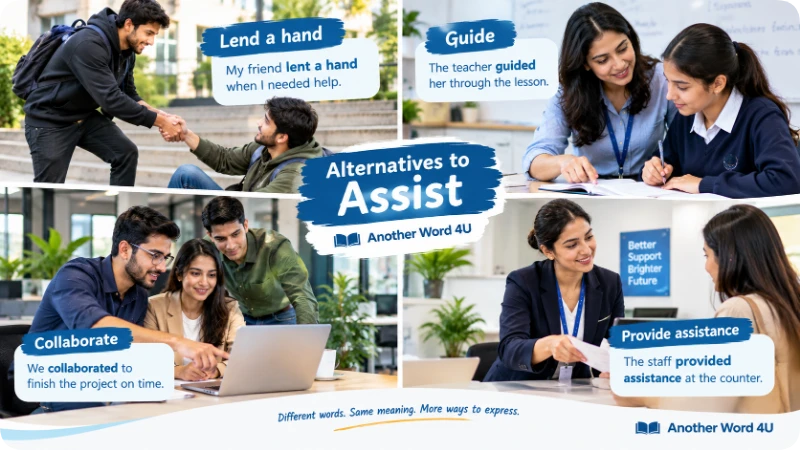
| If you mean… | Use… |
|---|---|
| General everyday help | Help — broad, natural, and widely understood. |
| Ongoing encouragement or resources | Support — emphasizes continued backing or assistance. |
| Formal or official help | Aid — common in formal and humanitarian contexts. |
| Making a process easier | Facilitate — focuses on enabling a process to proceed smoothly. |
| Showing someone how to proceed | Guide — emphasizes direction or instruction. |
| Working together | Collaborate — highlights joint effort rather than one-sided help. |
| Giving advice | Advise — specifically involves recommendations or guidance. |
| Casual physical help | Lend a hand — friendly and conversational. |
| Group participation | Pitch in — suggests everyone contributes to the work. |
| Making something possible | Enable — focuses on creating conditions for an action or result. |
| Developing someone’s skills | Mentor — implies guidance and development over time. |
| Professional assistance | Be of assistance — polite and formal. |
How to Choose the Right Synonym for Assist
Start by asking what kind of help is actually being provided.
If someone is simply helping with a task, help is usually the clearest choice. If they provide encouragement, resources, or continued backing, support may be more precise.
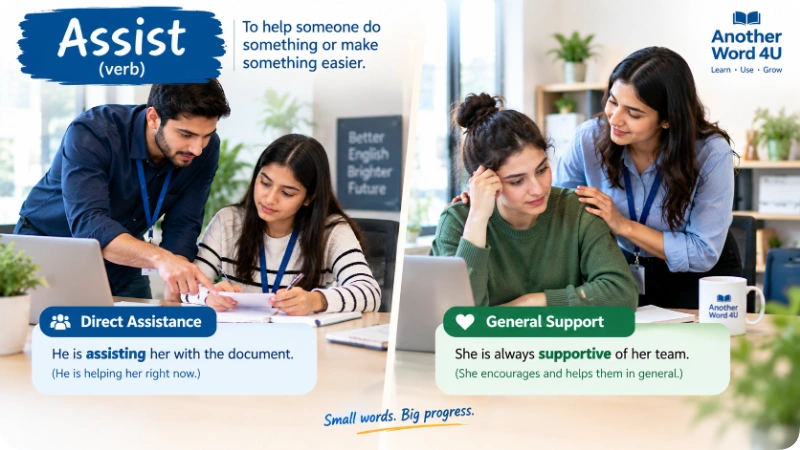
Next, consider formality. In everyday conversation, “Can you help me?” sounds more natural than “Can you assist me?” In a business, institutional, or service setting, assist and aid can fit comfortably.
Think about intensity and involvement too. Someone who gives directions may guide you, while someone who works alongside you may collaborate with you. Someone who gives professional recommendations may advise you.
Finally, consider your audience. Informal expressions such as lend a hand and pitch in work well with friends and coworkers in casual situations. More formal phrases such as provide assistance may be appropriate in official communication.
Real-Life Examples
Everyday conversation:
“Can you help me carry these groceries?”
Here, help is more natural than the formal-sounding assist.
Customer service:
“Our staff can assist you with your reservation.”
Assist fits the professional service context.
Business writing:
“The consultant assisted the company in developing a new procedure.”
The formal tone makes assistance suitable.
Giving directions:
“The volunteer guided visitors through the museum.”
A guide is more precise because the person is showing others where to go.
Teamwork:
“The marketing and design teams collaborated on the campaign.”
Collaborated emphasizes shared work rather than one person helping another.
Casual group work:
“Everyone pitched in to prepare the room.”
Pitch in emphasizes participation by several people.
Advice:
“The financial adviser advised the client on the available options.”
Advice is more precise when the help consists primarily of recommendations.
Skill development:
“She mentored two new employees during their first year.”
Mentoring suggests sustained guidance and professional development.
Antonyms for Assist
There is no single perfect opposite of assist in every context. The following words describe withholding help, creating difficulty, or acting independently, depending on the sentence.
| Antonym | Meaning & Example |
|---|---|
| Hinder | Make something more difficult. Poor communication hindered the project. |
| Obstruct | Block progress or action. The fallen tree obstructed the road. |
| Impede | Slow or interfere with progress. Heavy traffic impeded our journey. |
| Prevent | Stop something from happening. The safety barrier prevented access. |
| Oppose | Act against someone or something. Several members opposed the proposal. |
| Abandon | Leave without continued support. The organization did not abandon the affected families. |
| Neglect | Fail to give needed attention or care. The manager neglected the employee’s request. |
These are not interchangeable opposites in every sentence. For example, hinder is the clearest opposite when the idea is making a task harder, while oppose describes active resistance.
Words That Are Easy to Confuse With Assist
Help
Help and assist are very close, but help is generally broader and more common in everyday English.
- “Can you help me move this chair?”
- “Can you assist me with this application?”
Both can be correct, but the second has a more formal tone.
Facilitate
Facilitate does not simply mean “help” in every situation. It often means making a process, action, or interaction easier.
- “The moderator facilitated the discussion.”
The moderator helped the discussion happen smoothly rather than necessarily helping one participant directly.
Enable
Enabling means making something possible or giving someone the ability or opportunity to do something.
- “The new software enables employees to access the files remotely.”
The software is not necessarily assisting employees with each task; it provides the capability that makes the action possible.
When Assist Is Not the Precise Choice
Assist can be too broad when you know exactly how the help is being provided.
Use a guide when someone gives direction or shows another person how to proceed. Use advice when the assistance mainly consists of recommendations. Use support when the emphasis is on encouragement, resources, or ongoing backing.
For joint work, collaboration may be more accurate than assisting because it shows that both parties are actively working together.
In casual conversation, assist can also sound more formal than necessary. “Can you help me?” is usually more natural than “Can you assist me?” when speaking with a friend.
Similarly, facilitate is preferable when the key idea is making a process easier, while enable is appropriate when something makes an action possible.
The goal is not to replace assists every time. It is to select the word that communicates the exact relationship between the helper, the person receiving help, and the task.
Phrases, Idioms, and Expressions Related to Assist
Lend a hand
This informal expression means to help, usually with a practical task.
Example: “Could you lend a hand with these boxes?”
Give someone a hand
This is another informal way to say “help someone.”
Example: “Can you give me a hand setting up the chairs?”
Pitch in
Pitch in means to contribute effort to a shared task, especially when several people are helping.
Example: “Everyone pitched in to clean up after the event.”
Come to someone’s aid
This expression means to help someone who is experiencing difficulty or danger.
Example: “A nearby driver stopped and came to the injured cyclist’s aid.”
Do someone a favor
This means helping someone as a kindness, often with a specific request.
Example: “Could you do me a favor and send me the document?”
Be of assistance
This formal expression means to be helpful or available to help.
Example: “Please contact reception if we can be of assistance.”
Common Mistakes When Using Assist
1. Treating every alternative as an exact synonym
Words such as mentor, advise, and enable have more specific meanings. Replacing assist with one of them without checking the context can change the sentence.
2. Using “assist” when “help” sounds more natural
In casual conversation, help is usually the simpler choice.
Instead of: “Could you assist me with my bags?”
Natural everyday English: “Could you help me with my bags?”
3. Confusing “assist” with “attend”
Attend can mean being present at an event or taking care of a matter, but it is not automatically a synonym for assist.
- “She attended the meeting.” = She was present.
- “She assisted the manager.” = She helped the manager.
4. Assuming “assist” means doing everything
To assist someone means to help them; it does not necessarily mean completing the whole task for them.
Comparison of Assist and Its Alternatives
| Word | Meaning, Tone & Context |
|---|---|
| Assist | Meaning: Give help with a task or goal. Tone: Neutral to formal. Context: Work, services, general writing. |
| Help | Meaning: Give general assistance. Tone: Neutral, everyday. Context: Conversation and almost any setting. |
| Support | Meaning: Give backing, resources, or encouragement. Tone: Neutral. Context: Work, personal, social contexts. |
| Aid | Meaning: Provide needed help. Tone: Formal. Context: Official, humanitarian, medical contexts. |
| Guide | Meaning: Direct or instruct. Tone: Neutral. Context: Learning, navigation, procedures. |
| Facilitate | Meaning: Make a process easier. Tone: Formal. Context: Business, education, meetings. |
| Collaborate | Meaning: Work jointly. Tone: Neutral to formal. Context: Projects and professional work. |
| Advise | Meaning: Give recommendations. Tone: Neutral to formal. Context: Professional or decision-making contexts. |
| Lend a hand | Meaning: Give practical help. Tone: Informal. Context: Everyday conversation. |
| Mentor | Meaning: Develop someone through guidance. Tone: Neutral to professional. Context: Education and careers. |
The key distinction is that assist is broad enough to cover many forms of help, while its alternatives often tell the reader more about how the help is given.
Frequently Asked Questions About Assist
1. What is the most common synonym for assist?
Help is the most common broad alternative in everyday English. It can replace assist in many sentences, although it usually sounds less formal.
2. Is “help” or “assist” more formal?
Assist generally has a more formal or professional tone than help. However, both are standard English words and can be appropriate depending on the context.
3. What is a formal synonym for assist?
Depending on the meaning, aid, facilitate, and provide assistance can work in formal writing. The precise choice depends on whether you mean direct help, making a process easier, or formally providing support.
4. Can “support” replace “assist”?
Sometimes. Support is especially appropriate when the help involves encouragement, resources, backing, or continued assistance. It may not be the best replacement when you mean direct help with a specific task.
5. What is an informal way to say assist?
Common informal alternatives include help, lend a hand, give someone a hand, and pitch in. These expressions are especially natural in everyday conversation.
Final Thoughts
Assist is a useful, flexible word for describing help, particularly in professional or formal contexts. Help is usually the simplest everyday alternative, while support, aid, guide, facilitate, advise, collaborate, and informal expressions such as lend a hand communicate more specific meanings.
Choose the alternative that best matches the meaning, tone, context, and audience rather than replacing assist automatically.