
“I need to decline the invitation, but I don’t want my message to sound rude.” In situations like this, choosing another word for decline can make a sentence clearer and more natural.
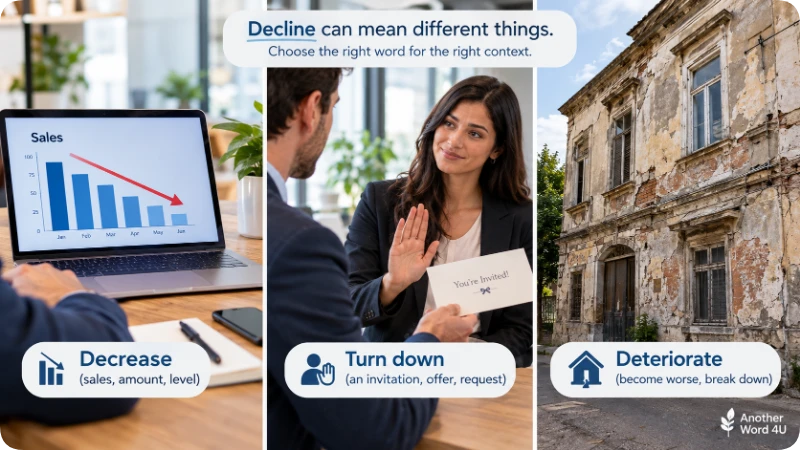
Decline can describe refusing something, becoming less, or losing strength, so the best alternative depends on what you mean. In a polite email, refuse or turn down may fit when you mean saying no to an offer or request. In a discussion about numbers, decrease or fall may be more precise.
When talking about health, strength, or quality, weakness or deterioration may communicate a different idea. Learning these distinctions helps you avoid using synonyms that look similar but do not work in the same sentence.
This guide explains the meanings of decline, useful alternatives, differences in tone and intensity, common phrases, and examples so you can choose the right word confidently in everyday conversation, schoolwork, and professional writing.
Featured Snippet
A synonym for decline depends on its meaning. For refusing, use refuse, reject, turn down, or deny. For becoming less, use decrease, fall, drop, lessen, or diminish. For worsening, deteriorate or weaken may be more precise. The context determines the best choice.
What Does Decline Mean?

Decline has two major uses.
First, it can mean to politely or formally refuse something.
- She declined the invitation.
- He declined the offer.
- I had to decline their request.
In this sense, decline is often more polite or formal than simply saying refuse. It can sound especially natural in professional communication.
Second, decline can mean to become lower, smaller, weaker, or worse.
- Sales began to decline in January.
- His energy declined after several hours.
- The quality of the service has declined.
The exact alternative depends on what is becoming lower or worse. Decrease often describes quantity, while fall is common for numbers or levels. Deteriorate specifically emphasizes becoming worse in condition or quality.
There is also a related noun use: a decline in sales, a decline in health, or a decline in quality. In each case, the surrounding context determines the most precise replacement.
Another Word for Decline
The best alternative depends on what decline means in your sentence. It can mean refusing something, becoming lower, becoming weaker, or getting worse in condition or quality.
Decline Meaning Refuse
When decline means to politely refuse an offer, invitation, request, or opportunity, words such as refuse, reject, and turn down are more appropriate.
| Word | Type | Simple Meaning |
|---|---|---|
| Refuse | Synonym | Say no to something |
| Reject | Near-synonym | Refuse to accept something |
| Turn down | Informal phrase | Refuse an offer or request |
| Deny | Context-specific | Refuse to grant or allow |
| Say no to | Informal phrase | Refuse something |
| Pass up | Informal phrase | Choose not to accept an opportunity |
For example, “She declined the invitation” can become “She turned down the invitation.” However, decrease would not work because it describes becoming less, not refusing something.
Decline Meaning Decrease
When decline means that an amount, level, number, or value becomes lower, several alternatives can work.
| Word | Type | Simple Meaning |
|---|---|---|
| Decrease | Synonym | Become or make less |
| Fall | Synonym | Become lower |
| Drop | Informal synonym | Decrease noticeably |
| Diminish | Formal synonym | Become smaller or weaker |
| Lessen | Synonym | Become or make less |
| Dwindle | Context-specific | Become gradually smaller |
| Go down | Informal phrase | Become lower |
| Slump | Context-specific | Experience a noticeable decrease |
For example, “Sales declined” can become “Sales fell” or “Sales decreased.” Dwindle is more suitable when something gradually becomes smaller, while slump often suggests a noticeable or significant decrease.
Decline Meaning Become Worse
Sometimes decline describes a deterioration in quality, condition, strength, or performance.
| Word | Type | Simple Meaning |
|---|---|---|
| Deteriorate | Near-synonym | Become worse in condition |
| Worsen | Synonym | Become worse |
| Weaken | Near-synonym | Become less strong |
| Degenerate | Formal | Become worse in quality or condition |
| Devalue | Context-specific | Lose financial or perceived value |
For example, “The building declined over time” may be expressed more precisely as “The building deteriorated over time.” Similarly, weaken is useful when something loses strength rather than simply becoming smaller.
Decline Meaning Become Less Intense
Some alternatives are specifically used when an activity, feeling, sound, storm, or other condition becomes less intense.
| Word | Type | Simple Meaning |
|---|---|---|
| Recede | Context-specific | Move or become farther back |
| Subside | Context-specific | Become less intense |
| Abate | Formal | Become less strong or intense |
| Taper off | Phrase | Gradually become less |
For example, “The noise declined” could become “The noise subsided.” For a storm, abate is a more formal choice, while taper off emphasizes a gradual reduction.
Other Context-Specific Alternatives
Some words describe particular kinds of decline and should not be treated as universal synonyms.
| Word | Type | Simple Meaning |
|---|---|---|
| Sink | Context-specific | Move to a lower level |
| Lose ground | Idiomatic phrase | Become less successful or competitive |
For example, “The company lost ground to its competitors” means that its competitive position became weaker. Sink can describe something moving to a lower physical or numerical level, such as a temperature.
How to Choose the Right Alternative
The correct alternative depends on the meaning of decline in your sentence.
- Use refuse when someone says no to something.
- Use reject when something is not accepted.
- Use turn down for an offer, request, invitation, or opportunity.
- Use decrease for a general reduction in amount or level.
- Use fall when a number, price, temperature, or level becomes lower.
- Use dwindle for something that gradually becomes smaller.
- Use deteriorate when a condition becomes worse.
- Use weaken when strength or power decreases.
- Use subside when something becomes less intense.
- Use lose ground when someone or something becomes less successful or competitive.
Decline vs. Similar Words
Not every alternative can replace decline in every sentence. Declining an invitation can mean turning down an invitation, but decreasing an invitation is incorrect. Likewise, sales declined can become sales fell, but sales refused completely changes the meaning.
The key is to identify whether decline means refuse, decrease, worsen, weaken, or become less intense before choosing an alternative.
Best Synonym by Context
| If you mean… | Use… | Why |
|---|---|---|
| Politely refusing an offer | Decline / turn down | Both mean saying no; decline is more formal |
| Strong refusal | Refuse | Clearly shows unwillingness to accept or do something |
| Rejecting a proposal | Reject | Means deciding something is unacceptable or unsuitable |
| A lower number | Decrease / fall | Natural for amounts, rates, prices, and statistics |
| A sudden lower amount | Drop | Conversational; often suggests a noticeable decrease |
| A gradual reduction | Diminish / dwindle | Emphasizes becoming smaller over time |
| Worse quality or condition | Deteriorate | Focuses on worsening condition |
| Lower intensity | Subside / abate | Useful for pain, noise, storms, or tension |
| Reduced strength | Weaken | Focuses on loss of strength or effectiveness |
| Reduced success | Lose ground / slump | Describes declining performance or position |
How to Choose the Right Synonym for Decline
Start by identifying which meaning of decline you need.
1. Ask if you mean “say no.”
If someone refuses an invitation, request, offer, or opportunity, consider refusing, turn down, rejecting, or denying. The choice depends on what is being refused and how formal the sentence should sound.
2. Identify what is becoming lower.
For numbers, prices, temperatures, or rates, decrease, fall, and drop are usually clearer.
3. Consider if something is becoming worse.
Use deteriorates or worsens when the important idea is a decline in condition or quality.
4. Consider intensity.
If pain, noise, tension, or a storm becomes less intense, subside or abate may be more precise than general words such as decrease.
5. Match the tone to your audience.
Turn down and go down are conversational. Decline, diminish, and deteriorate are more common in formal or professional writing.
6. Check if the change is gradual or sudden.
Dwindle and taper off suggest gradual reduction, while drop can describe a more noticeable or sudden decrease.
Real-Life Examples
Polite communication:
“I’m sorry, but I’ll have to decline the invitation.”
Here, decline sounds courteous and professional.
Casual conversation:
“I turned down the job because the schedule didn’t work for me.”
Turn down is natural in everyday speech.
Business writing:
“Customer demand decreased during the second quarter.”
Decrease works well for measurable quantities.
News or general writing:
“Temperatures fell sharply overnight.”
Fall is a natural choice for temperatures and levels.
Quality or condition:
“The condition of the old road has deteriorated.”
Deteriorated indicates worsening condition rather than simply a lower number.
Gradual reduction:
“Interest in the program gradually dwindled.”
Dwindled suggests a gradual loss.
Reduced intensity:
“The pain eventually subsided.”
Subsidising means the intensity becomes lower.
Competitive position:
“The team began to lose ground after several defeats.”
This expression focuses on reduced advantage or progress.
Antonyms for Decline
The correct opposite depends on which meaning of decline you are using.
| Antonym | Meaning | Example |
|---|---|---|
| Accept | Agree to receive or take something | She accepted the invitation. |
| Approve | Officially agree to something | The board approved the proposal. |
| Increase | Become greater in amount | Sales increased this month. |
| Rise | Move to a higher level | Temperatures rose quickly. |
| Improve | Become better | His condition improved. |
| Strengthen | Become stronger | The signal strengthened after the adjustment. |
| Grow | Become larger or greater | Demand continues to grow. |
| Advance | Move forward or make progress | The project advanced quickly. |
Accept and approve oppose the refusal sense, while increase, rise, and improve oppose different forms of the decrease or worsening sense.
Words That Are Easy to Confuse With Decline
Decrease
Decrease specifically focuses on becoming smaller or lower in amount, number, degree, or size. It does not normally mean politely refusing something.
Example: “The number of visitors decreased in winter.”
Reject
Reject means to refuse to accept, approve, or consider something. It can sound stronger than decline.
Example: “The editor rejected the article because it did not meet the requirements.”
Deteriorate
Deteriorate means to become worse in condition or quality. It is not a general substitute for every use of decline.
Example: “The patient’s condition deteriorated overnight.”
When Decline Is Not the Precise Choice
Decline is useful because it covers several meanings, but that flexibility can make it less precise.
If you are discussing a measurable number, decrease, fall, or drop may tell the reader exactly what happened.
If something becomes physically or materially worse, deterioration may be clearer.
If a person refuses something in casual conversation, a turn down can sound more natural than a formal decline.
If a reduction happens slowly and continuously, dwindle or taper off may provide more detail.
If something becomes less intense rather than simply smaller, subside or abate may be a better choice.
The goal is not to replace decline every time. Use it when it communicates the intended meaning naturally; switch to another word when that word expresses the specific idea more clearly.
Phrases, Idioms, and Expressions Related to Decline
Turn down
A common phrase meaning to refuse an offer, request, invitation, or opportunity.
Example: “She turned down the invitation because she was busy.”
Lose ground
An idiomatic expression meaning to become less successful or fall behind.
Example: “The company is losing ground to its competitors.”
Taper off
A phrase meaning to gradually become less in amount, strength, or activity.
Example: “The conversation tapered off as everyone became tired.”
Go down
An informal expression meaning to become lower.
Example: “Gas prices went down last week.”
On the decline
A phrase meaning that something is becoming less common, successful, strong, or important.
Example: “Traditional paper maps are on the decline.”
Take a downturn
An expression commonly used for a period when economic activity, business performance, or another measurable situation becomes worse.
Example: “The industry took a downturn after demand weakened.”
Common Mistakes When Using Decline
Mistake 1: Treating every use of decline as a synonym for decrease.
Decline can mean refusal as well as reduction. “She declined the offer” means she refused it, not that the offer became smaller.
Mistake 2: Using refuse when the intended tone is very polite.
“Refuse” is correct in many situations, but decline can sound more tactful in professional communication.
Mistake 3: Using decrease for worsening quality.
“The building decreased” is usually unnatural when you mean its condition became worse. Deteriorated is more precise.
Mistake 4: Assuming reject and decline always have identical force.
Reject can emphasize that something was judged unacceptable, unsuitable, or unwanted. Decline often sounds more neutral when someone simply says no.
Comparison of Decline and Its Alternatives
| Word | Main Meaning | Tone | Typical Context |
|---|---|---|---|
| Decline | Refuse or become less | Neutral/formal | Offers, requests, numbers, conditions |
| Refuse | Say no | Neutral; sometimes firm | Requests, demands, offers |
| Reject | Refuse to accept or approve | Neutral to firm | Proposals, applications, ideas |
| Turn down | Refuse | Informal | Invitations, jobs, offers |
| Decrease | Become less | Neutral/formal | Numbers, amounts, rates |
| Fall | Become lower | Neutral | Prices, temperatures, levels |
| Diminish | Become smaller or weaker | Formal | Importance, strength, effects |
| Deteriorate | Become worse | Formal | Health, quality, condition |
| Weaken | Lose strength | Neutral | Signals, forces, arguments |
| Subside | Become less intense | Neutral/formal | Pain, storms, noise, tension |
The important distinction is that these words overlap only in particular contexts. Decline is broad, while alternatives often identify the exact kind of reduction, refusal, or worsening involved.
Frequently Asked Questions About Decline
1. What is the most common synonym for decline?
There is no single synonym that works in every context. Refuse is useful when decline means saying no, while decrease or fall works when it means becoming lower.
2. Is decline a formal word?
Yes. Decline can sound polite and moderately formal when it means refusing something. It is also common in formal and general writing when describing reductions or worsening conditions.
3. What is a synonym for decline in numbers?
Decrease, fall, and drop are common choices. Decrease is neutral and precise, fall is widely used for levels and statistics, and drop can suggest a noticeable reduction.
4. What is the difference between decline and reject?
Decline often means politely choosing not to accept something. Reject can emphasize that something has been judged unacceptable, unsuitable, or unwanted.
5. What is the opposite of decline?
It depends on the meaning. Accept or approve can oppose the refusal sense, while increase, rise, improve, or strengthen can oppose different meanings involving reduction or worsening.
Final Thoughts
The best decline synonym depends on what you are trying to express. Use refuse or turn down for saying no, decrease, fall, or drop for lower amounts, and deteriorate or worsen for declining condition. Always consider meaning, tone, intensity, context, and audience before choosing an alternative.