
You may write, “Our team is diverse,” but sometimes that word does not quite express what you mean. Perhaps you want to highlight variety, different backgrounds, a wide range of choices, or something made up of many distinct parts.
In those situations, finding another word for diverse can make your sentence more precise and natural. The right alternative depends on what is varied and why the difference matters. For example, varied works well for a range of options, while multicultural focuses on different cultural backgrounds.
Diverse is a flexible word, but it is not interchangeable with every related term. A synonym should match the meaning, tone, and context of your sentence. This guide explains alternatives, from everyday choices such as varied and different to more specific words such as inclusive, multicultural, heterogeneous, and eclectic.
You will also see examples, common mistakes, antonyms, phrases, and tips for choosing the right word.
Featured Snippet
Useful synonyms for diverse include varied, different, assorted, multifaceted, multicultural, inclusive, heterogeneous, and eclectic. The best choice depends on context: varied suits options or experiences, multicultural suits cultures, inclusive emphasizes representation or participation, and heterogeneous describes a mixture of unlike elements.
What Does Diverse Mean?

Diverse means consisting of different kinds of people, things, qualities, or elements rather than being uniform or all the same.
For example:
- “The city has a diverse population.”
- “The store offers a diverse range of products.”
- “She has diverse interests, from music to science.”
The word is broad, so its exact meaning depends on the noun it describes.
When talking about people or groups, diverse often refers to differences in backgrounds, cultures, identities, experiences, perspectives, or other characteristics.
“The company has a diverse workforce.”
Here, diversity suggests that the workforce includes people with different backgrounds or characteristics. It does not specify exactly which differences are meant.
When talking about things, diverse often means varied or made up of several different types.
“The museum has a diverse collection of paintings.”
In this sentence, varied or wide-ranging may be more precise if the main idea is simply that the collection contains many different kinds of works.
Diverse is generally neutral and widely used in everyday, academic, professional, and social contexts. Because it can cover many kinds of differences, a more specific alternative is sometimes clearer.
Another Word for Diverse
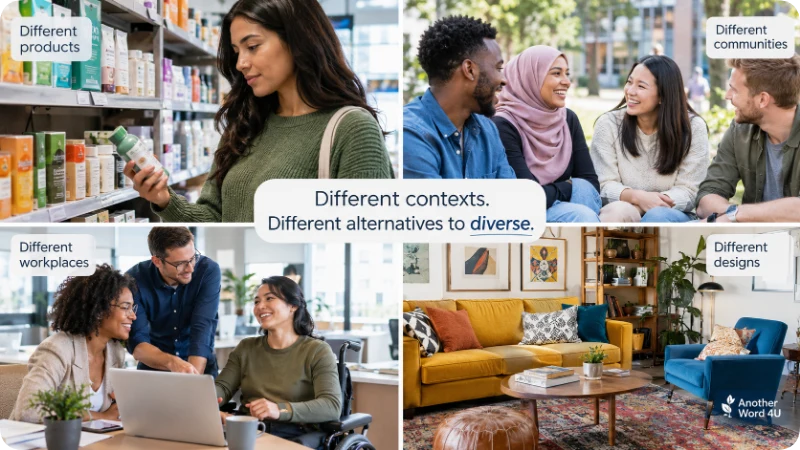
The best alternative depends on exactly what you want to emphasize. Diverse can describe different types, people, cultures, ideas, styles, or characteristics. Some alternatives are broad synonyms, while others work only in specific contexts.
Common Alternatives for Diverse
| Word | Type | Simple Meaning |
|---|---|---|
| Varied | Synonym | Including different types |
| Different | Near-synonym | Not the same |
| Assorted | Synonym | A mixture of different kinds |
| Various | Synonym | Several different kinds |
| Mixed | Everyday | Containing different types |
| Multifaceted | Near-synonym | Having many different aspects |
| Wide-ranging | Near-synonym | Covering many types or areas |
| Manifold | Formal | Existing in many forms |
These words are useful when diverse simply means that something contains several different types, qualities, or aspects.
Diverse Meaning Different People or Cultures
Some alternatives are more specific when diverse describes people, communities, or cultural backgrounds.
| Word | Type | Simple Meaning |
|---|---|---|
| Inclusive | Context-specific | Welcoming or involving different people |
| Multicultural | Context-specific | Involving multiple cultures |
| Pluralistic | Formal | Containing or accepting multiple groups or views |
| All walks of life | Expression | People from many backgrounds |
For example, a multicultural neighborhood includes people or influences from multiple cultures. An inclusive workplace focuses on welcoming and involving people with different backgrounds or characteristics.
Diverse Meaning Different Styles or Sources
Some words work especially well when describing a combination of styles, influences, patterns, or sources.
| Word | Type | Simple Meaning |
|---|---|---|
| Eclectic | Context-specific | Combining varied styles or sources |
| Variegated | Formal/literary | Showing different types or patterns |
| Disparate | Formal | Very different from one another |
| Heterogeneous | Formal | Made up of unlike elements |
For example, eclectic is often used for music, art, fashion, or design that combines different influences. Heterogeneous is more technical and describes a mixture of unlike elements.
Alternatives Meaning a Wide Range
When diverse emphasizes breadth or the number of available types, these expressions may be more natural.
| Word or Phrase | Type | Simple Meaning |
|---|---|---|
| Broad | Context-specific | Covering many areas or types |
| Wide | Context-specific | Covering many choices or categories |
| Comprehensive | Near-synonym | Covering many relevant areas |
| Numerous | Near-synonym | Existing in large numbers |
| A range of | Phrase | Several different types or options |
| Wide variety of | Phrase | Many different kinds |
| Assortment of | Phrase | A collection of different things |
| A broad spectrum of | Phrase | A wide range of types or positions |
For example, “a diverse selection of products” can become “a wide variety of products.” However, comprehensive usually means complete or thorough rather than simply different.
Informal and Idiomatic Alternatives
Some expressions can communicate the idea of diversity in a more conversational way.
| Expression | Type | Simple Meaning |
|---|---|---|
| Mixed bag | Idiom | A combination of different things |
| All walks of life | Expression | People from many backgrounds |
| A wide variety of | Phrase | Many different kinds |
For example, “The results were a mixed bag” means the results contained a mixture of positive and negative outcomes. It does not simply mean that the results were diverse.
How to Choose the Right Alternative
The best alternative depends on what diverse describes and which aspect you want to emphasize.
- Use varied for different types, subjects, or features.
- Use various for several different options or kinds.
- Use assorted for a mixture of different items.
- Use multifaceted for something with many aspects.
- Use inclusive when emphasizing the involvement or welcome of different people.
- Use multicultural when specifically discussing multiple cultures.
- Use eclectic for a mixture of styles or influences.
- Use heterogeneous in formal or technical contexts for unlike elements.
- Use wide-ranging when something covers many subjects or areas.
- Use comprehensive when emphasizing broad or complete coverage.
- Use disparate when emphasizing that things are strongly different from one another.
Diverse vs. Similar Words
Not every alternative can replace diverse in every sentence. Multicultural specifically relates to multiple cultures, while inclusive focuses more on welcoming or involving different people. Eclectic usually describes a mixture of styles or influences, whereas heterogeneous is more formal and emphasizes unlike elements.
Choosing the right alternative means considering both the meaning of diverse and the context in which it is used.
Best Synonym by Context
| If you mean… | Use… | Why |
|---|---|---|
| Many different options | Varied / various | Describes different choices, subjects, or possibilities |
| Different cultures | Multicultural | Directly identifies cultural variety |
| Different people or backgrounds | Diverse | Broad term when differences are not specified |
| Welcoming different groups | Inclusive | Emphasizes participation and belonging |
| Many different aspects | Multifaceted | Highlights complexity and multiple dimensions |
| Very different elements | Heterogeneous | Precise and more formal |
| Different styles combined | Eclectic | Suggests a deliberate mix of styles or influences |
| Many areas or subjects | Wide-ranging | Emphasizes breadth of coverage or interest |
| Different things collected together | Assorted | Works well for products, objects, or collections |
| Different opinions or positions | Broad spectrum | Emphasizes a range of viewpoints |
How to Choose the Right Synonym for Diverse
Start by asking what is different.
If you are describing choices, products, subjects, or experiences, varied, various, or wide-ranging will often sound natural. If you are describing cultures, multicultural is more precise.
Next, consider the main idea behind the difference. If the point is that people are welcomed and represented, inclusive may communicate more than diverse. If something has several important dimensions, multifaceted is usually more accurate.
Think about formality, too. In everyday writing, words such as varied, mixed, and different are easy to understand. In academic or technical writing, heterogeneous, disparate, or multifaceted may be appropriate when their meanings fit.
Finally, check the strength and implication of the alternative. “Different” simply states that things are not the same. “Eclectic” can suggest a distinctive combination of styles or influences. “Inclusive” says more about participation than variety.
Real-Life Examples
Everyday conversation:
“The menu has a varied selection of vegetarian dishes.”
Here, varied is more natural than diverse because the sentence focuses on different food choices.
Workplace writing:
“We want to build a diverse team with people from different backgrounds and experiences.”
Diverse works well because the sentence concerns differences among people.
Education:
“The teacher uses varied activities to keep students engaged.”
Varied emphasizes different types of classroom activities.
Culture:
“Toronto is known for its multicultural communities.”
Multicultural is more specific because culture is the focus.
Academic writing:
“The researchers studied a heterogeneous group with several distinct characteristics.”
Heterogeneous gives the sentence a formal, technical tone.
Design and fashion:
“Her home has an eclectic style that combines modern and traditional pieces.”
Eclectic is useful when different influences are deliberately combined.
Business:
“The company serves a wide range of customers.”
This phrase emphasizes breadth rather than simply saying customers are diverse.
Antonyms for Diverse
| Antonym | Meaning | Example |
|---|---|---|
| Uniform | All the same or consistent | The uniforms were identical and uniform in appearance. |
| Homogeneous | Consisting of similar elements | The group was relatively homogeneous. |
| Similar | Alike in important ways | The two products are quite similar. |
| Identical | Exactly the same | The two designs are identical. |
| Consistent | Remaining the same in character or quality | The results were consistent across the tests. |
| Monolithic | Appearing as one undifferentiated group | The audience was not a monolithic group. |
Some antonyms depend on context. Homogeneous is a particularly direct opposite when diverse means “made up of different kinds of elements.” Uniform works better when the emphasis is on sameness or consistency.
Words That Are Easy to Confuse With Diverse
Inclusive
Inclusive and diverse are related but not identical. Diverse describes variety; inclusive describes an environment or approach that welcomes or involves different people.
“The organization has a diverse membership and an inclusive culture.”
Multicultural
Multiculturalism is more specific than diverse. It concerns multiple cultures rather than every possible kind of difference.
“The school serves a multicultural community.”
Various
Various often means several different or separate things. It works especially well with options, examples, reasons, and categories.
“We discussed various ways to reduce costs.”
When Diverse Is Not the Precise Choice
Diverse can be too broad when your sentence needs to identify the specific type of difference.
For cultural differences, multicultural may be clearer:
Broad: “It is a diverse neighborhood.”
More specific: “It is a multicultural neighborhood.”
When you mean that a person or organization welcomes participation from different groups, inclusive may communicate the intended idea better.
When you mean many subjects, options, or activities, varied is often simpler:
“The workshop includes varied activities.”
When the subject contains several distinct dimensions, multifaceted may be more precise:
“Climate policy is a multifaceted issue.”
In technical writing, heterogeneity can be preferable when the subject consists of unlike components. The key is not to replace diverse automatically, but to identify the exact relationship you want to describe.
Phrases, Idioms, and Expressions Related to Diverse
A wide range of
This means many different types or options.
“The library offers a wide range of books.”
A wide variety of
This emphasizes many different kinds of things.
“The store sells a wide variety of household products.”
A broad spectrum of
This describes a broad range, often of opinions, characteristics, or positions.
“The discussion included a broad spectrum of viewpoints.”
All walks of life
This expression refers to people from many different social, professional, or personal backgrounds.
“The festival attracted people from all walks of life.”
Mixed bag
This informal idiom describes a combination of different things, often with both positive and negative aspects.
“The new features are a mixed bag.”
Assortment of
This phrase describes a collection containing different kinds of things.
“The gift box contained an assortment of chocolates.”
These expressions are related to the idea of variety, but they are not interchangeable single-word synonyms for diverse.
Common Mistakes When Using Diverse
1. Treating every related word as an exact synonym
Inclusive, multicultural, and varied overlap with diverse but emphasize different ideas. Choose the word that matches your intended meaning.
2. Using multicultural for every kind of difference
Multiculturalism specifically relates to multiple cultures. It is not a general replacement for diverse.
3. Using diverse when you only mean numerous
A large number does not automatically mean diversity.
Less precise: “The report contains diverse examples” when the examples are simply numerous.
Better: “The report contains numerous examples.”
4. Assuming different always sounds interchangeable
Different simply means not the same. It does not necessarily communicate the positive, broad, or inclusive associations that diverse may carry in some contexts.
Comparison of Diverse and Its Alternatives
| Word | Main Meaning | Tone | Best Context |
|---|---|---|---|
| Diverse | Containing meaningful differences or variety | Neutral | People, groups, collections, subjects |
| Varied | Including different types | Neutral | Activities, choices, experiences |
| Various | Several different kinds | Neutral | Options, reasons, examples |
| Inclusive | Welcoming or involving different people | Positive/neutral | Organizations, policies, environments |
| Multicultural | Involving multiple cultures | Neutral | Communities, schools, societies |
| Multifaceted | Having many aspects | Formal | Problems, issues, subjects |
| Heterogeneous | Made of unlike elements | Formal/technical | Groups, samples, mixtures |
| Eclectic | Combining different styles or influences | Neutral/positive | Art, fashion, taste, design |
| Different | Not the same | Everyday | General comparisons |
| Wide-ranging | Covering many areas or types | Neutral/formal | Research, interests, discussions |
The central distinction is specificity. Diverse is broad, while alternatives often tell the reader exactly what kind of variety is being discussed.
Frequently Asked Questions About Diverse
1. What is the best synonym for diverse?
There is no single best synonym for every sentence. Varied is useful for things such as activities or choices, while multicultural is more precise for cultures and inclusive emphasizes participation and belonging.
2. Is varied the same as diverse?
They overlap, but they are not identical in every context. Varied usually emphasizes different types, qualities, or options. Diverse can describe variety among people, backgrounds, perspectives, things, or characteristics.
3. Is inclusive a synonym for diverse?
Not exactly. Diverse describes the presence of differences, while inclusive describes an approach or environment that welcomes or involves different people. A workplace can be diverse without necessarily being described as inclusive.
4. What is the opposite of diverse?
Depending on context, useful opposites include uniform, homogeneous, similar, and identical. Homogeneous is especially suitable when describing a group or collection made up of similar elements.
5. Can diverse be used for people and things?
Yes. Diverse can describe people, groups, communities, opinions, interests, collections, products, subjects, and experiences. The intended meaning becomes clearer from the noun and surrounding context.
Final Thoughts
Diverse is a broad and flexible word, but a more specific alternative can make your writing clearer.
Use varied for different options or activities, multicultural for cultural differences, inclusive for participation and belonging, multifaceted for multiple aspects, and eclectic for mixed styles or influences.
Always choose according to meaning, tone, context, and audience.