You may write, “This is the final version,” and then wonder if another word would sound clearer or more professional. The best final synonym depends on what you mean. If you are talking about the last item in a sequence, “last” is usually the simplest choice.
If you mean a decision that cannot be changed, “definitive” or “conclusive” may be more precise. In formal writing, “ultimate” can work in some contexts, while “closing” fits events, stages, or remarks.
Choosing the right alternative is not about avoiding repetition. Small differences in meaning, tone, and strength can change how your sentence sounds.
This guide explains useful synonyms and alternatives for “final,” shows when each one fits, and gives practical examples for everyday, academic, and professional writing.
You will also learn which words are genuine substitutes, which are only near-synonyms, and when “final” itself remains the clearest choice for your reader and situation.
Quick Answer
A useful synonym for “final” is “last” when you mean the end of a sequence. “Definitive” suggests an authoritative, settled answer, while “conclusive” means providing a firm decision or result. “Ultimate” can mean greatest or most important, and “closing” works well for the end of an event or stage.
What Does Final Mean?
Final usually means last in a series, sequence, process, or period. It indicates that nothing follows it within the relevant situation.
- This is the final chapter of the book.
- She submitted the final report on Friday.
- The final train leaves at 11 p.m.
Final can also mean settled, conclusive, or not intended to be changed.
- The committee made its final decision.
- Please check the document before giving your final approval.
In these examples, final is stronger than simply saying something happened last. A final decision is generally understood as a decision that has been settled.
As a noun, final can also refer to the last examination or competition in a series, as in “She studied for her final” or “The teams reached the final.” However, when looking for alternatives, the exact meaning and grammatical role matter.
Another Word for Final
The best alternative depends on if final means last, concluding, settled, ultimate, or something similar.
| # | Word | Meaning & Example |
|---|---|---|
| 1 | Last | Synonym: Coming after everything else.Example: This is the last page of the book. |
| 2 | Concluding | Near-synonym: Bringing something to an end.Example: She gave the concluding remarks. |
| 3 | Closing | Near-synonym: Happening at the end.Example: He delivered the closing speech. |
| 4 | Ultimate | Near-synonym: Greatest, most important, or furthest.Example: Their ultimate goal is independence. |
| 5 | Definitive | Near-synonym: Authoritative and settled.Example: The study provides a definitive answer. |
| 6 | Conclusive | Near-synonym: Providing a firm result or decision.Example: The evidence was conclusive. |
| 7 | Terminal | Context-specific: Marking an endpoint.Example: The terminal stage requires careful planning. |
| 8 | Ending | Noun/alternative: The part where something finishes.Example: I liked the ending of the story. |
| 9 | Finishing | Context-specific: Bringing something to completion.Example: We are in the finishing stage of the project. |
| 10 | Completed | Near-synonym: Fully finished.Example: The completed report is ready for review. |
| 11 | Complete | Near-synonym: Having nothing necessary left to add.Example: The application is complete. |
| 12 | Settled | Context-specific: Decided and no longer open.Example: The matter is now settled. |
| 13 | Decisive | Near-synonym: Producing or determining a result.Example: The final goal was decisive. |
| 14 | Conclusive | Formal: Firmly resolving an issue.Example: The test produced conclusive evidence. |
| 15 | Permanent | Context-specific: Intended to remain unchanged.Example: This is a permanent arrangement. |
| 16 | Irrevocable | Formal: Impossible to reverse.Example: The agreement became irrevocable after signing. |
| 17 | Definite | Near-synonym: Clear, certain, or fixed.Example: We need a definite answer. |
| 18 | Lasting | Near-synonym: Continuing for a long time.Example: They wanted a lasting solution. |
| 19 | Wrap-up | Informal: The final part or conclusion.Example: Let’s have a quick wrap-up before we leave. |
| 20 | Bottom-line | Informal/context-specific: The essential final point.Example: The bottom-line message is simple. |
Not every choice above can replace final in every sentence. For example, last is usually best for sequence, while definitive is better when emphasizing authority or certainty.
Best Synonym by Context
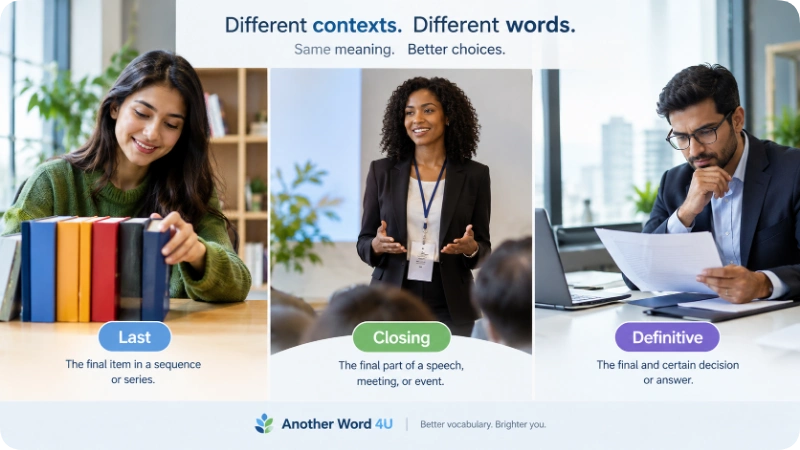
| If you mean… | Use… | Why |
|---|---|---|
| Comes after all others | Last | The simplest, most natural choice for sequence. |
| End of a speech or event | Closing | Describes something that brings an event to an end. |
| Last part of a discussion or process | Concluding | Emphasizes completion or bringing something to a close. |
| An authoritative answer | Definitive | Suggests a trusted or settled answer. |
| Evidence that settles an issue | Conclusive | Shows that the evidence establishes a firm result. |
| Greatest or most important | Ultimate | Describes the highest or most important point. |
| Decision that cannot easily be changed | Definitive or Settled | Both emphasize resolution, depending on context. |
| An irreversible action | Irrevocable | Specifically means impossible to reverse. |
| Project that is fully finished | Complete | Focuses on finished status rather than sequence. |
| Casual final discussion | Wrap-up | Natural for informal conversation. |
How to Choose the Right Synonym for Final
Start by asking what final means in your sentence.
1. Is it about order?
Choose last when something simply comes after everything else. The last question was difficult and is more natural than using a stronger word such as definitive.
2. Is it about ending an activity?
Use closing or concluding for speeches, ceremonies, statements, sections, or stages.
3. Is it about certainty?
Choose definitive, conclusive, or settled when the important idea is that an issue has been resolved.
4. Is it about importance or highest level?
Ultimate may be appropriate when final means the greatest, most important, or highest possible point.
5. Is the decision reversible?
If you specifically mean that something cannot be reversed, irrevocable is more precise than final.
Also consider your audience. Last and complete are straightforward for everyday writing. Definitive, conclusive, and irrevocable are more formal and may suit academic, legal, or professional contexts.
Real-Life Examples

Everyday conversation:
“I read the last chapter last night.”
Here, last simply identifies the final chapter in a sequence.
School writing:
“The concluding paragraph summarizes the main argument.”
Concluding works because the paragraph brings the writing to an end.
Business:
“We need a definitive answer before moving forward.”
Definitive emphasizes certainty and authority.
Research:
“The available evidence was not conclusive.”
Here, conclusive means the evidence did not establish a firm result.
Events:
“She gave the closing remarks at the ceremony.”
Closing is natural for the part that formally ends an event.
Contracts or decisions:
“The board’s decision is final.”
In this sentence, replacing final with last would change the meaning. The point is that the decision is settled, not merely the last decision made.
Goals:
“His ultimate goal is to become a teacher.”
Here, ultimate refers to the highest or most important goal rather than something that simply occurs last.
Antonyms for Final
| Antonym | Meaning & Example |
|---|---|
| First | Meaning: Coming before all others.Example: She was the first speaker. |
| Initial | Meaning: Existing at the beginning.Example: We discussed the initial proposal. |
| Beginning | Meaning: The starting point.Example: The beginning of the project was challenging. |
| Preliminary | Meaning: Happening before the main or final stage.Example: These are preliminary findings. |
| Interim | Meaning: Temporary until a final arrangement exists.Example: He accepted an interim position. |
| Ongoing | Meaning: Still continuing.Example: The investigation is ongoing. |
| Temporary | Meaning: Intended to last for a limited time.Example: This is a temporary solution. |
These are not interchangeable opposites in every sentence. Initial is a direct contrast when discussing stages, while temporary contrasts with final only when final means permanent or settled.
Words That Are Easy to Confuse With Final
Last vs. Final
Last often describes position in a sequence, while final can also suggest completion or an irreversible decision.
- This is the last train tonight.
- The committee reached its final decision.
Ultimate vs. Final
Ultimate often means greatest, highest, or most important. It does not simply mean “last.”
- Her ultimate ambition is to become a doctor.
Definitive vs. Final
Definitive emphasizes authority, certainty, or an answer that settles a question. Final is broader.
- The final report was submitted yesterday.
- The report gave a definitive explanation.
When Final Is Not the Precise Choice
Finals can be too broad when you need to explain exactly what kind of ending or completion you mean.
Use last when the main idea is position in a sequence. Saying “the final person in line” is correct, but “the last person in line” is often more natural.
Use conclusive when discussing evidence or results. Conclusive evidence specifically means evidence strong enough to settle an issue.
Use definitive when emphasizing an authoritative answer, interpretation, or version.
Use irrevocable when the important point is that an action cannot be reversed. Not every final decision is necessarily irrevocable.
Use complete when you mean that something has all its necessary parts. A complete report does not necessarily mean it is the final report.
Phrases, Idioms, and Expressions Related to Final
| Phrase or Expression | Meaning & Example |
|---|---|
| At last | Phrase: Finally, after waiting.Example: At last, the repairs are finished. |
| In the end | Expression: Eventually or after everything is considered.Example: In the end, we chose the simpler option. |
| Last but not least | Expression: Mentioned last but still important.Example: Last but not least, thank you to our volunteers. |
| Final say | Expression: The authority to make the final decision.Example: The director has the final say. |
| Final straw | Idiom: The last problem that makes a situation unacceptable.Example: The missed deadline was the final straw. |
| Come to an end | Expression: Finish or stop.Example: The meeting came to an end at noon. |
These expressions are related to the idea of ending, completion, or decisive finality, but they are not direct one-word synonyms for final.
Common Mistakes When Using Final
1. Treating “final” and “last” as identical in every context
They overlap, but last mainly indicates position or sequence. Final can also mean settled or conclusive.
2. Using “ultimate” simply to mean “last”
Ultimate often means greatest or most important. It should not automatically replace final.
3. Using “definitive” for every completed item
A document can be the final version without being called definitive. Definitive adds the idea of authority or certainty.
4. Confusing “complete” with “final”
Something may be complete but still subject to revision. Final can indicate that the relevant process has reached its accepted endpoint.
Comparison of Final and Its Alternatives
| Word | Main Idea, Tone & Best Context |
|---|---|
| Final | Idea: Last or settled.Tone: Neutral.Best for: General use. |
| Last | Idea: Comes after all others.Tone: Neutral.Best for: Sequences and order. |
| Concluding | Idea: Brings something to an end.Tone: Neutral/formal.Best for: Writing, speeches, processes. |
| Closing | Idea: Ends an event or activity.Tone: Neutral.Best for: Events, remarks, stages. |
| Definitive | Idea: Authoritative or settled.Tone: Strong/formal.Best for: Answers, versions, explanations. |
| Conclusive | Idea: Firmly establishes a result.Tone: Strong/formal.Best for: Evidence, findings, arguments. |
| Ultimate | Idea: Greatest or most important.Tone: Strong.Best for: Goals, priorities, outcomes. |
| Complete | Idea: Fully finished.Tone: Neutral.Best for: Work, documents, tasks. |
| Irrevocable | Idea: Cannot be reversed.Tone: Very strong/formal.Best for: Decisions, actions, agreements. |
The key distinction is simple: final is the broadest term, while alternatives often add a specific shade of meaning.
Frequently Asked Questions About Final
1. What is the best synonym for final?
Last is usually the best synonym when final means the one that comes after everything else. However, definitive, conclusive, or closing may be better when the context involves certainty, evidence, or an ending event.
2. Is “last” the same as “final”?
Not always. Both can describe the end of a sequence, but final can also mean settled or conclusive. For example, the last meeting identifies position, while the final decision suggests a settled decision.
3. What is a formal synonym for final?
Definitive and conclusive are useful formal alternatives, but they have different meanings. Definitive emphasizes authority or certainty, while conclusive emphasizes evidence or a result that settles an issue.
4. What is a synonym for final in academic writing?
Depending on the sentence, concluding, definitive, conclusive, or ultimate may work. For example, concluding paragraphs is natural for an essay, while conclusive evidence is appropriate when discussing research results.
5. What is the opposite of final?
Common context-based opposites include initial, first, preliminary, ongoing, and interim. The correct opposite depends on if final means last, settled, completed, or permanent.
Final Thoughts
The best final synonym depends on the exact idea you want to express.
Choose last for sequence, closing or concluding for an ending, definitive for an authoritative answer, conclusive for firm evidence or results, and ultimate for the highest or most important point.
When none adds useful precision, final is often the clearest choice. Always consider meaning, tone, context, and audience before replacing it.

Ethan Brooks is a passionate Language Researcher and Content Writer at AnotherWord4UU.com. He specializes in creating well-researched content on synonyms, alternative words, vocabulary, idioms, and English language usage. His goal is to help students, writers, professionals, and language enthusiasts find the right words to communicate with clarity and confidence. Through practical language guides and easy-to-understand resources, Ethan makes expanding vocabulary simple, engaging, and effective.