“Green” can describe a color, a fresh lawn, an environmentally friendly product, or someone who is new to a job.
That range of meanings is exactly why you may want another word for green. In a sentence such as “She wore a green dress,” a color word like emerald or olive may be more precise. If you write “The company is becoming more green,” eco-friendly or sustainable may communicate the idea more clearly.
In “He is still green at work,” words such as inexperienced or novice fit better. The best alternative depends on what you mean, who you are addressing, and how formal the situation is. Some choices describe a particular shade, while others describe youth, freshness, vegetation, or environmental responsibility.
Understanding these differences helps you avoid awkward substitutions and choose a word that sounds natural. This guide explains useful alternatives, examples, related expressions, and practical ways to select the right word for your sentence.
Quick Answer
A synonym for green depends on its meaning. For the color, try emerald, olive, or verdant in suitable contexts. For environmental meaning, use eco-friendly or sustainable. For an inexperienced person, inexperienced, novice, or unseasoned may be better choices. Each alternative adds a different shade of meaning.
What Does Green Mean?
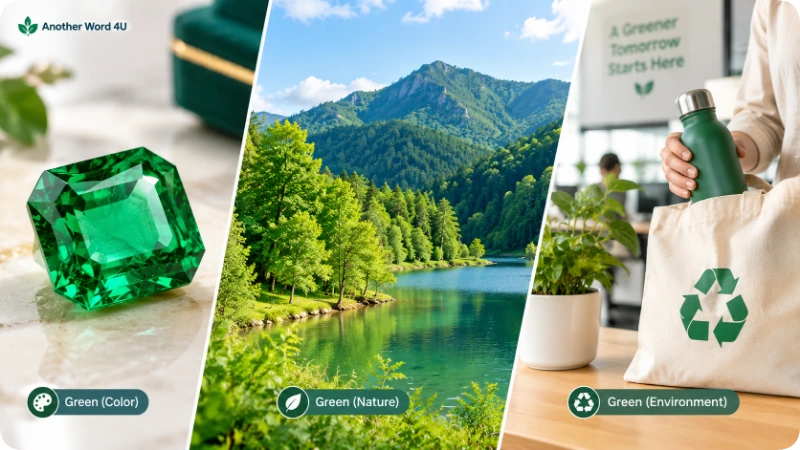
Green has several common meanings, so there is no single synonym that works in every sentence.
Most literally, green describes a color between blue and yellow:
- She bought a green jacket.
- The leaves are bright green.
It can also describe something covered with or associated with vegetation:
- The valley looks green after the rain.
Another common meaning describes environmental responsibility:
- The company is trying to become greener.
Here, green can refer to reducing environmental harm, conserving resources, or using more environmentally responsible practices.
Finally, green can describe someone who is inexperienced or unfamiliar with a particular activity:
- He was still green when he started his first job.
The intended meaning matters because emerald, eco-friendly, and inexperienced are not interchangeable. Always identify the meaning before choosing an alternative.
Another Word for Green
The best alternative depends on which meaning of green you want to express. The word can describe a color, vegetation, environmental responsibility, or a lack of experience.
Green Synonyms for Color
| # / Word | Type & Meaning | Example |
|---|---|---|
| 1. Emerald | Color alternative: A rich, vivid green. | She wore an emerald scarf. |
| 2. Olive | Color alternative: A muted yellowish green. | The walls are painted olive. |
| 3. Lime | Color alternative: A bright yellowish green. | He chose a lime shirt. |
| 4. Jade | Color alternative: A medium green associated with jade. | The necklace has a jade-colored stone. |
| 5. Sage | Color alternative: A soft, muted gray-green. | Sage is popular for interior walls. |
| 6. Mint | Color alternative: A pale, fresh green. | The kitchen has mint-green cabinets. |
Green Synonyms for Vegetation
| # / Word | Type & Meaning | Example |
|---|---|---|
| 7. Verdant | Context-specific: Lush and covered with vegetation. | They walked through a verdant valley. |
| 8. Leafy | Near-synonym: Full of leaves or plants. | They live on a leafy street. |
| 9. Lush | Near-synonym: Rich, healthy, and abundant vegetation. | The garden looked lush after the rain. |
| 10. Vegetated | Formal/context-specific: Covered with plants. | The slope is densely vegetated. |
| 11. Fresh | Near-synonym: New or recently developed. | The team brought a fresh perspective. |
| 12. Viridescent | Formal/literary: Becoming green or green in appearance. | The hills were viridescent in spring. |
Green Alternatives for Environmental Ideas
| # / Word | Type & Meaning | Example |
|---|---|---|
| 13. Eco-friendly | Environmental alternative: Less harmful to the environment. | We chose an eco-friendly cleaning product. |
| 14. Environmentally friendly | Formal alternative: Designed to reduce environmental harm. | The company promotes environmentally friendly packaging. |
| 15. Sustainable | Context-specific: Able to continue with less environmental impact. | They are investing in sustainable farming. |
| 16. Low-impact | Context-specific: Causing relatively little environmental harm. | The project uses low-impact materials. |
| 17. Renewable | Context-specific: Naturally replenished over time. | Solar power is a renewable energy source. |
| 18. Conservation-minded | Context-specific: Focused on protecting natural resources. | She is conservation-minded when choosing products. |
Green Alternatives for Inexperience
| # / Word | Type & Meaning | Example |
|---|---|---|
| 19. Inexperienced | Synonym for one sense: Lacking experience. | The inexperienced worker needed guidance. |
| 20. Novice | Noun: A person who is new to something. | The course is suitable for a novice. |
| 21. Unseasoned | Near-synonym: Lacking practical experience. | He was an unseasoned manager. |
| 22. Newcomer | Context-specific: Someone new to a place or activity. | The newcomer quickly joined the team. |
| 23. Amateur | Context-specific: Someone who is not a professional. | He is an amateur photographer. |
| 24. Young | Context-specific: Early in age, development, or existence. | The young plants need regular watering. |
| 25. Raw | Context-specific: Not yet developed or trained. | She has raw talent but needs experience. |
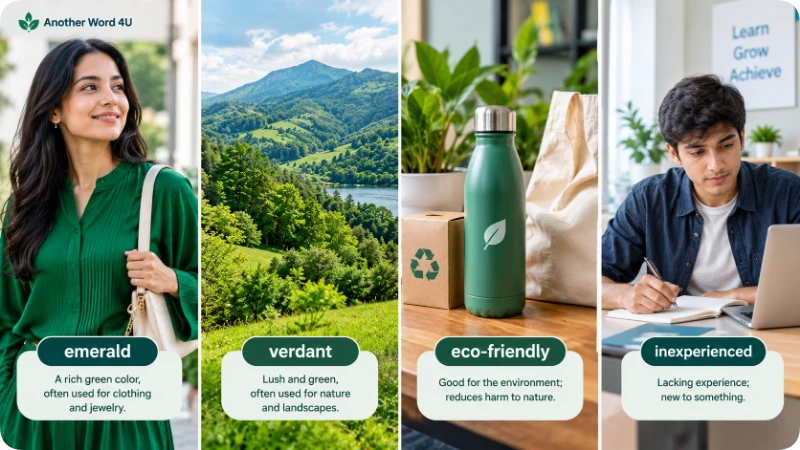
Not every alternative is interchangeable with green. For example, emerald identifies a particular vivid shade, while eco-friendly changes the meaning completely when green refers to environmental responsibility. When green describes a person, inexperienced, novice, or unseasoned may be more precise depending on the sentence.
Best Synonym by Context
| If you mean… | Use… | Why |
|---|---|---|
| A vivid green color | Emerald | More specific and visually descriptive. |
| A muted green | Olive or Sage | Identifies a softer, less vivid shade. |
| A pale green | Mint | Suggests a light, fresh shade. |
| Lush plant growth | Verdant or Lush | Focuses on vegetation rather than color alone. |
| An environmentally responsible product | Eco-friendly | Clearly communicates environmental meaning. |
| A long-term environmental approach | Sustainable | Emphasizes continued responsible practices. |
| Someone lacking experience | Inexperienced | Direct and clear. |
| Someone new to a field | Novice | Identifies a beginner. |
| A new or developing perspective | Fresh | Focuses on novelty rather than color. |
| Someone with undeveloped skill | Unseasoned or Raw | Highlights limited experience or development. |
How to Choose the Right Synonym for Green
Start by asking what green means in your sentence.
1. Check the literal meaning.
If you are describing color, choose a shade such as emerald, olive, sage, or lime.
2. Consider if you mean vegetation.
For plants or landscapes, lush, leafy, or verdant may be more descriptive than simply green.
3. Identify the environmental meaning.
Use eco-friendly products or practices designed to reduce environmental harm. Use sustainable when the emphasis is on practices that can continue responsibly over time.
4. Check if you are describing the experience.
If a person is inexperienced, use inexperienced, novice, or unseasoned rather than a color word.
5. Match the audience and tone.
Inexperienced is straightforward and widely understood. Novice is common in instructional and professional contexts. Verdant is more literary and may sound unusual in casual conversation.
6. Do not confuse specificity with synonymy.
A shade name such as emerald is not a universal replacement for green. It is useful only when that particular shade is intended.
Real-Life Examples
Everyday description:
Instead of “She wore a green dress,” you could write “She wore an emerald dress” when the dress is a rich, vivid green.
Interior design:
“They painted the bedroom sage” is more precise than “They painted the bedroom green” when the color is a muted gray-green.
Nature writing:
“The hills were verdant after the spring rains” creates a stronger image of abundant vegetation than the basic sentence “The hills were green.”
Workplace writing:
Instead of “Our company is becoming more green,” write “Our company is adopting more sustainable practices.” This is clearer in a professional context.
Product description:
“This is an eco-friendly cleaning product” is more specific when the intended meaning concerns reduced environmental impact.
Learning situation:
Instead of “She is green at coding,” write “She is a novice programmer.” The latter makes the meaning immediately clear to most readers.
Professional development:
“He was inexperienced when he joined the team” is more direct and natural than using green in formal writing.
Antonyms for Green
Because green has several meanings, its opposite also depends on context.
| Antonym | Meaning & Example |
|---|---|
| Red | Meaning: A contrasting color, depending on the comparison.Example: The signal changed from green to red. |
| Ripe | Meaning: Mature rather than unripe; context-specific.Example: The fruit is ripe rather than green. |
| Dry | Meaning: Lacking lush or fresh vegetation; context-specific.Example: The landscape became dry during the drought. |
| Barren | Meaning: Lacking vegetation or plant growth.Example: The barren land had almost no vegetation. |
| Experienced | Meaning: Having practical knowledge or skill.Example: She is experienced in project management. |
| Seasoned | Meaning: Highly experienced.Example: He is a seasoned professional. |
| Unsustainable | Meaning: Not environmentally sustainable.Example: The old process was environmentally unsustainable. |
These are not universal opposites. For example, red is a color contrast, while experienced is an opposite only when green means inexperienced.
Words That Are Easy to Confuse With Green
Verdant
Verdant usually describes land or vegetation that is lush and green. It is more descriptive and literary than the everyday word green.
The hikers crossed a verdant meadow.
Sustainable
Sustainable is related to environmental responsibility, but it has a more specific meaning than green. It often concerns practices or systems that can continue without exhausting resources or causing unacceptable environmental harm.
The farm is moving toward sustainable agriculture.
Fresh
Fresh can describe something new, recently produced, or pleasantly different. Although green things can look fresh, fresh does not normally mean the color green.
The team offered a fresh approach to the problem.
When Green Is Not the Precise Choice
Green can be too broad when you need to identify a particular color. If you know the shade, emerald, olive, sage, lime, or mint can create a clearer mental image.
It can also be too general in environmental writing. Calling a product “green” may leave readers unsure what makes it environmentally responsible. Depending on the claim, eco-friendly, low-impact, or sustainable may communicate the intended idea more precisely.
When describing an inexperienced person, green can sound informal or somewhat old-fashioned. In professional, academic, or instructional writing, inexperienced, novice, or unseasoned is often clearer.
Likewise, green may be insufficient when describing vegetation. Lush emphasizes abundance and healthy growth, while verdant emphasizes rich green vegetation.
Phrases, Idioms, and Expressions Related to Green
| Phrase or Expression | Type & Meaning | Example |
|---|---|---|
| Green thumb | Idiom: A natural ability to grow plants well. | My grandmother has a green thumb. |
| The grass is always greener on the other side | Proverb/idiom: Other situations may seem better than one’s own. | He keeps changing jobs because he thinks the grass is always greener on the other side. |
| Give the green light | Idiom: Give permission or approval. | The manager gave the project the green light. |
| In the green | Expression: Financially profitable or in a favorable financial position. | The business is finally in the green. |
| Green with envy | Idiom: Extremely jealous. | She was green with envy when she saw her friend’s new car. |
| Go green | Expression: Adopt more environmentally responsible practices. | The school is encouraging students to go green. |
These expressions have meanings that cannot always be predicted simply by replacing green with another color word.
Common Mistakes When Using Green
1. Treating every color synonym as interchangeable.
Emerald, olive, and sage describe different shades. Use them only when the intended color matches.
2. Using “green” when you mean environmentally friendly.
In formal writing, eco-friendly or another precise environmental term may make the meaning clearer.
3. Assuming “green” always means inexperienced.
That meaning applies to certain contexts involving people, skills, or work. It does not replace green as a color word.
4. Using a formal word in casual conversation.
Verdant and viridescent can sound literary. In everyday speech, green, lush, or leafy may be more natural.
Comparison of Green and Its Alternatives
| Word | Main Meaning, Tone & Best Context |
|---|---|
| Green | Meaning: Basic color; environmental or inexperienced meanings.Tone: Neutral.Best for: General use. |
| Emerald | Meaning: Rich green shade.Tone: Neutral/descriptive.Best for: Fashion, design, color description. |
| Olive | Meaning: Muted yellowish green.Tone: Neutral.Best for: Clothing, décor, color. |
| Verdant | Meaning: Lush green vegetation.Tone: Literary/formal.Best for: Nature and descriptive writing. |
| Lush | Meaning: Abundant, healthy vegetation.Tone: Neutral.Best for: Gardens, landscapes, nature. |
| Eco-friendly | Meaning: Less harmful to the environment.Tone: Neutral.Best for: Products and practices. |
| Sustainable | Meaning: Environmentally responsible and maintainable.Tone: Neutral/formal.Best for: Business, agriculture, policy. |
| Inexperienced | Meaning: Lacking experience.Tone: Neutral.Best for: Work, education, general description. |
| Novice | Meaning: Beginner.Tone: Neutral/formal.Best for: Learning and professional contexts. |
| Unseasoned | Meaning: Lacking practical experience.Tone: Neutral/formal.Best for: Work and leadership contexts. |
Frequently Asked Questions About Green
1. What is the best synonym for green?
There is no single best synonym. Emerald works for a vivid color, verdant for lush vegetation, eco-friendly for environmental meaning, and inexperienced for the meaning related to a beginner.
2. What is a formal word for green?
For vegetation, verdant is a more literary or formal alternative. For environmental contexts, sustainable or environmentally friendly may be appropriate, depending on the intended meaning.
3. What is another word for green when describing a person?
When green means inexperienced, useful alternatives include inexperienced, novice, unseasoned, and sometimes newcomer. The best choice depends on if you mean limited experience, beginner status, or simply being new.
4. What is another word for green in an environmental context?
Eco-friendly, environmentally friendly, sustainable, and low-impact can work in environmental contexts. They are not identical, so choose the one that accurately describes the environmental characteristic you mean.
5. What is a synonym for green in nature writing?
Verdant, lush, and leafy can work when describing vegetation. Verdant emphasizes rich green plant growth, while lush emphasizes abundant, healthy vegetation.
Final Thoughts
The best green synonym depends on the meaning you want to express.
Use a specific shade such as emerald or sage for color, verdant or lush for vegetation, eco-friendly or sustainable for environmental ideas, and inexperienced or novice for limited experience.
Choosing the right alternative means considering meaning, tone, context, and audience rather than simply replacing one word with another.

Sophia Bennett is a dedicated Language Researcher and Content Writer at AnotherWord4UU.com. She specializes in creating well-researched content on synonyms, alternative words, vocabulary, expressions, and English language usage. Her goal is to help students, writers, professionals, and language learners communicate more effectively by finding the most accurate and impactful words. Through clear, practical, and engaging language guides, Sophia makes expanding vocabulary simple, accessible, and enjoyable.