
Imagine describing a new house to a friend. You could call it large, but perhaps it is actually spacious, enormous, roomy, or simply bigger than expected.
Choosing the right word helps readers picture its size more clearly. The same applies when describing a large dog, a large business, a large amount of money, or a large problem.
Although these expressions share a general idea of size or extent, they are not interchangeable in every sentence.
Learning a suitable synonym for large can make your writing more precise, natural, and engaging. Some alternatives emphasize physical dimensions, while others describe volume, quantity, importance, or intensity.
A word that works well in everyday conversation may sound exaggerated or too formal in professional writing.
This guide explores useful alternatives to large, explains their meanings, and shows when to use them. You will also learn about antonyms, common mistakes, related expressions, and practical examples to help you select the most appropriate word for your audience and situation.
Featured Snippet
A synonym for large is big, sizable, substantial, spacious, enormous, or vast. Big is common in everyday conversation, sizable suggests considerable size, spacious describes an area with plenty of room, and enormous emphasizes exceptional size. Vast often describes extensive spaces, quantities, or areas of land.
What Does Large Mean?
The word large means greater than average or usual in size, amount, extent, or capacity. It is a common adjective that works in casual conversation, academic writing, and professional communication.
Examples:
- Physical size: They live in a large house.
- Quantity: The company received a large order.
- Extent: The project requires a large amount of time.
- Importance or impact: The decision had a large effect on the community.
Large is a flexible, relatively neutral word. It does not automatically suggest something is impressive, positive, or unusually enormous. The context determines if it describes physical dimensions, quantity, or the extent of an effect.
For example, a large room has considerable space, while a large expense involves a considerable amount of money. In both cases, large communicates more than the usual amount or size without specifying an exact measurement.
Another Word for Large
The best alternative depends on what you are describing. Some words refer to physical size, while others describe space, quantity, importance, or the scale of an effect. Choose a synonym that fits your sentence.
Common Synonyms for Large
| Synonym | Simple Meaning | Example Sentence |
|---|---|---|
| Big | Large in size or amount | They bought a big table. |
| Huge | Extremely large | A huge crowd gathered outside. |
| Enormous | Exceptionally large | An enormous ship entered the harbor. |
| Massive | Very large, heavy, or substantial | A massive rock blocked the road. |
| Gigantic | Extremely big | A gigantic tree shaded the garden. |
| Immense | Extremely large in size or degree | They faced an immense challenge. |
| Colossal | Extremely large or impressive | The project required a colossal effort. |
| Mammoth | Exceptionally large or demanding | Organizing the festival was a mammoth task. |
Synonyms for Large Amounts or Significant Quantities
| Synonym | Simple Meaning | Example Sentence |
|---|---|---|
| Sizable | Fairly large or considerable | She received a sizable bonus. |
| Substantial | Considerable in amount or importance | The repairs required substantial investment. |
| Considerable | Large enough to matter | The plan saved considerable time. |
| Tremendous | Very great in amount, degree, or effect | The team made tremendous progress. |
| Hefty | Large, heavy, or considerable | They paid a hefty fee. |
| Generous | Ample or more than sufficient | The recipe calls for a generous serving of rice. |
| Ample | Enough or more than enough | There is ample room for everyone. |
Synonyms for Large Spaces, Areas, or Dimensions
| Synonym | Simple Meaning | Example Sentence |
|---|---|---|
| Vast | Very extensive or wide-ranging | The explorers crossed a vast desert. |
| Spacious | Providing plenty of room | Their new apartment is spacious. |
| Roomy | Having enough space; informal | This car has a roomy interior. |
| Expansive | Wide, extensive, or open | The hotel overlooks an expansive lawn. |
| Extensive | Covering a wide area or range | The team conducted extensive research. |
| Broad | Wide or covering many areas | The course offers a broad overview. |
| Wide | Measuring a great distance from side to side | They built a wide entrance. |
| Oversized | Larger than the standard size | He wore an oversized jacket. |
Alternatives for Large Scale, Capacity, or Impact
| Synonym or Alternative | Simple Meaning | Example Sentence |
|---|---|---|
| Major | Important or significant in scale | The company announced a major change. |
| High-volume | Involving a large quantity or rate | The warehouse handles high-volume orders. |
| High-capacity | Able to hold or process a large amount | The venue has a high-capacity auditorium. |
| Far-reaching | Affecting many people or areas | The policy had far-reaching consequences. |
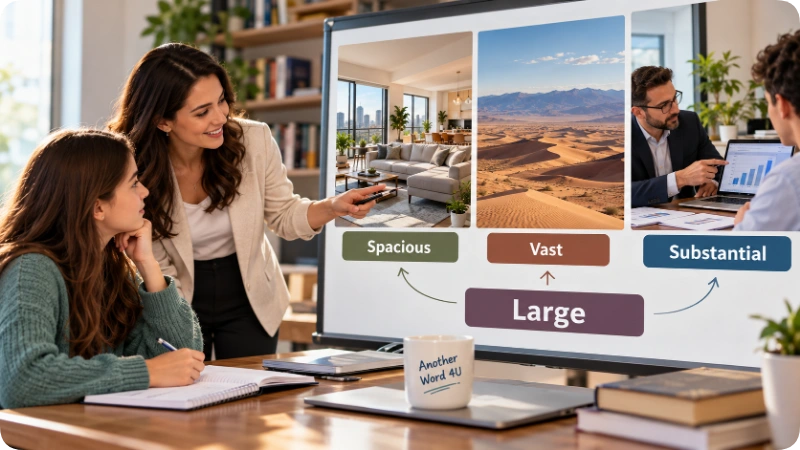
These choices are not all direct substitutes. Spacious describes available room, major emphasizes importance, and high-capacity describes what something can hold or process. Vast often describes extensive areas, while substantial suits significant amounts or investments. Choose the alternative that preserves your intended meaning and sounds natural in the sentence.
Best Synonym by Context
| If you mean… | Use… | Why |
|---|---|---|
| Bigger than usual in everyday speech | Big | Natural and widely understood. |
| Extremely large | Huge or enormous | Clearly emphasizes size. |
| Heavy or solid in appearance | Massive | Suggests bulk or substantial physical presence. |
| A wide area or landscape | Vast or expansive | Emphasizes extent and openness. |
| Plenty of interior room | Spacious or roomy | Focuses on usable space. |
| A considerable quantity | Substantial or sizable | Works well for amounts and resources. |
| More than enough space or time | Ample | Highlights sufficiency. |
| A significant effect or change | Major or considerable | Emphasizes importance or degree. |
| A difficult, demanding task | Mammoth | Informal and expressive. |
| A large fee or bill | Hefty | Emphasizes the burden of the amount. |
| A wide range of subjects | Broad or extensive | Highlights scope rather than physical size. |
| A container or facility that holds much | High-capacity | Describes capacity precisely. |
How to Choose the Right Synonym for Large
Use these practical checks before replacing large.
- Identify what is being measured. A room may be spacious, a payment substantial, and a landscape vast. The noun helps determine the best choice.
- Match the intensity. Big is neutral and conversational; enormous, colossal, and gigantic convey much greater size. Avoid exaggerating when the difference is modest.
- Consider the tone. Roomy and hefty suit casual speech. Substantial and considerable often work well in professional writing.
- Distinguish size from importance. A large decision may mean an important decision, but a major decision communicates importance more directly.
- Prefer measurable language when precision matters. Instead of saying “a large box,” give its dimensions when the exact size matters.
- Check the natural word pairing. English speakers commonly say a substantial investment, a vast desert, and a spacious office. Not every synonym sounds natural with every noun.
The aim is not to replace large every time it appears. It is to choose a word that conveys the right amount, scale, or effect.
Real-Life Examples

Notice how the best alternative changes with the situation.
- Home description: “We rented a spacious apartment.” This emphasizes the available living space.
- Shopping: “They bought a huge television.” Huge makes the size sound striking.
- Business: “The company made a substantial investment.” This sounds measured and professional.
- Travel: “The hikers crossed a vast plain.” Vast communicates extensive geographical reach.
- School: “The assignment requires considerable research.” Considerable highlights the amount of work.
- Personal finance: “The repair came with a hefty bill.” Hefty makes the cost sound burdensome.
- Events: “A massive crowd filled the stadium.” Massive emphasizes the crowd’s scale.
- Food: “Would you like a generous portion?” Generous suggests an ample serving.
- Technology: “The server supports high-volume traffic.” This describes the system’s workload more precisely than large traffic.
- Public policy: “The new law introduced a major change.” Major focuses on significance rather than physical dimensions.
Antonyms for Large
An antonym is a word with an opposite or contrasting meaning. The most suitable opposite of large depends on if you mean physical size, quantity, or significance.
| Antonym | Meaning | Example |
| Small | Limited in size | They live in a small house. |
| Little | Small in size or amount | We have little storage space. |
| Tiny | Extremely small | A tiny insect landed on the leaf. |
| Miniature | Much smaller than the usual version | She collects miniature cars. |
| Compact | Small and efficiently arranged | The compact desk fits beside the bed. |
| Narrow | Limited in width | A narrow path led to the beach. |
| Minor | Less important or less serious | The report contained a minor error. |
| Insignificant | Too small or unimportant to matter much | The difference was insignificant. |
Small is the most general opposite of large. Narrow refers specifically to width, while minor and insignificant contrast with large when it means important or substantial in effect.
Words That Are Easy to Confuse With Large
1. Long
Long describes length or duration, not overall size. A narrow road can be long without being large in width.
Example: “We walked along a long, narrow road.”
2. Tall
Tall describes height, especially for people, buildings, and other upright objects. A building can be tall without being particularly wide.
Example: “The tall tower stands beside a small house.”
3. Important
Important describes significance or value, not physical dimensions. A small detail can be important, and a large object can be unimportant.
Example: “This is an important decision, even though it seems simple.”
When Large Is Not the Precise Choice
Large is useful when you need a general description, but a more specific word can communicate your meaning more clearly.
- For rooms and homes: Choose spacious when you mean there is plenty of usable room. A large room is not necessarily well laid out.
- For money and costs: Use substantial for an investment or contribution and hefty for a cost that feels burdensome.
- For landscapes: Choose vast when emphasizing extensive space, distance, or scale.
- For importance: Use major for a significant event, decision, or change instead of relying on large.
- For physical bulk: Use massive when something looks heavy, solid, or imposing.
- For capacity: Use high-capacity when describing how much a machine, venue, or storage system can hold.
Large is not incorrect in these situations. The alternative simply provides more information and helps readers form a clearer picture.
Phrases, Idioms, and Expressions Related to Large
These expressions communicate size, quantity, or scale in ways that a single adjective may not.
| Phrase or Expression | Simple Meaning | Example |
| By and large | Generally or on the whole | By and large, the event was successful. |
| A big deal | Something important or significant | Winning the award was a big deal for her. |
| On a grand scale | On a very large or ambitious scale | The city rebuilt the park on a grand scale. |
| A large amount of | A considerable quantity of something | The project requires a large amount of funding. |
| In great numbers | In large quantities or groups | Visitors arrived in great numbers. |
| Larger than life | More impressive, dramatic, or distinctive than ordinary | The performer had a larger-than-life personality. |
These are expressions, not interchangeable single-word synonyms. In particular, by and large means generally, while larger than life often describes a person’s personality or public image rather than physical size.
Common Mistakes When Using Large
1. Treating every synonym as interchangeable. A vast room may sound less natural than a spacious room when the emphasis is on comfort and usable space. Choose words according to the noun and intended meaning.
2. Using enormous when large is more accurate. Enormous suggests exceptional size. If something is only somewhat bigger than average, large or sizable may be more appropriate.
3. Confusing size with importance. A large problem may be understandable, but a major problem often expresses seriousness more directly.
4. Using vague descriptions when measurements matter. In product specifications, construction, or technical instructions, exact dimensions, weight, or capacity are more useful than large.
Comparison of Large and Its Alternatives
| Word | Main Idea | Tone or Strength | Best Context |
| Large | Greater than usual in size or amount | Neutral | General descriptions |
| Big | Large in size or quantity | Casual, familiar | Everyday conversation |
| Huge | Extremely large | Strong, emphatic | Crowds, objects, quantities |
| Massive | Great bulk or scale | Strong, physical | Buildings, rocks, crowds |
| Vast | Extensive space or range | Expansive | Landscapes, resources, knowledge |
| Spacious | Plenty of usable room | Positive, descriptive | Homes, offices, vehicles |
| Substantial | Considerable amount or importance | Professional, measured | Investments, evidence, contributions |
| Sizable | Fairly large amount or size | Neutral | Bonuses, collections, orders |
| Major | Significant in importance or effect | Direct, formal-friendly | Decisions, changes, problems |
| Ample | Enough or more than enough | Reassuring | Time, space, resources |
The key difference is emphasis. Large is a general-purpose adjective; huge emphasizes exceptional size, vast emphasizes extent, spacious focuses on available room, and substantial often highlights amount or importance. The best choice is the one that describes the specific quality you want readers to notice.
Frequently Asked Questions About Large
1. What is the most common synonym for large?
Big is one of the most common alternatives. It works naturally in everyday speech, such as “a big house” or “a big opportunity.” In formal writing, large may be preferable, depending on the sentence.
2. What is a stronger word than large?
Huge, enormous, gigantic, and immense can express greater size or degree. The best option depends on the noun. For example, an enormous building emphasizes size, while an immense challenge emphasizes the scale of the difficulty.
3. What is a formal synonym for large?
Substantial, considerable, and sizable often work well in professional or academic writing. Use substantial for a significant amount or contribution and considerable when emphasizing degree or extent.
4. What is another word for large in a business context?
The best choice depends on the meaning. Use major for an important change, substantial for a significant investment, high-volume for large quantities of transactions, and large-scale for activities involving extensive operations.
5. What is the opposite of large?
Small is the most common antonym. Other options include tiny for something extremely small, compact for something small and efficiently arranged, and minor when large refers to importance rather than physical dimensions.
Final Thoughts
Large is a versatile word, but the right alternative can make your writing more specific and expressive.
Choose big for everyday conversation, enormous for exceptional size, vast for extensive areas, spacious for usable room, and substantial for considerable amounts or importance.
Always consider meaning, tone, context, and audience before choosing a replacement.

I am Olivia Carter, a passionate Language Researcher and Content Writer at AnotherWord4UU.com. I specialize in creating well-researched content on synonyms, alternative words, phrases, vocabulary, and English language usage. My goal is to help students, writers, professionals, and language enthusiasts find the perfect words to communicate more clearly and confidently. Through practical language guides and easy-to-understand resources, I make expanding your vocabulary simple and enjoyable.