Imagine receiving an unfair accusation at work and feeling so angry that ordinary words no longer express your reaction. You might describe the feeling as rage, fury, outrage, or indignation, but each word communicates something slightly different.
Choosing the right rage synonym can make your writing more precise, if you are describing a character in a story, explaining a disagreement, writing an email, or speaking about an upsetting experience.
Some alternatives emphasize intense anger, while others suggest a reaction to injustice, sudden irritation, or a loss of emotional control. For English learners, understanding these differences is more useful than memorizing a long list of similar words.
The best choice depends on what caused the anger, how intense it feels, and the impression you want to create. This guide explains common synonyms, practical alternatives, contrasting words, and related expressions, with simple definitions and natural examples to help you choose the right word for each situation.
Featured Snippet
A synonym for rage is fury, which describes extremely intense anger. Other alternatives include wrath, often used in formal or literary contexts; outrage, which emphasizes anger about something offensive or unjust; and ire, a more formal word for anger. Fury is often the closest choice when you mean powerful, overwhelming anger.
What Does Rage Mean?

Rage is an intense feeling of anger that can be difficult to control. It may develop after an insult, an injustice, a frustrating experience, or a serious disappointment. The word is stronger than ordinary anger and often suggests overwhelming emotion.
Examples:
- She was filled with rage after discovering the deliberate deception.
- His face showed rage when he heard the accusation.
Rage can describe an emotion or, in some contexts, a violent outburst caused by intense anger. It is also used figuratively in expressions such as “a storm of rage.”
Another Word for Rage
The best synonym for rage depends on the cause, intensity, and expression of the anger. Some alternatives describe extreme anger, while others emphasize irritation, resentment, aggression, or a sudden loss of control. These words and expressions are not always interchangeable.
Synonyms for Rage Meaning Intense Anger
| Synonym or Alternative | Simple Meaning | Example Sentence |
|---|---|---|
| Fury | Extremely intense anger | She could barely contain her fury. |
| Wrath | Powerful anger, sometimes associated with punishment; formal or literary | The king’s wrath frightened the entire court. |
| Ire | Strong anger or irritation; formal | His careless remark drew her ire. |
| Anger | The general feeling of being upset or displeased | He spoke calmly despite his anger. |
| Outrage | Anger caused by something offensive or unjust | The decision sparked public outrage. |
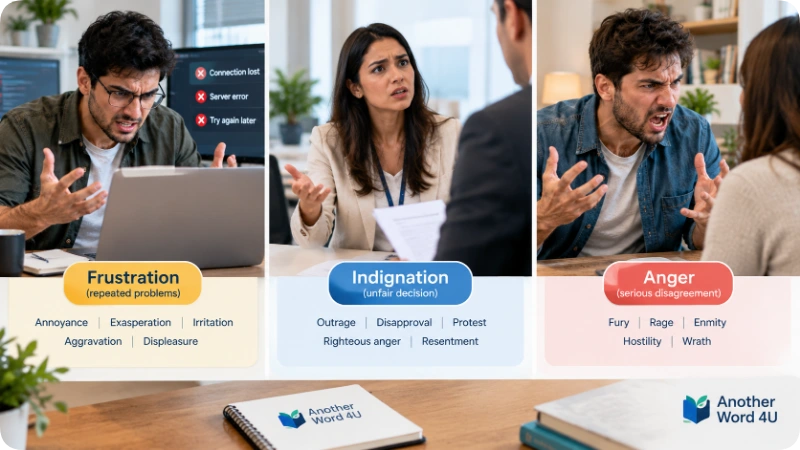
| Indignation | Anger at something perceived as unfair or wrong | She expressed indignation at the unequal treatment. |
Related Emotions: Resentment, Irritation, and Frustration
| Synonym or Alternative | Simple Meaning | Example Sentence |
|---|---|---|
| Resentment | Lasting bitterness about unfair treatment | Years of resentment affected their friendship. |
| Exasperation | Intense irritation caused by repeated problems | She sighed in exasperation at the repeated errors. |
| Irritation | Annoyance or mild anger | The constant noise caused irritation. |
| Frustration | Anger or distress caused by obstacles | His frustration grew when the computer stopped working. |
| Bitterness | Anger mixed with hurt or resentment | He spoke with bitterness about the betrayal. |
| Annoyance | Mild displeasure | She showed annoyance at the interruption. |
Words for Rage Expressed Through Aggression
| Synonym or Alternative | Simple Meaning | Example Sentence |
|---|---|---|
| Hostility | An unfriendly or antagonistic attitude | Their conversation was marked by hostility. |
| Belligerence | An aggressive, confrontational attitude | His belligerence made cooperation difficult. |
| Ferocity | Extreme force or aggressiveness | She argued with surprising ferocity. |
| Temper | A person’s tendency to become angry | He struggled to control his temper. |
Expressions for Extreme or Suppressed Rage
| Synonym or Alternative | Simple Meaning | Example Sentence |
|---|---|---|
| Boiling anger | Anger that feels close to erupting | He was boiling with anger after the meeting. |
| Blind fury | Extreme anger that overwhelms judgment | In blind fury, he nearly said something he regretted. |
| White-hot anger | Exceptionally intense anger | She felt white-hot anger at the betrayal. |
| Seething anger | Anger held inside but strongly felt | He sat in seething anger throughout the discussion. |
| Fit of rage | A sudden episode of intense anger | He broke the old phone in a fit of rage. |
| Temper tantrum | An uncontrolled display of anger | The customer threw a temper tantrum over the delay. |
Informal Expressions for Losing Control of Anger
| Synonym or Alternative | Simple Meaning | Example Sentence |
|---|---|---|
| Blow up | Suddenly become very angry; informal phrasal verb | She blew up when she learned the truth. |
| Lose one’s temper | Stop controlling one’s anger | Try not to lose your temper during the interview. |
These alternatives differ in meaning and intensity. Fury and wrath describe powerful anger, while indignation specifically involves a perceived injustice. Resentment often lasts over time, and exasperation usually comes from repeated difficulties. Expressions such as blind fury and seething anger describe particular ways anger is experienced or expressed.
Choose the word that best reflects the cause, strength, and outward expression of the anger you want to describe.
Best Synonym by Context
| If you mean… | Use… | Why |
|---|---|---|
| Extremely powerful anger | Fury | Emphasizes intensity. |
| Anger at injustice | Outrage | Highlights a reaction to something offensive or unfair. |
| Anger in formal or literary writing | Wrath | Has a weightier, more elevated tone. |
| Anger at unfair treatment | Indignation | Emphasizes a sense of moral wrong. |
| Anger caused by repeated difficulties | Exasperation | Highlights frustration and irritation. |
| Anger that lasts over time | Resentment | Suggests a lingering emotional response. |
| Mild displeasure | Annoyance | Avoids overstating the feeling. |
| An aggressive attitude | Belligerence | Focuses on confrontational behavior. |
| Anger that suddenly erupts | Fit of rage | Describes an episode rather than simply an emotion. |
| Anger that remains concealed | Seething anger | Suggests strong but restrained emotion. |
How to Choose the Right Synonym for Rage
Consider these four practical questions before selecting a word.
1. How intense is the emotion?
Use annoyance for mild displeasure, anger for the general emotion, and fury for extreme anger. Reserve blind fury for situations where anger overwhelms judgment.
2. What caused the anger?
If someone feels angry because of an injustice, indignation or outrage may be more precise. If repeated obstacles cause the reaction, frustration or exasperation may fit better.
3. Who is your audience?
In everyday conversation, anger, fury, and blow up are natural choices. In formal writing, indignation and ire may suit the context. Wrath often sounds literary or dramatic.
4. Are you describing a feeling or behavior?
Rage describes an intense emotional state. Hostility describes an unfriendly attitude, while belligerence suggests confrontational behavior. Someone can feel rage without acting aggressively.
Real-Life Examples
Different alternatives can make the same situation sound more specific.
- Everyday conversation: “I was furious when the bus left without me.” Fury communicates stronger anger than simple annoyance.
- Workplace writing: “The unexplained salary reduction caused considerable indignation among employees.” Indignation emphasizes perceived unfairness.
- News reporting: “The announcement prompted widespread public outrage.” Outrage conveys a collective reaction to something offensive.
- Fiction: “The general’s wrath fell upon the disobedient soldiers.” Wrath creates a formal, dramatic tone.
- Family disagreement: “Repeated interruptions left her exasperated.” Exasperated emphasizes irritation caused by a recurring problem.
- Personal reflection: “He still felt resentment over the way his friend had treated him.” Resentment suggests an emotion that persists.
- A heated argument: “She lost her temper and shouted.” This describes a loss of control rather than simply naming the emotion.
- A restrained reaction: “He remained silent, seething with anger.” Seething communicates intense emotion without an outward outburst.
Antonyms for Rage
The most appropriate opposite depends on if rage refers to intense emotion, aggressive behavior, or a person’s emotional state.
| Antonym | Meaning | Example |
|---|---|---|
| Calm | Free from agitation | She remained calm during the disagreement. |
| Composure | A state of emotional control | He regained his composure before responding. |
| Serenity | A peaceful, undisturbed state | She approached the difficult conversation with serenity. |
| Tranquility | Peacefulness and freedom from disturbance | The garden offered tranquility after a stressful day. |
| Patience | Ability to tolerate delays or difficulties | He responded with patience instead of anger. |
| Goodwill | A friendly, cooperative attitude | They resolved the dispute in a spirit of goodwill. |
These are contextual opposites rather than perfect antonyms in every sentence. For example, calm contrasts with rage as an emotional state, while goodwill contrasts with the hostility that anger may produce.
Words That Are Easy to Confuse With Rage
1. Anger
Anger is the broad term for displeasure or hostility. Rage is generally much more intense.
Example: “She felt anger at the unfair decision, but she did not lose control.”
2. Fury
Fury is a close synonym for rage, but it may emphasize the intensity of the feeling rather than an episode of uncontrolled behavior.
Example: “He trembled with fury after hearing the accusation.”
3. Outrage
Outrage usually highlights anger triggered by something offensive, shocking, or unjust. Rage does not necessarily involve a moral judgment.
Example: “The public expressed outrage over the misuse of funds.”
When Rage Is Not the Precise Choice
Although rage is powerful, it can exaggerate an emotion if the situation involves only mild annoyance or disappointment.
- For minor inconveniences: Use annoyance or irritation instead of rage.
- For unfair treatment: Choose indignation when the sense of injustice matters most.
- For persistent bitterness: Use resentment when the feeling continues long after an incident.
- For repeated obstacles: Choose frustration or exasperation when the main issue is difficulty or repeated failure.
- For aggressive behavior: Use hostility or belligerence if you are describing a person’s attitude rather than the emotion itself.
- For ordinary displeasure: Use anger when the intensity does not justify the stronger word.
Precise vocabulary helps readers understand not only how someone feels but also why they feel that way.
Phrases, Idioms, and Expressions Related to Rage
These expressions describe different degrees or manifestations of anger. They are phrases and idioms, not all single-word synonyms.
| Phrase or Expression | Meaning | Example |
|---|---|---|
| Fly into a rage | Suddenly become extremely angry | He flew into a rage when he discovered the damage. |
| See red | Become so angry that clear thinking becomes difficult | She saw red when she heard the insulting remark. |
| Hit the roof | Become extremely angry suddenly | Dad hit the roof when he saw the broken window. |
| Blow a fuse | Lose one’s temper suddenly | He blew a fuse over the unexpected bill. |
| Seethe with anger | Feel intense anger that remains partly concealed | She seethed with anger but finished the meeting calmly. |
| Have a fit of rage | Experience a sudden episode of extreme anger | The character had a fit of rage after the betrayal. |
Common Mistakes When Using Rage
1. Treating rage and anger as equally intense
Anger covers a broad range of feelings, whereas rage usually indicates extreme anger. Choose according to the strength of the emotion.
2. Using outrage when no offense or injustice is involved
Outrage often implies that something is offensive or wrong. For anger caused by an everyday inconvenience, frustration may be more accurate.
3. Confusing an emotion with an action
Rage is an emotion; shouting, threatening, or breaking something are behaviors. Do not assume that everyone who feels rage will act aggressively.
4. Using formal words in casual conversation unnecessarily
Ire and wrath can sound elevated or dramatic in ordinary speech. Anger and fury are often more natural, depending on intensity.
Comparison of Rage and Its Alternatives
| Word | Strength | Main Emphasis | Best Context |
|---|---|---|---|
| Rage | Very strong | Intense anger | Emotional descriptions and dramatic situations |
| Fury | Very strong | Extreme anger | Strong reactions and vivid writing |
| Wrath | Strong | Anger with a formal or literary tone | Literature, formal rhetoric, dramatic descriptions |
| Outrage | Strong | Anger at something offensive or unjust | Public issues and perceived wrongdoing |
| Indignation | Moderate to strong | Anger at unfairness | Formal discussion and moral criticism |
| Frustration | Variable | Obstacles and unmet expectations | Work, everyday problems, personal challenges |
| Resentment | Often enduring | Lingering bitterness | Relationships and past unfair treatment |
| Exasperation | Moderate to strong | Repeated irritation | Recurring problems and difficult situations |
| Annoyance | Mild to moderate | Minor displeasure | Everyday conversation |
The key distinction is that rage emphasizes intensity, outrage emphasizes the cause, resentment emphasizes persistence, and exasperation emphasizes repeated irritation. These differences help you communicate more accurately.
Frequently Asked Questions About Rage
1. What is the closest synonym for rage?
Fury is often the closest synonym because both words describe extremely intense anger. The best choice still depends on the sentence and if you want to emphasize the feeling, its cause, or its expression.
2. What is a stronger word than anger?
Rage and fury are stronger than the general word anger. Blind fury adds the idea that intense emotion may interfere with judgment.
3. What is a formal synonym for rage?
Wrath and ire are formal or literary alternatives. Indignation is useful when the anger results from perceived injustice, although it does not mean exactly the same thing as rage.
4. Is rage the same as fury?
The words overlap substantially and can often be substituted for each other. However, either may fit better depending on the sentence, tone, and intended emphasis. Neither word requires a person to act violently.
5. What is the opposite of rage?
Calm is a useful opposite when describing an emotional state. Composure emphasizes self-control, while serenity suggests peacefulness. The best choice depends on the contrast you want to express.
Final Thoughts
The best rage synonym depends on the emotion you want to communicate.
Choose fury for extreme anger, outrage for anger at something offensive, indignation for perceived injustice, and resentment for lasting bitterness.
Use frustration or annoyance when the feeling is less intense. Considering meaning, tone, context, and audience will make your English more natural and precise.

Ethan Brooks is a passionate Language Researcher and Content Writer at AnotherWord4UU.com. He specializes in creating well-researched content on synonyms, alternative words, vocabulary, idioms, and English language usage. His goal is to help students, writers, professionals, and language enthusiasts find the right words to communicate with clarity and confidence. Through practical language guides and easy-to-understand resources, Ethan makes expanding vocabulary simple, engaging, and effective.