
When you want to explain how someone gets through a difficult experience, survival may not always express the exact meaning you intend. Depending on the situation, you might choose to endure, persevere, withstand, live through, or overcome.
Each word highlights a different part of the experience, from staying alive during danger to continuing despite hardship or recovering from a setback. Choosing the right alternative can make your writing clearer and more natural.
For example, a person can survive a serious illness, endure months of uncertainty, withstand intense pressure, or overcome a personal obstacle. Although these expressions are related, they are not interchangeable in every sentence. Students, writers, professionals, and English learners can benefit from understanding their differences.
This guide explains the meaning of survival, introduces useful synonyms with simple examples, compares alternatives by context, and highlights common mistakes. By the end, you will be better equipped to select a word that accurately communicates the situation, intensity, and intended meaning.
Quick Answer
A synonym for survive is endure, withstand, persevere, outlast, or live through, depending on the context. Endure means to experience hardship without giving up, while withstand emphasizes resisting pressure or damage. Persevere means continuing despite difficulties, and living through means experiencing a challenging event.
What Does Survive Mean?
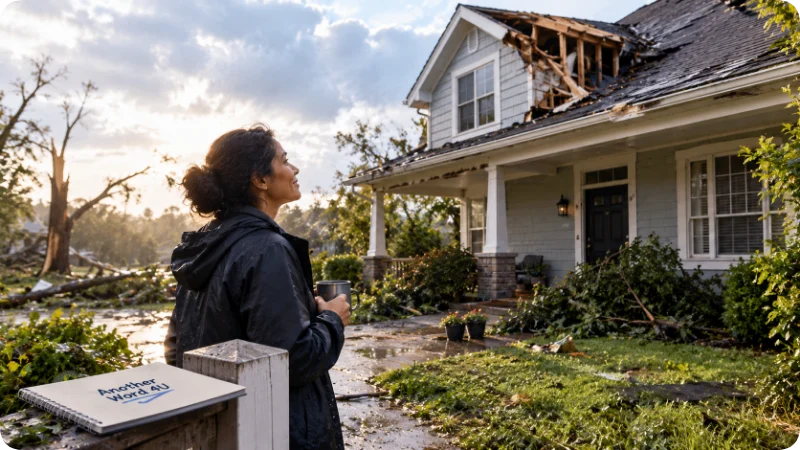
The verb survive means to remain alive despite danger, illness, injury, or another serious threat. It can also mean continuing to exist or function after a difficult experience, setback, or period of change.
For example:
- Physical survival: The climber survived the accident.
- Illness: She survived a serious infection.
- Financial difficulty: The small business survived a challenging year.
- Emotional hardship: He survived a painful breakup and gradually rebuilt his life.
Survive often emphasizes the outcome: a person, organization, or thing continues to exist when it might not have.
The word can also describe something that remains from an earlier period. For example, several old buildings survived the fire. In this sentence, survive means remain intact or continue to exist after a destructive event.
Survive is a versatile, neutral verb suitable for everyday conversation, academic writing, journalism, and professional communication. Its best alternative depends on whether you want to emphasize staying alive, tolerating hardship, resisting damage, continuing an effort, or recovering from a setback.Another Word for Survive
The best alternative for survive depends on the situation. Some words describe staying alive, while others emphasize enduring hardship, resisting damage, recovering from a crisis, or continuing despite difficulties.
Another Word for Survive
The best alternative for survive depends on the situation. Some words describe staying alive, while others emphasize enduring hardship, resisting damage, recovering from a crisis, or continuing despite difficulties.
Synonyms for Survive That Mean Enduring Hardship
| Synonym or Alternative | Simple Meaning | Example Sentence |
|---|---|---|
| Endure | Experience hardship without giving up | She endured months of uncertainty. |
| Persevere | Continue despite difficulties | He persevered through a difficult training program. |
| Persist | Continue despite obstacles | She persisted despite repeated setbacks. |
| Live through | Experience and get through an event | They lived through a devastating storm. |
| Get through | Manage to pass through a difficult period | We got through the toughest week together. |
| Weather | Get through a difficult situation | The company weathered an economic downturn. |
| Carry on | Continue despite difficulties | They carried on after the unexpected setback. |
| Make it | Succeed in getting through a difficult situation | She made it through a demanding first year. |
Words for Survive That Mean Resisting Pressure or Damage
| Synonym or Alternative | Simple Meaning | Example Sentence |
|---|---|---|
| Withstand | Resist pressure, damage, or force | The bridge withstood strong winds. |
| Resist | Oppose or withstand a force | The material resists heat. |
| Hold up | Remain strong or functional under pressure | The equipment held up during the test. |
| Outlast | Last longer than someone or something | The old building outlasted several newer structures. |
| Sustain | Maintain or support something over time | The organization sustained its operations during the crisis. |
Words for Survive That Mean Staying Alive or Continuing to Exist
| Synonym or Alternative | Simple Meaning | Example Sentence |
|---|---|---|
| Stay alive | Continue living | The crew struggled to stay alive in freezing conditions. |
| Remain alive | Continue to be living | Several animals remained alive after the flood. |
| Remain | Continue to exist or stay in place | Only a few original buildings remained. |
| Continue | Keep going or operating | The project continued despite funding problems. |
| Last | Continue for a period of time | The supplies lasted through the winter. |
| Live to tell the tale | Survive a frightening or dangerous experience | The explorers survived the ordeal and lived to tell the tale. |
Alternatives for Survive That Mean Recovery or Success
| Synonym or Alternative | Simple Meaning | Example Sentence |
|---|---|---|
| Pull through | Recover from a serious illness or crisis | The patient pulled through after surgery. |
| Recover | Return toward health or normal functioning | She recovered from her illness. |
| Overcome | Successfully deal with an obstacle | He overcame significant financial difficulties. |
| Prevail | Succeed despite opposition or difficulty | The team prevailed against strong competition. |
Words Related to Survive That Mean Escaping Danger
| Synonym or Alternative | Simple Meaning | Example Sentence |
|---|---|---|
| Escape | Get away from danger | The hikers escaped the approaching wildfire. |
| Evade | Avoid capture, harm, or an unwanted outcome | The suspect evaded capture. |
These alternatives are not interchangeable in every sentence. Endure emphasizes experiencing hardship, withstand focuses on resisting pressure or damage, and live through describes experiencing an event and getting through it. Pull through usually refers to recovery from a serious illness or crisis, while escape emphasizes getting away from danger.
Best Synonym by Context
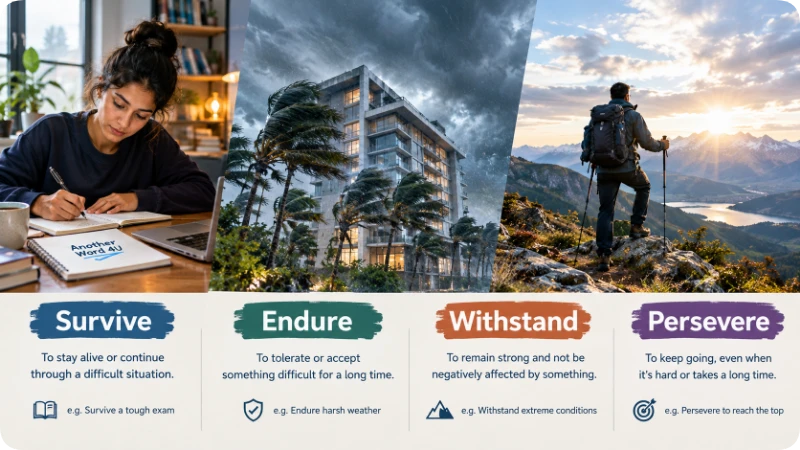
The most suitable synonym for survive depends on what happens and what you want to emphasize.
| If You Mean… | Use… | Why |
|---|---|---|
| Stay alive after a life-threatening event | Live through | Emphasizes experiencing the event and remaining alive |
| Tolerate pain or hardship | Endure | Focuses on bearing a difficult experience |
| Resist physical force or damage | Withstand | Highlights resistance to an external force |
| Continue working toward a goal | Persevere | Emphasizes sustained effort |
| Last longer than a competitor or object | Outlast | Makes the comparison explicit |
| Recover from a serious illness or crisis | Pull through | Suggests coming through a dangerous or difficult period successfully |
| Deal successfully with an obstacle | Overcome | Focuses on defeating or resolving a challenge |
| Continue during an economic or social crisis | Weather | Often used figuratively for organizations and difficult periods |
| Continue to exist | Remain or persist | Highlights continued existence, depending on the sentence |
| Get through an ordinary difficult day | Get through or make it | Sounds conversational and natural |
| Escape an immediate threat | Escape | Emphasizes getting away from danger rather than enduring it |
| Succeed despite opposition | Prevail | Emphasizes eventual success |
How to Choose the Right Synonym for Survive
Use these practical checks before replacing survive with another word.
1. Identify the main meaning. If the sentence concerns staying alive, use survive, remain alive, or live through. If it concerns tolerating hardship, endure may be more precise.
2. Check whether the subject resists or continues. A building may withstand a storm, while a business may weather an economic downturn. A person working toward a goal may persevere.
3. Match the intensity. Endure can describe prolonged discomfort, whereas pull through often suggests recovery from a serious crisis. Do not make an ordinary inconvenience sound life-threatening.
4. Consider formality. Remaining alive is explicit and sometimes formal. Get through and make it conversational. Prevail often suits formal or persuasive writing.
5. Distinguish survival from success. Someone can survive a competition without winning it. Use prevail or overcome when the sentence specifically describes success against opposition.
6. Check the grammar. Some alternatives need different sentence structures. You survive an illness, endure pain, withstand pressure, and recover from an illness.
Real-Life Examples
These examples demonstrate how a different word can make the intended meaning more specific.
– Everyday conversation: “I don’t know how I survived that exhausting week.” Alternative: “I don’t know how I got through that exhausting week.” The second version sounds conversational and emphasizes managing the experience.
– Health: “He survived the operation.” Alternative: “He pulled through after the operation.” The alternative emphasizes recovery from a serious medical situation.
– Weather: “The cabin survived the storm.” Alternative: “The cabin withstood the storm.” This highlights the structure’s resistance to wind and other physical forces.
– Education: “She survived her first year at university.” Alternative: “She persevered through her first year at university.” This emphasizes continuing despite academic challenges.
– Business: “The shop survived the economic downturn.” Alternative: “The shop weathered the economic downturn.” This gives the sentence a natural business-writing tone.
– Personal development: “He survived a difficult period in his life.” Alternative: “He overcame many obstacles during that period.” This focuses on the challenges he successfully addressed, rather than simply getting through the experience.
Antonyms for Survive
The opposite of survival depends on whether the sentence refers to living, continuing to exist, or remaining functional.
| Antonym | Meaning | Example |
|---|---|---|
| Die | Stop living | Many plants died during the prolonged drought. |
| Perish | Die, especially in a disaster or dangerous event | Several animals perished in the fire. |
| Succumb | Fail to resist an illness, force, or pressure | The weakened plant succumbed to the disease. |
| Decease | Die; a formal term generally used for people | The historical record states that the individual died in 1890. |
| Expire | Die in formal or specific contexts; also means reach an end date | The document expired last month. |
| Cease to exist | No longer exist | The ancient settlement eventually ceased to exist. |
| Collapse | Fall down or fail suddenly | The weakened structure collapsed during the storm. |
Usage note: Die and perish can directly oppose survival in life-threatening situations. Succumb often emphasizes being overcome by a disease or force. Collapse and cease to exist are more appropriate when discussing structures, systems, or organizations. Decease is uncommon as a verb in everyday English; die is usually more natural.
Words That Are Easy to Confuse With Survive
1. Endure
Endure means to bear pain, hardship, or an unpleasant experience. It does not necessarily mean staying alive.
Example: “She endured weeks of discomfort while recovering.”
2. Overcome
Overcome means successfully dealing with or defeating a problem. Surviving a problem does not always mean resolving it.
Example: “He overcame his fear of public speaking.”
3. Recover
Recover means return toward a previous state of health, strength, or normal functioning. Someone may survive an illness but still need time to recover.
Example: “She survived the infection and recovered gradually.”
When Survive Is Not the Precise Choice
Although survive is widely useful, another verb can communicate the situation more accurately.
- When you mean resistance: Instead of “The fabric survived high temperatures,” write “The fabric withstood high temperatures.” This emphasizes its resistance to heat.
- When you mean recovery: Instead of “He survived and became healthy again,” consider “He recovered.” This describes the return to health more directly.
- When you mean success: Instead of “The team survived the competition,” use “The team prevailed” if it defeated its opponents.
- When you mean continued effort: Instead of “She survived the difficult course,” use “She persevered through the difficult course” if the emphasis is on her determination.
- When you mean continued existence: Instead of “The tradition survived for centuries,” you could write “The tradition endured for centuries.” This emphasizes its persistence over time.
- When you mean escaping danger: Use escaped if the important point is getting away from a threat, rather than remaining alive after facing it.
Keep surviving when the central idea is that someone or something continues to exist despite a threat. Replacing it is useful only when the alternative better expresses your intended meaning.
Phrases, Idioms, and Expressions Related to Survive
These expressions communicate survival in different situations. They are phrases or idioms, not all direct synonyms.
| Expression | Simple Meaning | Example |
|---|---|---|
| Get through | Manage a difficult period or experience | We’ll get through this difficult month together. |
| Pull through | Recover from a serious illness or crisis | Everyone hoped the patient would pull through. |
| Weather the storm | Manage a period of serious difficulty | The family worked together to weather the storm. |
| Keep one’s head above water | Manage to avoid being overwhelmed, especially financially | The small business is struggling to keep its head above water. |
| Make it through | Successfully get to the end of a difficult experience | She made it through the final exams. |
| Live to tell the tale | Survive a frightening or dangerous experience | The hikers made it home safely and lived to tell the tale. |
Use weather the storm figuratively for adversity, keep one’s head above water for situations where demands or financial pressures threaten to overwhelm someone, and pull through when recovery is the main idea.
Common Mistakes When Using Survive
Here are four mistakes to avoid when choosing survive or a similar expression.
1. Treating survival and overcoming as identical. Survive means to continue to exist or remain alive despite difficulty. Overcome means successfully dealing with a challenge. Someone can survive a difficult situation without overcoming every problem it creates.
2. Using endure when you mean recover. “She endured the illness” emphasizes experiencing it, while “She recovered from the illness” emphasizes improvement in health.
3. Using withstand for every difficult experience. Withstand works especially well for pressure, force, damage, and opposition. For an emotional experience, endure or live through may sound more natural.
4. Forgetting the correct preposition. Write “survive the accident,” “endure the pain,” “recover from the illness,” and “persevere through difficulties.” These expressions follow different grammatical patterns.
Comparison of Survive and Its Alternatives
| Word | Main Emphasis | Tone | Best Context |
|---|---|---|---|
| Survive | Staying alive or continuing to exist | Neutral | Accidents, illness, crises, and continued existence |
| Endure | Bearing hardship | Neutral | Pain, discomfort, and prolonged difficulties |
| Withstand | Resisting force or damage | Neutral to formal | Weather, pressure, heat, and criticism |
| Persevere | Continuing despite obstacles | Positive, determined | Education, work, and personal goals |
| Outlast | Lasting longer than something else | Neutral | Competitions, objects, and comparisons over time |
| Overcome | Successfully defeating a problem | Positive | Fears, obstacles, and setbacks |
| Recover | Returning toward normal health or functioning | Neutral | Illness, injury, and setbacks |
| Pull through | Getting through a serious crisis | Conversational | Medical emergencies and difficult situations |
| Weather | Getting through adversity | Figurative, often professional | Economic downturns and organizational challenges |
The key difference is that survive emphasizes continued existence, while alternatives such as persevere, overcome, and recover highlight particular actions or outcomes.
Frequently Asked Questions About Survive
1. What is the closest synonym for survival?
Live through is a close alternative when describing a dangerous or difficult experience. Endurance is more appropriate when the focus is on bearing hardship, while withstand emphasizes resisting force or damage.
2. What is a more formal word for survival?
Withstand, endure, and prevail can sound more formal in suitable contexts. However, they have different meanings: withstand emphasizes resistance, endure emphasizes tolerating hardship, and prevail emphasizes succeeding despite opposition.
3. What is another word for surviving a difficult situation?
You can use get through, endure, weather, or persevere, depending on the situation. For example, a person can get through a difficult week, endure pain, weather a crisis, or persevere toward a goal.
4. What is the opposite of survive?
Die is the most direct opposite when discussing living organisms. Perish is often used for death in disasters, while cease to exist is appropriate for things such as traditions, organizations, or settlements.
5. Can survive be used figuratively?
Yes. Survive can describe continuing to exist or function despite difficulties. For example, “The restaurant survived the economic downturn” means it remained in business despite challenging conditions.
Final Thoughts
The best synonym for survival depends on what you want to communicate.
Use endure for hardship, withstand for resistance, persevere for continued effort, overcome for successfully dealing with obstacles, and recover for returning to health or normal functioning.
For a close, everyday alternative, live through or get through often works well.
Always consider meaning, tone, context, and audience before replacing a word.
The most effective choice is the one that expresses your intended message clearly and naturally.

Sophia Bennett is a dedicated Language Researcher and Content Writer at AnotherWord4UU.com. She specializes in creating well-researched content on synonyms, alternative words, vocabulary, expressions, and English language usage. Her goal is to help students, writers, professionals, and language learners communicate more effectively by finding the most accurate and impactful words. Through clear, practical, and engaging language guides, Sophia makes expanding vocabulary simple, accessible, and enjoyable.